



 Chat with AI
Exam 1: Biology and the Tree of Life

Exam 1: Biology and the Tree of Life40 Questions
Exam 2: Water and Carbon: the Chemical Basis of Life50 Questions
Exam 3: Protein Structure and Function47 Questions
Exam 4: Nucleic Acids and the Rna World33 Questions
Exam 5: An Introduction to Carbohydrates30 Questions
Exam 6: Lipids, membranes, and the First Cells47 Questions
Exam 7: Inside the Cell28 Questions
Exam 8: Cell-Cell Interactions27 Questions
Exam 9: Cellular Respiration and Fermentation27 Questions
Exam 10: Photosynthesis32 Questions
Exam 11: The Cell Cycle31 Questions
Exam 12: Meiosis34 Questions
Exam 13: Mendel and the Gene32 Questions
Exam 14: Dna and the Gene: Synthesis and Repair37 Questions
Exam 15: How Genes Work34 Questions
Exam 16: Transcription and Translation38 Questions
Exam 17: Control of Gene Expression in Bacteria31 Questions
Exam 18: Control of Gene Expression in Eukaryotes37 Questions
Exam 19: Analyzing and Engineering Genes40 Questions
Exam 20: Genomics38 Questions
Exam 21: Principles of Development25 Questions
Exam 22: An Introduction to Animal Development22 Questions
Exam 23: An Introduction to Plant Development21 Questions
Exam 24: Evolution by Natural Selection32 Questions
Exam 25: Evolutionary Processes32 Questions
Exam 26: Speciation33 Questions
Exam 27: Phylogenies and the History of Life38 Questions
Exam 28: Bacteria and Archaea38 Questions
Exam 29: Protists34 Questions
Exam 30: Green Plants49 Questions
Exam 31: Fungi37 Questions
Exam 32: An Introduction to Animals38 Questions
Exam 33: Protostome Animals38 Questions
Exam 34: Deuterostome Animals46 Questions
Exam 35: Viruses31 Questions
Exam 36: Plant Form and Function39 Questions
Exam 37: Water and Sugar Transport in Plants42 Questions
Exam 38: Plant Nutrition36 Questions
Exam 39: Plant Sensory Systems, signals, and Responses66 Questions
Exam 40: Plant Reproduction41 Questions
Exam 41: Animal Form and Function29 Questions
Exam 42: Water and Electrolyte Balance in Animals38 Questions
Exam 43: Animal Nutrition37 Questions
Exam 44: Gas Exchange and Circulation37 Questions
Exam 45: Electrical Signals in Animals33 Questions
Exam 46: Animal Sensory Systems and Movement36 Questions
Exam 47: Chemical Signals in Animals33 Questions
Exam 48: Animal Reproduction34 Questions
Exam 49: The Immune System in Animals32 Questions
Exam 50: An Introduction to Ecology38 Questions
Exam 51: Behavioral Ecology37 Questions
Exam 52: Population Ecology46 Questions
Exam 53: Community Ecology39 Questions
Exam 54: Ecosystems41 Questions
Exam 55: Biodiversity and Conservation Biology39 Questions
Select questions type


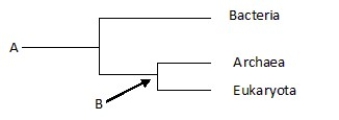
On an evolutionary tree,any group that includes a common ancestor and all of its descendants is called monophyletic ("one-tribe").Recall the current evolutionary tree for Bacteria,Archaea,and Eukarya.According to this tree,are all organisms alive today monophyletic?

Free
(Multiple Choice)
4.9/5  (80)
(80) Correct Answer: Verified
A
How does a scientific theory differ from a scientific hypothesis?
Free
(Multiple Choice)
4.7/5 (81)
(81) Correct Answer:Verified
VerifiedB
On an evolutionary tree,any group that includes a common ancestor and all of its descendants is called monophyletic ("one-tribe").Recall the current evolutionary tree for Bacteria,Archaea,and Eukarya.Are prokaryotes monophyletic?
Free
(Multiple Choice)
4.9/5 (65)
(65) Correct Answer:Verified
VerifiedB
What is the difference between experimental replicates and experimental controls?
(Multiple Choice)
4.8/5 (81)
(81) Which of the following statements about cells is true? A cell is _____.
(Multiple Choice)
4.9/5 (85)
(85) Which of the following observations led to the conclusion that the food competition hypothesis for giraffe neck length might not be correct?
(Multiple Choice)
4.9/5 (85)
(85) You find yourself standing next to a beautiful rosebush.Based on the current evolutionary data,which of the following do you and the rose have in common?
(Multiple Choice)
4.9/5 (77)
(77) Recall the caterpillar experiment,where caterpillars born in the spring looked like flowers,and caterpillars born in the summer looked like twigs.What is the most likely selective advantage for this difference in body shape?
(Multiple Choice)
4.9/5 (80)
(80) Figure 1.1
The following experiment is used for the corresponding question(s).
A researcher discovered a species of moth that lays its eggs on oak trees.Eggs are laid at two distinct times of the year: early in spring when the oak trees are flowering and in midsummer when flowering is past.Caterpillars from eggs that hatch in spring feed on oak flowers and look like oak flowers.But caterpillars that hatch in summer feed on oak leaves and look like oak twigs.
How does the same population of moths produce such different-looking caterpillars on the same trees? To answer this question,the biologist caught many female moths from the same population and collected their eggs.He put at least one egg from each female into eight identical cups.The eggs hatched,and at least two larvae from each female were maintained in one of the four temperature and light conditions listed below.
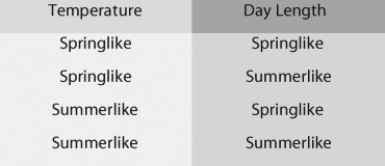 Figure 1.1
In each of the four environments,one of the caterpillars was fed oak flowers,the other oak leaves.Thus,there were a total of eight treatment groups (4 environments × 2 diets).
-Refer to Figure 1.1.Recall that eggs from the same female were exposed to each of the eight treatments used.This aspect of the experimental design tested which of the following hypotheses?
Figure 1.1
In each of the four environments,one of the caterpillars was fed oak flowers,the other oak leaves.Thus,there were a total of eight treatment groups (4 environments × 2 diets).
-Refer to Figure 1.1.Recall that eggs from the same female were exposed to each of the eight treatments used.This aspect of the experimental design tested which of the following hypotheses? (Multiple Choice)
4.9/5 (69)
(69) Current evolutionary data groups land plants with green algae and red algae.Brown algae,which you often find in the same habitat as red and green algae,is part of a distantly related group that includes the diatoms.This suggests that _____.
(Multiple Choice)
4.8/5 (67)
(67) If you find a mouse in your basement,it is likely Mus musculus.Peromyscus leucopus is also common.Or,you may get lucky and find a relatively rare Peromyscus maniculatus instead.Out of these three species,which two are the most closely related (from an evolutionary standpoint)?
(Multiple Choice)
4.8/5 (86)
(86) Agrobacterium is a type of bacteria that infects plants and causes them to form tumors.You are asked to determine how long a plant must be exposed to the bacteria to become infected.Which of the following experiments will provide the best data for that question?
(Multiple Choice)
4.9/5 (81)
(81) Lance Armstrong just finished third (by about 5 minutes)in the 2009 Tour de France cycling race.This was an incredible feat for the 37-year-old father of 4.First and second-place winners,Alberto Contador (age 27)and Andy Schleck (age 24),respectively,have no children.Which of these three men shows the greatest evolutionary fitness?
(Multiple Choice)
4.9/5 (89)
(89) Starting from the wild mustard Brassica oleracea,breeders have created the strains known as Brussels sprouts,broccoli,kale,and cabbage.Which of the following statements is supported by this observation?
(Multiple Choice)
4.8/5 (77)
(77) Figure 1.1
The following experiment is used for the corresponding question(s).
A researcher discovered a species of moth that lays its eggs on oak trees.Eggs are laid at two distinct times of the year: early in spring when the oak trees are flowering and in midsummer when flowering is past.Caterpillars from eggs that hatch in spring feed on oak flowers and look like oak flowers.But caterpillars that hatch in summer feed on oak leaves and look like oak twigs.
How does the same population of moths produce such different-looking caterpillars on the same trees? To answer this question,the biologist caught many female moths from the same population and collected their eggs.He put at least one egg from each female into eight identical cups.The eggs hatched,and at least two larvae from each female were maintained in one of the four temperature and light conditions listed below.
Figure 1.1
In each of the four environments,one of the caterpillars was fed oak flowers,the other oak leaves.Thus,there were a total of eight treatment groups (4 environments × 2 diets).
-Refer to Figure 1.1.In every case,caterpillars that feed on oak flowers look like oak flowers.In every case,caterpillars that were raised on oak leaves looked like twigs.These results support which of the following hypotheses?
Figure 1.1
In each of the four environments,one of the caterpillars was fed oak flowers,the other oak leaves.Thus,there were a total of eight treatment groups (4 environments × 2 diets).
-Refer to Figure 1.1.In every case,caterpillars that feed on oak flowers look like oak flowers.In every case,caterpillars that were raised on oak leaves looked like twigs.These results support which of the following hypotheses? (Multiple Choice)
5.0/5 (74)
(74) Figure 1.1
The following experiment is used for the corresponding question(s).
A researcher discovered a species of moth that lays its eggs on oak trees.Eggs are laid at two distinct times of the year: early in spring when the oak trees are flowering and in midsummer when flowering is past.Caterpillars from eggs that hatch in spring feed on oak flowers and look like oak flowers.But caterpillars that hatch in summer feed on oak leaves and look like oak twigs.
How does the same population of moths produce such different-looking caterpillars on the same trees? To answer this question,the biologist caught many female moths from the same population and collected their eggs.He put at least one egg from each female into eight identical cups.The eggs hatched,and at least two larvae from each female were maintained in one of the four temperature and light conditions listed below.
Figure 1.1
In each of the four environments,one of the caterpillars was fed oak flowers,the other oak leaves.Thus,there were a total of eight treatment groups (4 environments × 2 diets).
-In Figure 1.1,which of the following is not a plausible hypothesis to explain the difference in caterpillar appearance observed in this population?
Figure 1.1
In each of the four environments,one of the caterpillars was fed oak flowers,the other oak leaves.Thus,there were a total of eight treatment groups (4 environments × 2 diets).
-In Figure 1.1,which of the following is not a plausible hypothesis to explain the difference in caterpillar appearance observed in this population? (Multiple Choice)
4.9/5 (74)
(74) 

Filters
- Essay(0)
- Multiple Choice(0)
- Short Answer(0)
- True False(0)
- Matching(0)