



 Chat with AI
Exam 27: Phylogenies and the History of Life

Exam 1: Biology and the Tree of Life40 Questions
Exam 2: Water and Carbon: the Chemical Basis of Life50 Questions
Exam 3: Protein Structure and Function47 Questions
Exam 4: Nucleic Acids and the Rna World33 Questions
Exam 5: An Introduction to Carbohydrates30 Questions
Exam 6: Lipids, membranes, and the First Cells47 Questions
Exam 7: Inside the Cell28 Questions
Exam 8: Cell-Cell Interactions27 Questions
Exam 9: Cellular Respiration and Fermentation27 Questions
Exam 10: Photosynthesis32 Questions
Exam 11: The Cell Cycle31 Questions
Exam 12: Meiosis34 Questions
Exam 13: Mendel and the Gene32 Questions
Exam 14: Dna and the Gene: Synthesis and Repair37 Questions
Exam 15: How Genes Work34 Questions
Exam 16: Transcription and Translation38 Questions
Exam 17: Control of Gene Expression in Bacteria31 Questions
Exam 18: Control of Gene Expression in Eukaryotes37 Questions
Exam 19: Analyzing and Engineering Genes40 Questions
Exam 20: Genomics38 Questions
Exam 21: Principles of Development25 Questions
Exam 22: An Introduction to Animal Development22 Questions
Exam 23: An Introduction to Plant Development21 Questions
Exam 24: Evolution by Natural Selection32 Questions
Exam 25: Evolutionary Processes32 Questions
Exam 26: Speciation33 Questions
Exam 27: Phylogenies and the History of Life38 Questions
Exam 28: Bacteria and Archaea38 Questions
Exam 29: Protists34 Questions
Exam 30: Green Plants49 Questions
Exam 31: Fungi37 Questions
Exam 32: An Introduction to Animals38 Questions
Exam 33: Protostome Animals38 Questions
Exam 34: Deuterostome Animals46 Questions
Exam 35: Viruses31 Questions
Exam 36: Plant Form and Function39 Questions
Exam 37: Water and Sugar Transport in Plants42 Questions
Exam 38: Plant Nutrition36 Questions
Exam 39: Plant Sensory Systems, signals, and Responses66 Questions
Exam 40: Plant Reproduction41 Questions
Exam 41: Animal Form and Function29 Questions
Exam 42: Water and Electrolyte Balance in Animals38 Questions
Exam 43: Animal Nutrition37 Questions
Exam 44: Gas Exchange and Circulation37 Questions
Exam 45: Electrical Signals in Animals33 Questions
Exam 46: Animal Sensory Systems and Movement36 Questions
Exam 47: Chemical Signals in Animals33 Questions
Exam 48: Animal Reproduction34 Questions
Exam 49: The Immune System in Animals32 Questions
Exam 50: An Introduction to Ecology38 Questions
Exam 51: Behavioral Ecology37 Questions
Exam 52: Population Ecology46 Questions
Exam 53: Community Ecology39 Questions
Exam 54: Ecosystems41 Questions
Exam 55: Biodiversity and Conservation Biology39 Questions
Select questions type


Which of the following would be least likely in the fossil record?

Free
(Multiple Choice)
4.7/5  (74)
(74) Correct Answer: Verified
D
How do mass extinctions differ from background extinctions?
Free
(Multiple Choice)
4.8/5 (81)
(81) Correct Answer:Verified
VerifiedC
The Permian period ends with a massive extinction event and then rapid speciation occurs as new animal and plant forms come into being.The most likely explanation for this is _____.
Free
(Multiple Choice)
4.8/5 (71)
(71) Correct Answer:Verified
VerifiedE
The phenetic approach to estimating phylogenetic trees is most like the approach of which species concept?
(Multiple Choice)
4.8/5 (82)
(82) Which of the following are typically responsible for island extinctions?
(Multiple Choice)
4.9/5 (79)
(79) Figure 27.9
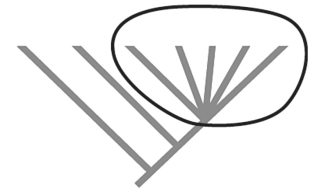 -A hypothetical island lies far from any other landmasses.There are many different types of plants,but only one animal a beetle that can fly or walk from plant to plant and feeds by chewing leaves.Given that the beetle is not exploiting all the resources on the island,which morphological change would be most likely to trigger an adaptive radiation of the beetles?
 (Multiple Choice)
4.9/5 (76)
(76) Your professor wants you to construct a phylogenetic tree of orchids.She gives you tissue from seven orchid species and one lily.What is the most likely reason she gave you the lily?
(Multiple Choice)
4.9/5 (65)
(65) The cladistic approach to estimating phylogenetic trees is most like the approach of which species concept?
(Multiple Choice)
4.8/5 (75)
(75) Figure 27.6
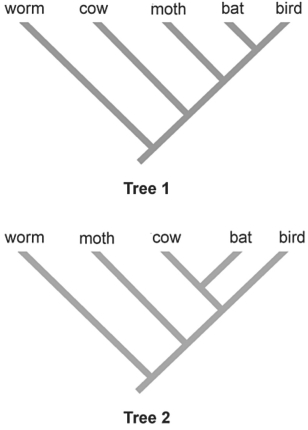 -Applying the principle of parsimony to the trait "ability to fly," which of the two phylogenetic trees above is better?
 (Multiple Choice)
4.8/5 (74)
(74) The largest extinction,measured as a percentage of species that disappeared,occurred at the end of which geological period?
(Multiple Choice)
4.8/5 (83)
(83) Islands are well known for having many endemic species species that are unique to that location.What is a likely explanation for this pattern?
(Multiple Choice)
4.8/5 (81)
(81) Figure 27.5
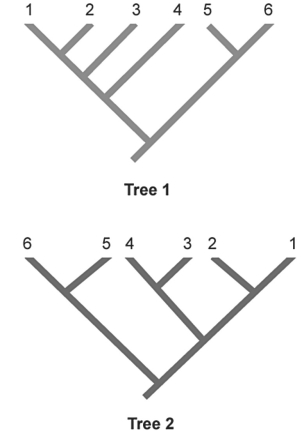 -In the phylogenetic trees above,numbers represent species and the same species are shown in both trees.Which two species are represented as sister species in Tree 2 but are not shown as sister species in Tree 1?
 (Multiple Choice)
4.8/5 (90)
(90) Which listing of geological periods is in the correct order,from oldest to most recent?
(Multiple Choice)
4.9/5 (83)
(83) Which value(s)would be required to calculate how long ago the most recent ancestor of ungulates lived?
(Multiple Choice)
5.0/5 (92)
(92) Figure 27.1
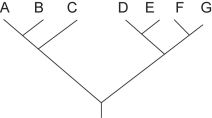 -Which of the following trees depicts the same relationship among species as shown above?
 (Multiple Choice)
4.8/5 (89)
(89) For many years scientists believed that almost all animal lineages burst into being during the Cambrian era (just after the end of the Precambrian super eon).However,there have been many recent findings of animal-like fossils and "trace fossils" (fossils of an animal-like organisms movement)from the late Precambrian.Which of the following best explains why it took so long to realize there was animal-like life in the Precambrian?
(Multiple Choice)
4.9/5 (78)
(78) You are the lucky student of a wacky professor who develops a time machine and he asks if you will test it with him.You get in and there's an immediate glitch-the date readout fails so that when you land you're not sure what era you're in.Your professor begins to panic,but you see something that tells you you're in the Cenozoic era.Which of the following could it be?
(Multiple Choice)
4.8/5 (86)
(86) Which of the following statements is true about a phylogeny,as represented by a phylogenetic tree?
(Multiple Choice)
4.9/5 (83)
(83) 
Filters
- Essay(0)
- Multiple Choice(0)
- Short Answer(0)
- True False(0)
- Matching(0)