



 Chat with AI
Exam 27: Phylogenies and the History of Life

Exam 1: Biology and the Tree of Life40 Questions
Exam 2: Water and Carbon: the Chemical Basis of Life50 Questions
Exam 3: Protein Structure and Function47 Questions
Exam 4: Nucleic Acids and the Rna World33 Questions
Exam 5: An Introduction to Carbohydrates30 Questions
Exam 6: Lipids, membranes, and the First Cells47 Questions
Exam 7: Inside the Cell28 Questions
Exam 8: Cell-Cell Interactions27 Questions
Exam 9: Cellular Respiration and Fermentation27 Questions
Exam 10: Photosynthesis32 Questions
Exam 11: The Cell Cycle31 Questions
Exam 12: Meiosis34 Questions
Exam 13: Mendel and the Gene32 Questions
Exam 14: Dna and the Gene: Synthesis and Repair37 Questions
Exam 15: How Genes Work34 Questions
Exam 16: Transcription and Translation38 Questions
Exam 17: Control of Gene Expression in Bacteria31 Questions
Exam 18: Control of Gene Expression in Eukaryotes37 Questions
Exam 19: Analyzing and Engineering Genes40 Questions
Exam 20: Genomics38 Questions
Exam 21: Principles of Development25 Questions
Exam 22: An Introduction to Animal Development22 Questions
Exam 23: An Introduction to Plant Development21 Questions
Exam 24: Evolution by Natural Selection32 Questions
Exam 25: Evolutionary Processes32 Questions
Exam 26: Speciation33 Questions
Exam 27: Phylogenies and the History of Life38 Questions
Exam 28: Bacteria and Archaea38 Questions
Exam 29: Protists34 Questions
Exam 30: Green Plants49 Questions
Exam 31: Fungi37 Questions
Exam 32: An Introduction to Animals38 Questions
Exam 33: Protostome Animals38 Questions
Exam 34: Deuterostome Animals46 Questions
Exam 35: Viruses31 Questions
Exam 36: Plant Form and Function39 Questions
Exam 37: Water and Sugar Transport in Plants42 Questions
Exam 38: Plant Nutrition36 Questions
Exam 39: Plant Sensory Systems, signals, and Responses66 Questions
Exam 40: Plant Reproduction41 Questions
Exam 41: Animal Form and Function29 Questions
Exam 42: Water and Electrolyte Balance in Animals38 Questions
Exam 43: Animal Nutrition37 Questions
Exam 44: Gas Exchange and Circulation37 Questions
Exam 45: Electrical Signals in Animals33 Questions
Exam 46: Animal Sensory Systems and Movement36 Questions
Exam 47: Chemical Signals in Animals33 Questions
Exam 48: Animal Reproduction34 Questions
Exam 49: The Immune System in Animals32 Questions
Exam 50: An Introduction to Ecology38 Questions
Exam 51: Behavioral Ecology37 Questions
Exam 52: Population Ecology46 Questions
Exam 53: Community Ecology39 Questions
Exam 54: Ecosystems41 Questions
Exam 55: Biodiversity and Conservation Biology39 Questions
Select questions type


Which of the following key adaptations is found in many animals from the Burgess Shale fauna but not found in the Doushantuo and Ediacaran faunas?
(Multiple Choice)
4.9/5  (74)
(74) Which of the following could be seen in the Mesozoic,but not the Paleozoic?
(Multiple Choice)
4.9/5 (87)
(87) Figure 27.9
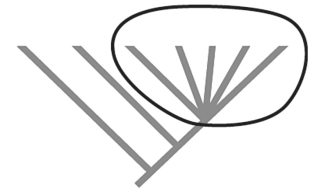 -All of the following events can trigger an adaptive radiation except _____.
 (Multiple Choice)
4.9/5 (72)
(72) Figure 27.7
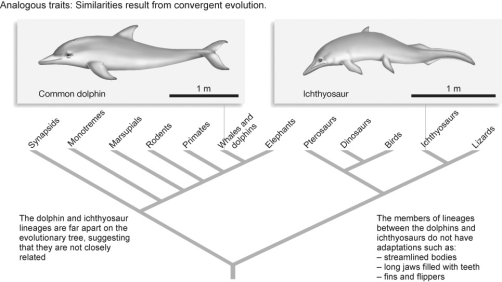 -We know the streamlined bodies shown in Figure 27.7 are homoplasious.If the following groups also had streamlined bodies,which of the groupings would give the MOST support to this body type being homologous?
 (Multiple Choice)
4.9/5 (84)
(84) What is still lacking in the hypothesis of an asteroid impact as the cause of the end-Cretaceous mass extinction?
(Multiple Choice)
4.8/5 (76)
(76) Some beetles and flies have antler-like structures on their heads,much like male deer do.The existence of antlers in beetle,fly,and deer species with strong male-male competition is an example of _____.
(Multiple Choice)
5.0/5 (82)
(82) You have obtained the following data on genetic similarity among five species.The higher the number,the closer the relationship between the two species (so a species is related to itself 100%).What approach can you take to construct a phylogeny using these data?
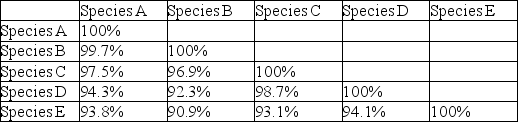
(Multiple Choice)
4.8/5 (86)
(86) You get back into your time machine with your wacky professor and take off again.As your time machine lands,you see an unusual landscape before you.As you open the door you realize you cannot breathe.You quickly shut the door,realizing you are in the _____.
(Multiple Choice)
4.8/5 (75)
(75) Deletions in mice in the Hoxa3 gene,on the A cluster,result in abnormal formation of glands in the neck.Deletions in the homologous Hoxd3 gene,on the D cluster,result in abnormal formation of the neck skeleton.The protein-coding sequences of Hoxa3 and Hoxd3 are about 50% the same.Researchers inserted a functional copy of the coding sequence of Hoxd3 in place of the coding sequence of a nonfunctional Hoxa3.They left all promoters,enhancers,splicing signals,and processing signals of Hoxa3 in place.Normal neck gland development was restored.What can you conclude? (J.M.Greer,J.Puetz,K.R.Thomas,and M.R.Capecchi.2000.Maintenance of functional equivalence during paralogous Hox gene evolution.Nature 403:
661-65. )
(Multiple Choice)
4.8/5 (87)
(87) Which of the following organisms would be most likely to fossilize?
(Multiple Choice)
4.8/5 (77)
(77) Why would gene duplication events,such as those seen in the Hox gene complex,set the stage for adaptive radiation?
(Multiple Choice)
4.8/5 (75)
(75) Figure 27.9
-What does the circled part of the phylogenetic tree above indicate?
-What does the circled part of the phylogenetic tree above indicate? (Multiple Choice)
4.7/5 (89)
(89) Which of the following statements best describes the rationale for applying the principle of parsimony in constructing phylogenetic trees?
(Multiple Choice)
4.9/5 (87)
(87) Which statement best describes why the Cambrian explosion was important?
(Multiple Choice)
4.9/5 (74)
(74) Which of the following would be useful in creating a phylogenetic tree of a taxon?
(Multiple Choice)
4.9/5 (69)
(69) What is thought to be the significance of the duplication of homeotic genes?
(Multiple Choice)
4.8/5 (79)
(79) In plant communities today,leaf morphology is correlated with mean annual temperature,so paleobotanists use fossil leaf morphology to estimate the mean annual temperature of paleoclimates.However,the angiosperm fossil record contains an overabundance of samples fossilized near lakes or rivers where vines are especially common.Since vine leaves have a somewhat different association with temperature,use of data from vine-rich locations leads to mean average temperature estimates that are lower than actual recorded temperatures in modern plant communities.This potential bias in paleobotanical climate estimates is due to which type of bias in the fossil record? (R.J.Burnham,N.C.A.Pitman,K.R.Johnson,and P.Wilf.2001.Habitat-related error in estimating temperature from leaf margins in a humid tropical forest.American Journal of Botany 88:
1096-1102. )
(Multiple Choice)
5.0/5 (87)
(87) Given that phylogenies are based on shared derived characteristics,which of the following traits is useful in generating a phylogeny of species W,X,Y,and Z?
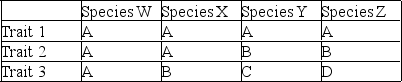
(Multiple Choice)
4.7/5 (87)
(87) 
Filters
- Essay(0)
- Multiple Choice(0)
- Short Answer(0)
- True False(0)
- Matching(0)