



 Chat with AI
Exam 55: Biodiversity and Conservation Biology

Exam 1: Biology and the Tree of Life40 Questions
Exam 2: Water and Carbon: the Chemical Basis of Life50 Questions
Exam 3: Protein Structure and Function47 Questions
Exam 4: Nucleic Acids and the Rna World33 Questions
Exam 5: An Introduction to Carbohydrates30 Questions
Exam 6: Lipids, membranes, and the First Cells47 Questions
Exam 7: Inside the Cell28 Questions
Exam 8: Cell-Cell Interactions27 Questions
Exam 9: Cellular Respiration and Fermentation27 Questions
Exam 10: Photosynthesis32 Questions
Exam 11: The Cell Cycle31 Questions
Exam 12: Meiosis34 Questions
Exam 13: Mendel and the Gene32 Questions
Exam 14: Dna and the Gene: Synthesis and Repair37 Questions
Exam 15: How Genes Work34 Questions
Exam 16: Transcription and Translation38 Questions
Exam 17: Control of Gene Expression in Bacteria31 Questions
Exam 18: Control of Gene Expression in Eukaryotes37 Questions
Exam 19: Analyzing and Engineering Genes40 Questions
Exam 20: Genomics38 Questions
Exam 21: Principles of Development25 Questions
Exam 22: An Introduction to Animal Development22 Questions
Exam 23: An Introduction to Plant Development21 Questions
Exam 24: Evolution by Natural Selection32 Questions
Exam 25: Evolutionary Processes32 Questions
Exam 26: Speciation33 Questions
Exam 27: Phylogenies and the History of Life38 Questions
Exam 28: Bacteria and Archaea38 Questions
Exam 29: Protists34 Questions
Exam 30: Green Plants49 Questions
Exam 31: Fungi37 Questions
Exam 32: An Introduction to Animals38 Questions
Exam 33: Protostome Animals38 Questions
Exam 34: Deuterostome Animals46 Questions
Exam 35: Viruses31 Questions
Exam 36: Plant Form and Function39 Questions
Exam 37: Water and Sugar Transport in Plants42 Questions
Exam 38: Plant Nutrition36 Questions
Exam 39: Plant Sensory Systems, signals, and Responses66 Questions
Exam 40: Plant Reproduction41 Questions
Exam 41: Animal Form and Function29 Questions
Exam 42: Water and Electrolyte Balance in Animals38 Questions
Exam 43: Animal Nutrition37 Questions
Exam 44: Gas Exchange and Circulation37 Questions
Exam 45: Electrical Signals in Animals33 Questions
Exam 46: Animal Sensory Systems and Movement36 Questions
Exam 47: Chemical Signals in Animals33 Questions
Exam 48: Animal Reproduction34 Questions
Exam 49: The Immune System in Animals32 Questions
Exam 50: An Introduction to Ecology38 Questions
Exam 51: Behavioral Ecology37 Questions
Exam 52: Population Ecology46 Questions
Exam 53: Community Ecology39 Questions
Exam 54: Ecosystems41 Questions
Exam 55: Biodiversity and Conservation Biology39 Questions
Select questions type


Figure 55.5 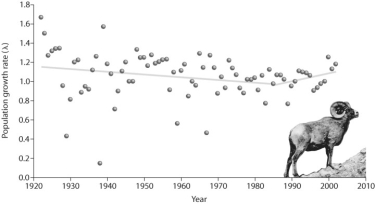 -According to Figure 55.5,what is occurring after 1985?
Free
(Multiple Choice)
4.8/5  (75)
(75) Correct Answer: Verified
C
Figure 55.1 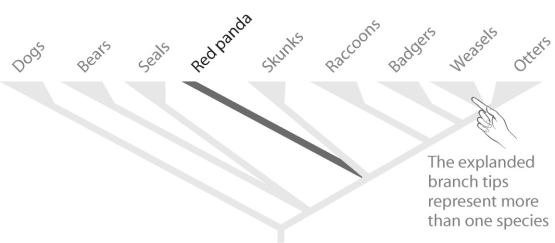 -According to Figure 55.1,which of the following explains why the red panda is an important species to preserve?
Free
(Multiple Choice)
4.9/5 (80)
(80) Correct Answer:Verified
VerifiedD
Which of the following statements regarding species diversity is false?
Free
(Multiple Choice)
4.8/5 (84)
(84) Correct Answer:Verified
VerifiedC
Erwin and Scott used an insecticidal fog to knock down insects from the top of a L.seemannii tree.The researchers identified over 900 species of beetles among the individuals that fell.Erwin also projected that this entire tree is host to about 600 specialist arthropods.There are approximately 50,000 species of tropical trees.Although it could not be entirely accurate,what would be the best way to estimate the total number of arthropod species?
(Multiple Choice)
4.7/5 (77)
(77) Ecosystems services include processes that increase the quality of the abiotic environment.Which of the following processes would not fall under this category?
(Multiple Choice)
4.9/5 (78)
(78) While traveling in the Alps,you come across a butterfly that you cannot identify.You quickly find out that it is a new species.Which of the following is not a step in studying biodiversity?
(Multiple Choice)
4.9/5 (84)
(84) Figure 55.7 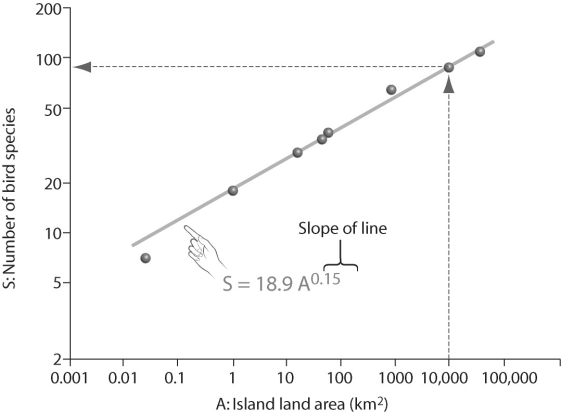 -In looking at the species-area plot in Figure 55.7,what can be concluded?
 (Multiple Choice)
4.8/5 (81)
(81) Figure 55.6 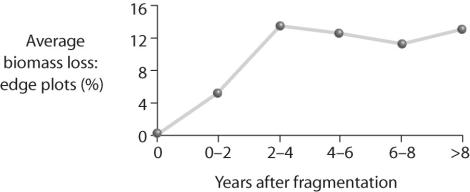 -In looking at Figure 55.6,what can be said about edge effects?
 (Multiple Choice)
4.8/5 (80)
(80) A land developer is arguing with a group of ecologists.Of course the land developer wants the most land possible for building houses,but has to compromise by saving some land for animal habitat.The land developer offers 20 hectares in evenly distributed but isolated 1-hectare portions.The ecologists keep arguing for one 20 hectare area to remain intact.Why are the ecologists making this proposal?
(Multiple Choice)
4.9/5 (79)
(79) The habitat of your bat population (in your 2000-hectare forest)is designated as a protected area.What,if any,might be an advantage of removing a small number of bats and placing them in a zoo?
(Multiple Choice)
4.7/5 (95)
(95) Researchers have been studying a rare population of 87 voles in an isolated area.Ten voles from a larger population were added to this isolated population.Besides having 10 additional animals,what benefits are there to importing individuals?
(Multiple Choice)
4.9/5 (87)
(87) If the last remaining population of a particular bird species were all highly related,which type of diversity would be of greatest concern when planning to keep the species from going extinct?
(Multiple Choice)
4.9/5 (86)
(86) What is the main difference between sustainable development and adaptive management?
(Multiple Choice)
4.8/5 (76)
(76) The main factor that leads to the loss of biodiversity is _____.
(Multiple Choice)
5.0/5 (88)
(88) In a debate about the destruction of tropical wet forests,the arguments keep focusing on biodiversity and how this affects the animals themselves,as well as the ecosystem.What is one direct benefit of biodiversity to humans that you can argue to help people understand why these forests need to be preserved?
(Multiple Choice)
4.7/5 (70)
(70) On Easter Island,data show that it was once covered by massive palm trees.How can an ecosystem collapse from removal of just one species of large tree?
(Multiple Choice)
4.9/5 (80)
(80) Figure 55.2  -By knowing the interrelatedness of various snake species,the type of antivenom can be chosen depending on the species involved in the bite.Based on Figure 55.2,which snake antivenom would you administer to a person bitten by an Australian copperhead?
 (Multiple Choice)
4.8/5 (80)
(80) Figure 55.8 Use the following information when answering the corresponding question(s).
Abstract:
Recognition of the importance of land-use legacies in most ecological systems has been a major factor driving the recent focus on human activity as a legitimate and essential subject of environmental science.Ecologists,conservationists,and natural resource policy makers now recognize that the legacies of land-use activities continue to influence ecosystem structure and function for decades or centuries or even longer after those activities have ceased.
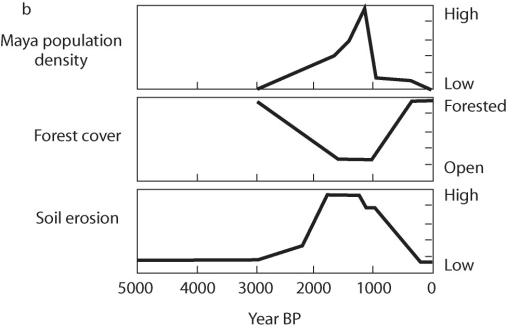 -Based on Figure 55.8,what can you conclude about land-use legacy in the southern Yucatán?
 (Multiple Choice)
4.9/5 (96)
(96) Figure 55.9 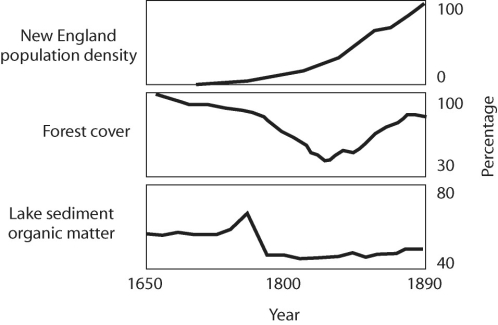 -Based on Figure 55.9,what can you conclude about land-use legacy in New England?
 (Multiple Choice)
4.9/5 (64)
(64) 
Filters
- Essay(0)
- Multiple Choice(0)
- Short Answer(0)
- True False(0)
- Matching(0)