



 Chat with AI
Exam 55: Biodiversity and Conservation Biology

Exam 1: Biology and the Tree of Life40 Questions
Exam 2: Water and Carbon: the Chemical Basis of Life50 Questions
Exam 3: Protein Structure and Function47 Questions
Exam 4: Nucleic Acids and the Rna World33 Questions
Exam 5: An Introduction to Carbohydrates30 Questions
Exam 6: Lipids, membranes, and the First Cells47 Questions
Exam 7: Inside the Cell28 Questions
Exam 8: Cell-Cell Interactions27 Questions
Exam 9: Cellular Respiration and Fermentation27 Questions
Exam 10: Photosynthesis32 Questions
Exam 11: The Cell Cycle31 Questions
Exam 12: Meiosis34 Questions
Exam 13: Mendel and the Gene32 Questions
Exam 14: Dna and the Gene: Synthesis and Repair37 Questions
Exam 15: How Genes Work34 Questions
Exam 16: Transcription and Translation38 Questions
Exam 17: Control of Gene Expression in Bacteria31 Questions
Exam 18: Control of Gene Expression in Eukaryotes37 Questions
Exam 19: Analyzing and Engineering Genes40 Questions
Exam 20: Genomics38 Questions
Exam 21: Principles of Development25 Questions
Exam 22: An Introduction to Animal Development22 Questions
Exam 23: An Introduction to Plant Development21 Questions
Exam 24: Evolution by Natural Selection32 Questions
Exam 25: Evolutionary Processes32 Questions
Exam 26: Speciation33 Questions
Exam 27: Phylogenies and the History of Life38 Questions
Exam 28: Bacteria and Archaea38 Questions
Exam 29: Protists34 Questions
Exam 30: Green Plants49 Questions
Exam 31: Fungi37 Questions
Exam 32: An Introduction to Animals38 Questions
Exam 33: Protostome Animals38 Questions
Exam 34: Deuterostome Animals46 Questions
Exam 35: Viruses31 Questions
Exam 36: Plant Form and Function39 Questions
Exam 37: Water and Sugar Transport in Plants42 Questions
Exam 38: Plant Nutrition36 Questions
Exam 39: Plant Sensory Systems, signals, and Responses66 Questions
Exam 40: Plant Reproduction41 Questions
Exam 41: Animal Form and Function29 Questions
Exam 42: Water and Electrolyte Balance in Animals38 Questions
Exam 43: Animal Nutrition37 Questions
Exam 44: Gas Exchange and Circulation37 Questions
Exam 45: Electrical Signals in Animals33 Questions
Exam 46: Animal Sensory Systems and Movement36 Questions
Exam 47: Chemical Signals in Animals33 Questions
Exam 48: Animal Reproduction34 Questions
Exam 49: The Immune System in Animals32 Questions
Exam 50: An Introduction to Ecology38 Questions
Exam 51: Behavioral Ecology37 Questions
Exam 52: Population Ecology46 Questions
Exam 53: Community Ecology39 Questions
Exam 54: Ecosystems41 Questions
Exam 55: Biodiversity and Conservation Biology39 Questions
Select questions type


Approximately how many species have we described out of the species alive today?
(Multiple Choice)
4.8/5  (71)
(71) Environmental sequencing has brought to light what crucial finding?
(Multiple Choice)
4.9/5 (77)
(77) Which of the following statements regarding extinction is false?
(Multiple Choice)
4.8/5 (81)
(81) Figure 55.2  -Based on how you would go about measuring biodiversity,which of the following is true?
 (Multiple Choice)
4.9/5 (76)
(76) Which of the following is a likely mechanism for biodiversity increasing productivity?
(Multiple Choice)
4.8/5 (78)
(78) Which of the following is the true statement regarding species diversity and taxonomic diversity?
(Multiple Choice)
4.7/5 (74)
(74) You discover,in your massive 2000-hectare forest,a species of bat that is not found anywhere else.Which of the following agencies would not be involved in helping you formulate a plan to conserve this species?
(Multiple Choice)
4.8/5 (71)
(71) Figure 55.3 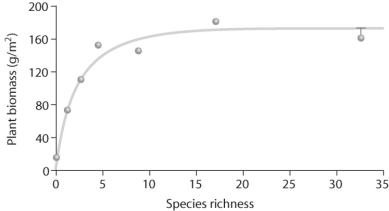 -Upon looking at Figure 55.3,what can you conclude about the data?
 (Multiple Choice)
4.9/5 (81)
(81) What are the criteria Conservation International has established to determine if an area is a conservation hotspot?
(Multiple Choice)
5.0/5 (69)
(69) Figure 55.5 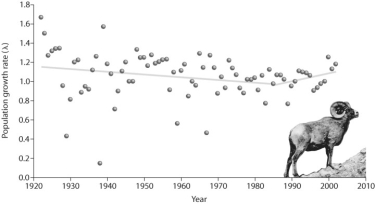 -According to Figure 55.5,what is the least likely explanation for the data after 1985?
 (Multiple Choice)
4.7/5 (87)
(87) How can biodiversity affect the way we decontaminate industrial sites?
(Multiple Choice)
4.8/5 (80)
(80) Figure 55.7 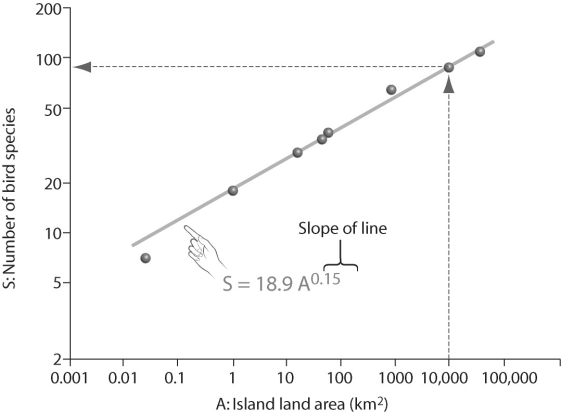 -Based on the species-area plot in Figure 55.7,if habitable area on an island were reduced from 10,000 km² to 1000 km²,roughly what percentage of the species would disappear?
 (Multiple Choice)
5.0/5 (84)
(84) Philippe Bouchet and colleagues conducted a massive survey of marine mollusks on the west coast of New Caledonia.Twenty percent of the species found were represented by a single specimen.What does that suggest about the diversity of mollusks in this area?
(Multiple Choice)
4.9/5 (66)
(66) Which one of the following is likely not a hotspot for birds?
(Multiple Choice)
4.8/5 (83)
(83) Which of the following criteria have to be met in order for a species to qualify as invasive?
(Multiple Choice)
4.8/5 (74)
(74) During the inventory of bacterial genes present in the Sargasso Sea,a research team concluded that at least 1800 bacterial species were discovered.Based on what you know about this area,what would you expect to see in coral reef waters?
(Multiple Choice)
4.8/5 (84)
(84) Figure 55.4 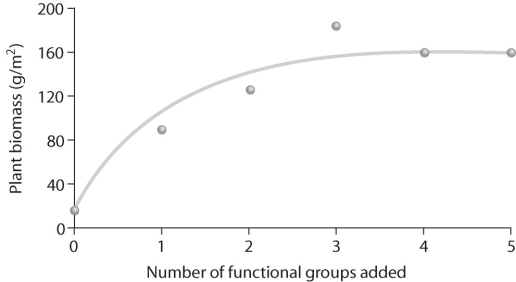 -Hypothesis:
Productivity increases with species richness because certain species or functional groups facilitate the growth of other species by providing them with nutrients,partial shade,or other benefits.In looking at the data in Figure 55.4,how would you relate it to this hypothesis?
-Hypothesis:
Productivity increases with species richness because certain species or functional groups facilitate the growth of other species by providing them with nutrients,partial shade,or other benefits.In looking at the data in Figure 55.4,how would you relate it to this hypothesis? (Multiple Choice)
4.9/5 (87)
(87) Figure 55.1 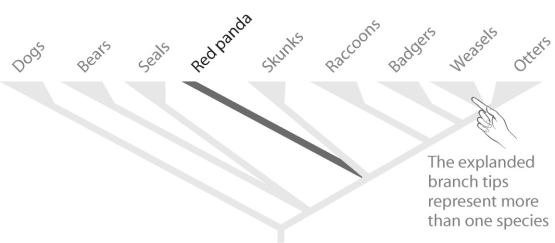 -Why is it important to preserve the red panda (see Figure 55.1)?
 (Multiple Choice)
4.9/5 (75)
(75) Figure 55.2
-Based on Figure 55.2,what snake antivenom would you administer to a person bitten by a king brown snake?
-Based on Figure 55.2,what snake antivenom would you administer to a person bitten by a king brown snake? (Multiple Choice)
4.8/5 (79)
(79) 
Filters
- Essay(0)
- Multiple Choice(0)
- Short Answer(0)
- True False(0)
- Matching(0)