



 Chat with AI
Exam 29: Protists

Exam 1: Biology and the Tree of Life40 Questions
Exam 2: Water and Carbon: the Chemical Basis of Life50 Questions
Exam 3: Protein Structure and Function47 Questions
Exam 4: Nucleic Acids and the Rna World33 Questions
Exam 5: An Introduction to Carbohydrates30 Questions
Exam 6: Lipids, membranes, and the First Cells47 Questions
Exam 7: Inside the Cell28 Questions
Exam 8: Cell-Cell Interactions27 Questions
Exam 9: Cellular Respiration and Fermentation27 Questions
Exam 10: Photosynthesis32 Questions
Exam 11: The Cell Cycle31 Questions
Exam 12: Meiosis34 Questions
Exam 13: Mendel and the Gene32 Questions
Exam 14: Dna and the Gene: Synthesis and Repair37 Questions
Exam 15: How Genes Work34 Questions
Exam 16: Transcription and Translation38 Questions
Exam 17: Control of Gene Expression in Bacteria31 Questions
Exam 18: Control of Gene Expression in Eukaryotes37 Questions
Exam 19: Analyzing and Engineering Genes40 Questions
Exam 20: Genomics38 Questions
Exam 21: Principles of Development25 Questions
Exam 22: An Introduction to Animal Development22 Questions
Exam 23: An Introduction to Plant Development21 Questions
Exam 24: Evolution by Natural Selection32 Questions
Exam 25: Evolutionary Processes32 Questions
Exam 26: Speciation33 Questions
Exam 27: Phylogenies and the History of Life38 Questions
Exam 28: Bacteria and Archaea38 Questions
Exam 29: Protists34 Questions
Exam 30: Green Plants49 Questions
Exam 31: Fungi37 Questions
Exam 32: An Introduction to Animals38 Questions
Exam 33: Protostome Animals38 Questions
Exam 34: Deuterostome Animals46 Questions
Exam 35: Viruses31 Questions
Exam 36: Plant Form and Function39 Questions
Exam 37: Water and Sugar Transport in Plants42 Questions
Exam 38: Plant Nutrition36 Questions
Exam 39: Plant Sensory Systems, signals, and Responses66 Questions
Exam 40: Plant Reproduction41 Questions
Exam 41: Animal Form and Function29 Questions
Exam 42: Water and Electrolyte Balance in Animals38 Questions
Exam 43: Animal Nutrition37 Questions
Exam 44: Gas Exchange and Circulation37 Questions
Exam 45: Electrical Signals in Animals33 Questions
Exam 46: Animal Sensory Systems and Movement36 Questions
Exam 47: Chemical Signals in Animals33 Questions
Exam 48: Animal Reproduction34 Questions
Exam 49: The Immune System in Animals32 Questions
Exam 50: An Introduction to Ecology38 Questions
Exam 51: Behavioral Ecology37 Questions
Exam 52: Population Ecology46 Questions
Exam 53: Community Ecology39 Questions
Exam 54: Ecosystems41 Questions
Exam 55: Biodiversity and Conservation Biology39 Questions
Select questions type


Consider the following data:
(a)Most ancient eukaryotes are unicellular.(b)All eukaryotes alive today have a nucleus and cytoskeleton.(c)Most ancient eukaryotes lack a cell wall.Which of the following conclusions could reasonably follow the data presented?

Free
(Multiple Choice)
4.9/5  (85)
(85) Correct Answer: Verified
C
Figure 29.2
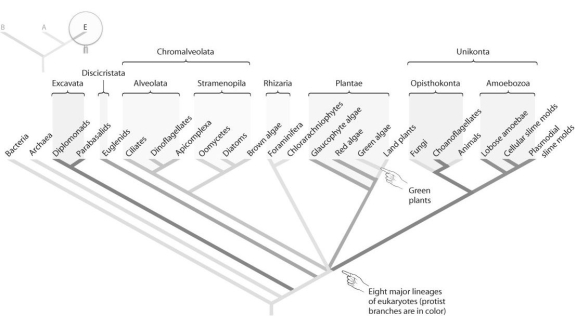 -Refer to Figure 29.2 and consider the following data:
Brown algae (protists)include unicellular and multicellular organisms.Red algae (protists)include unicellular and multicellular organisms.Amoebae (protists)include unicellular and multicellular organisms.Which of the following conclusions is consistent with the data presented?
-Refer to Figure 29.2 and consider the following data:
Brown algae (protists)include unicellular and multicellular organisms.Red algae (protists)include unicellular and multicellular organisms.Amoebae (protists)include unicellular and multicellular organisms.Which of the following conclusions is consistent with the data presented?Free
(Multiple Choice)
4.9/5 (83)
(83) Correct Answer:Verified
VerifiedC
A particular species of protist lacks the ability to engulf food and does not contain chloroplasts.However,gene sequencing data indicate that this species evolved from a lineage containing many species with the ability to engulf food.What does this information suggest about this species of protist?
Free
(Multiple Choice)
4.9/5 (81)
(81) Correct Answer:Verified
VerifiedB
In an area with a high abundance of algal blooms,the introduction of _____ might alleviate the severity of the blooms.
(Multiple Choice)
4.9/5 (69)
(69) Which of the following protist lineages is appropriately paired with its supportive and/or protective structure?
(Multiple Choice)
4.9/5 (63)
(63) One of the fish in your aquarium dies.Adding which protist to the water would allow you to avoid flushing the dead fish by speeding its decay?
(Multiple Choice)
4.9/5 (68)
(68) Which of the following statements is consistent with the assertion that protists are paraphyletic?
(Multiple Choice)
5.0/5 (97)
(97) The manufacture of which of the following products involves using materials that once belonged to a Phaetophyte?
(Multiple Choice)
4.8/5 (83)
(83) Figure 29.5
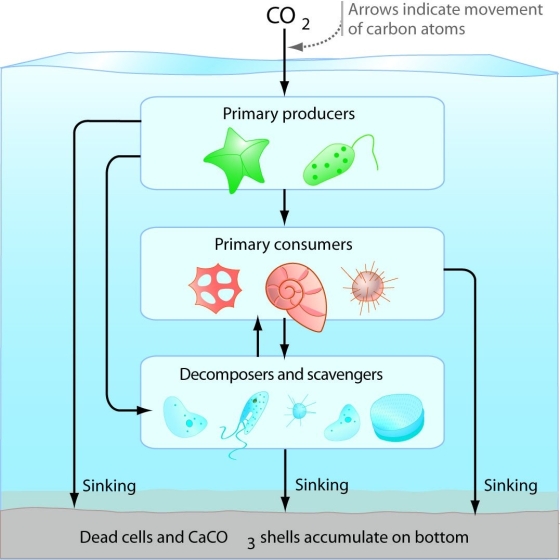 -Which of the following might be a result of adding a secondary consumer (a species that feeds on primary consumers)to the aquatic ecosystem illustrated above?
 (Multiple Choice)
4.8/5 (79)
(79) Which of the following groups is matched with an incorrect anatomical feature?
(Multiple Choice)
4.8/5 (77)
(77) Figure 29.3
Use the following information when answering the corresponding question(s).
The mechanism of cell crawling in protist species is not well defined.The textbook states that pseudopodia extension involves interactions between actin and myosin (the same molecules that are involved in mammalian muscle contraction).However,prior to the study described below,no one had provided convincing data that actin and myosin were actually involved in cell crawling in protists.Anatomical studies had identified the cytoskeletal protein actin just below the surface of the cell membrane in several species of protist;but physiological studies had failed to show a functional link between actin,myosin,and cell crawling.
In a study by N.Poulsen et al.(Diatom gliding is the result of an actin-myosin motility system,Cell Motility and the Cytoskeleton 44 (1999):23-22),researchers tested whether motility in a particular species of diatom involves interactions between actin and myosin.
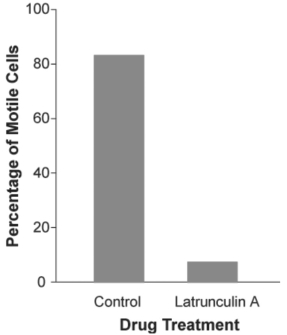 -Refer to the study by Poulsen et al.and Figure 29.3.Cultures of a species of diatom were treated with BDM,a reversible inhibitor of myosin function.Which of the following predictions is consistent with the hypothesis that an actin-myosin interaction is necessary for motility?
 (Multiple Choice)
4.8/5 (75)
(75) Which of the following eukaryotic lineages contains species that all lack functioning mitochondria?
(Multiple Choice)
4.7/5 (81)
(81) Figure 29.3
Use the following information when answering the corresponding question(s).
The mechanism of cell crawling in protist species is not well defined.The textbook states that pseudopodia extension involves interactions between actin and myosin (the same molecules that are involved in mammalian muscle contraction).However,prior to the study described below,no one had provided convincing data that actin and myosin were actually involved in cell crawling in protists.Anatomical studies had identified the cytoskeletal protein actin just below the surface of the cell membrane in several species of protist;but physiological studies had failed to show a functional link between actin,myosin,and cell crawling.
In a study by N.Poulsen et al.(Diatom gliding is the result of an actin-myosin motility system,Cell Motility and the Cytoskeleton 44 (1999):23-22),researchers tested whether motility in a particular species of diatom involves interactions between actin and myosin.
-Refer to the study by Poulsen et al.and Figure 29.3.The data graphed in Figure 29.3 could be an artifact if latrunculin A kills this species of diatoms (i.e. ,that may be why the cells are not moving).Which of the following would be the best evidence that latrunculin A is not killing the cells?
-Refer to the study by Poulsen et al.and Figure 29.3.The data graphed in Figure 29.3 could be an artifact if latrunculin A kills this species of diatoms (i.e. ,that may be why the cells are not moving).Which of the following would be the best evidence that latrunculin A is not killing the cells? (Multiple Choice)
4.7/5 (83)
(83) Figure 29.1
Use the following information to answer the corresponding question(s).
Giardia intestinalis can cause disease in several different mammalian species,including humans.Giardia organisms (G.intestinalis)that infect humans are similar morphologically to those that infect other mammals;thus they have been considered a single species,though other species in the Giardia genus infect other organisms.However,G.intestinalis has been divided into different subgroups based on their host and a few other characteristics.
In 1999,a DNA sequence comparison study tested the hypothesis that these subgroups actually constitute different species.The following phylogenetic tree was constructed from the sequence comparison of rRNA from several subgroups of G.intestinalis and a few other morphologically distinct species of Giardia.The researchers concluded that the subgroups of Giardia are sufficiently different from one another genetically that they could be considered different species.
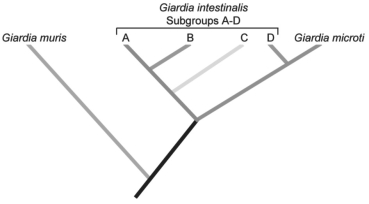 -By examining the phylogenetic tree diagrammed in Figure 29.1,what conclusion can you draw about the species G.microti?
 (Multiple Choice)
4.9/5 (87)
(87) Which of the following characteristics is true of all protists?
(Multiple Choice)
4.8/5 (83)
(83) A particular species of protist has obtained a chloroplast via secondary endosymbiosis.How can you tell?
(Multiple Choice)
4.9/5 (83)
(83) According to the endosymbiotic theory,why was it adaptive for the larger (host)cell to keep the engulfed cell alive,rather than digesting it as food?
(Multiple Choice)
4.7/5 (83)
(83) Which of the following statements best describes the term synapomorphy?
(Multiple Choice)
4.8/5 (87)
(87) Figure 29.1
Use the following information to answer the corresponding question(s).
Giardia intestinalis can cause disease in several different mammalian species,including humans.Giardia organisms (G.intestinalis)that infect humans are similar morphologically to those that infect other mammals;thus they have been considered a single species,though other species in the Giardia genus infect other organisms.However,G.intestinalis has been divided into different subgroups based on their host and a few other characteristics.
In 1999,a DNA sequence comparison study tested the hypothesis that these subgroups actually constitute different species.The following phylogenetic tree was constructed from the sequence comparison of rRNA from several subgroups of G.intestinalis and a few other morphologically distinct species of Giardia.The researchers concluded that the subgroups of Giardia are sufficiently different from one another genetically that they could be considered different species.
-According to the phylogenetic tree in Figure 29.1,Giardia intestinalis constitutes a _____ group.
-According to the phylogenetic tree in Figure 29.1,Giardia intestinalis constitutes a _____ group. (Multiple Choice)
4.8/5 (76)
(76) 
Filters
- Essay(0)
- Multiple Choice(0)
- Short Answer(0)
- True False(0)
- Matching(0)