Multiple Choice
Figure 29.3
Use the following information when answering the corresponding question(s) .
The mechanism of cell crawling in protist species is not well defined.The textbook states that pseudopodia extension involves interactions between actin and myosin (the same molecules that are involved in mammalian muscle contraction) .However,prior to the study described below,no one had provided convincing data that actin and myosin were actually involved in cell crawling in protists.Anatomical studies had identified the cytoskeletal protein actin just below the surface of the cell membrane in several species of protist;but physiological studies had failed to show a functional link between actin,myosin,and cell crawling.
In a study by N.Poulsen et al.(Diatom gliding is the result of an actin-myosin motility system,Cell Motility and the Cytoskeleton 44 (1999) :23-22) ,researchers tested whether motility in a particular species of diatom involves interactions between actin and myosin.
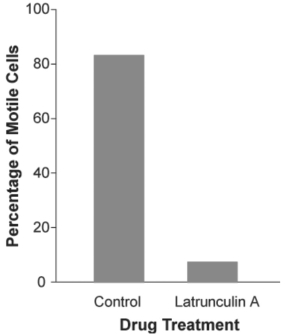
-Refer to the study by Poulsen et al.and Figure 29.3.Cultures of a species of diatom were treated with BDM,a reversible inhibitor of myosin function.Which of the following predictions is consistent with the hypothesis that an actin-myosin interaction is necessary for motility?
A) BDM will significantly decrease motility of the cells in culture.
B) BDM will not significantly alter motility of the cells in culture.
C) BDM will significantly increase motility of the cells in culture.
Correct Answer:

Verified
Correct Answer:
Verified
Q6: One of the fish in your aquarium
Q7: Which of the following statements is consistent
Q8: The manufacture of which of the following
Q9: Figure 29.5<br> <img src="https://d2lvgg3v3hfg70.cloudfront.net/TB3734/.jpg" alt="Figure 29.5
Q10: Which of the following groups is matched
Q13: Figure 29.3<br>Use the following information when answering
Q14: Figure 29.1<br>Use the following information to answer
Q15: Which of the following characteristics is true
Q16: A particular species of protist has obtained
Q34: Which of the following eukaryotic lineages contains