



 Chat with AI
Exam 29: Protists

Exam 1: Biology and the Tree of Life40 Questions
Exam 2: Water and Carbon: the Chemical Basis of Life50 Questions
Exam 3: Protein Structure and Function47 Questions
Exam 4: Nucleic Acids and the Rna World33 Questions
Exam 5: An Introduction to Carbohydrates30 Questions
Exam 6: Lipids, membranes, and the First Cells47 Questions
Exam 7: Inside the Cell28 Questions
Exam 8: Cell-Cell Interactions27 Questions
Exam 9: Cellular Respiration and Fermentation27 Questions
Exam 10: Photosynthesis32 Questions
Exam 11: The Cell Cycle31 Questions
Exam 12: Meiosis34 Questions
Exam 13: Mendel and the Gene32 Questions
Exam 14: Dna and the Gene: Synthesis and Repair37 Questions
Exam 15: How Genes Work34 Questions
Exam 16: Transcription and Translation38 Questions
Exam 17: Control of Gene Expression in Bacteria31 Questions
Exam 18: Control of Gene Expression in Eukaryotes37 Questions
Exam 19: Analyzing and Engineering Genes40 Questions
Exam 20: Genomics38 Questions
Exam 21: Principles of Development25 Questions
Exam 22: An Introduction to Animal Development22 Questions
Exam 23: An Introduction to Plant Development21 Questions
Exam 24: Evolution by Natural Selection32 Questions
Exam 25: Evolutionary Processes32 Questions
Exam 26: Speciation33 Questions
Exam 27: Phylogenies and the History of Life38 Questions
Exam 28: Bacteria and Archaea38 Questions
Exam 29: Protists34 Questions
Exam 30: Green Plants49 Questions
Exam 31: Fungi37 Questions
Exam 32: An Introduction to Animals38 Questions
Exam 33: Protostome Animals38 Questions
Exam 34: Deuterostome Animals46 Questions
Exam 35: Viruses31 Questions
Exam 36: Plant Form and Function39 Questions
Exam 37: Water and Sugar Transport in Plants42 Questions
Exam 38: Plant Nutrition36 Questions
Exam 39: Plant Sensory Systems, signals, and Responses66 Questions
Exam 40: Plant Reproduction41 Questions
Exam 41: Animal Form and Function29 Questions
Exam 42: Water and Electrolyte Balance in Animals38 Questions
Exam 43: Animal Nutrition37 Questions
Exam 44: Gas Exchange and Circulation37 Questions
Exam 45: Electrical Signals in Animals33 Questions
Exam 46: Animal Sensory Systems and Movement36 Questions
Exam 47: Chemical Signals in Animals33 Questions
Exam 48: Animal Reproduction34 Questions
Exam 49: The Immune System in Animals32 Questions
Exam 50: An Introduction to Ecology38 Questions
Exam 51: Behavioral Ecology37 Questions
Exam 52: Population Ecology46 Questions
Exam 53: Community Ecology39 Questions
Exam 54: Ecosystems41 Questions
Exam 55: Biodiversity and Conservation Biology39 Questions
Select questions type


Alternation of generations occurs in some protists.Which of the following represents the correct sequence of events for this mode of reproduction?
(Multiple Choice)
4.7/5  (72)
(72) In examining a multicellular protist,you notice that it uses pseudopods to engulf its food,that it reproduces asexually by mitosis,and that it has multiple nuclei.These data allow you to infer that the species belongs to which of the following protist groups?
(Multiple Choice)
4.9/5 (79)
(79) Which of the following monophyletic eukaryotic clades includes photosynthetic species with double-membraned chloroplasts?
(Multiple Choice)
4.7/5 (90)
(90) You discover a new eukaryotic species.It is non-photosynthetic,unicellular,and its motile cells contain a single flagellum.To which group of eukaryotes might this organism belong?
(Multiple Choice)
4.9/5 (76)
(76) Which of the following is most likely to lead to PSP (paralytic shellfish poisoning)?
(Multiple Choice)
4.7/5 (84)
(84) Consider the following points:
(a)All excavates live in environments where oxygen availability is low;(b)all excavates lack mitochondria;and (c)all excavates have some mitochondrial genes.Based on this information,which of the following statements is true of the excavate lineage?
(Multiple Choice)
4.9/5 (79)
(79) Encouraging the growth (via nutrient fertilization)of photosynthetic protists in marine environments may help reduce global warming.Why?
(Multiple Choice)
4.9/5 (85)
(85) When a mosquito infected with Plasmodium first bites a human _____.
(Multiple Choice)
4.9/5 (70)
(70) Imagine there are 25 different species of protists living in a tide pool.Some of these species reproduce both sexually and asexually,and some of them can reproduce only asexually.The pool gradually becomes infested with disease-causing viruses and bacteria.Which species are more likely to thrive in the changing environment?
(Multiple Choice)
4.8/5 (83)
(83) Which of the following observations about flagella is true and is consistent with the scientific conclusion that the flagella from protists and bacteria evolved independently?
(Multiple Choice)
4.8/5 (74)
(74) Figure 29.3
Use the following information when answering the corresponding question(s).
The mechanism of cell crawling in protist species is not well defined.The textbook states that pseudopodia extension involves interactions between actin and myosin (the same molecules that are involved in mammalian muscle contraction).However,prior to the study described below,no one had provided convincing data that actin and myosin were actually involved in cell crawling in protists.Anatomical studies had identified the cytoskeletal protein actin just below the surface of the cell membrane in several species of protist;but physiological studies had failed to show a functional link between actin,myosin,and cell crawling.
In a study by N.Poulsen et al.(Diatom gliding is the result of an actin-myosin motility system,Cell Motility and the Cytoskeleton 44 (1999):23-22),researchers tested whether motility in a particular species of diatom involves interactions between actin and myosin.
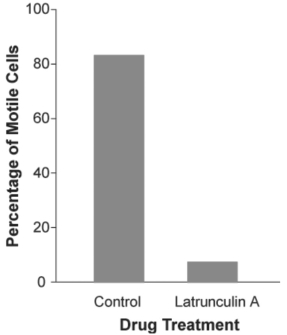 -Refer to the study by Poulsen et al.and Figure 29.3.Latrunculin A is a reversible toxin that disrupts the formation of actin fibers.A culture of a particular species of diatom was treated with this toxin diluted in a buffer,while another culture was treated only with the buffer (no toxin;control).The motility of cells in each culture was assessed by counting the number of cells that were moving during a defined period of time.Which of the following conclusion statements is reasonable based on the above figure?
 (Multiple Choice)
4.9/5 (75)
(75) Assume that some members of an aquatic species of motile,photosynthetic protists evolve to become parasitic to fish.They gain the ability to live in the fish gut,absorbing nutrients as the fish digests food.Over time,which of the following phenotypic changes would you expect to observe in this population of protists?
(Multiple Choice)
4.8/5 (94)
(94) You discover a new species of protist.Which of the following characteristics would provide the strongest evidence for your hypothesis that your species belongs in Euglenida?
(Multiple Choice)
4.9/5 (80)
(80) Plankton is comprised of photosynthetic protists and bacteria.What is the primary importance of plankton to humans?
(Multiple Choice)
4.8/5 (81)
(81) 
Filters
- Essay(0)
- Multiple Choice(0)
- Short Answer(0)
- True False(0)
- Matching(0)