



 Chat with AI
Exam 43: Animal Nutrition

Exam 1: Biology and the Tree of Life40 Questions
Exam 2: Water and Carbon: the Chemical Basis of Life50 Questions
Exam 3: Protein Structure and Function47 Questions
Exam 4: Nucleic Acids and the Rna World33 Questions
Exam 5: An Introduction to Carbohydrates30 Questions
Exam 6: Lipids, membranes, and the First Cells47 Questions
Exam 7: Inside the Cell28 Questions
Exam 8: Cell-Cell Interactions27 Questions
Exam 9: Cellular Respiration and Fermentation27 Questions
Exam 10: Photosynthesis32 Questions
Exam 11: The Cell Cycle31 Questions
Exam 12: Meiosis34 Questions
Exam 13: Mendel and the Gene32 Questions
Exam 14: Dna and the Gene: Synthesis and Repair37 Questions
Exam 15: How Genes Work34 Questions
Exam 16: Transcription and Translation38 Questions
Exam 17: Control of Gene Expression in Bacteria31 Questions
Exam 18: Control of Gene Expression in Eukaryotes37 Questions
Exam 19: Analyzing and Engineering Genes40 Questions
Exam 20: Genomics38 Questions
Exam 21: Principles of Development25 Questions
Exam 22: An Introduction to Animal Development22 Questions
Exam 23: An Introduction to Plant Development21 Questions
Exam 24: Evolution by Natural Selection32 Questions
Exam 25: Evolutionary Processes32 Questions
Exam 26: Speciation33 Questions
Exam 27: Phylogenies and the History of Life38 Questions
Exam 28: Bacteria and Archaea38 Questions
Exam 29: Protists34 Questions
Exam 30: Green Plants49 Questions
Exam 31: Fungi37 Questions
Exam 32: An Introduction to Animals38 Questions
Exam 33: Protostome Animals38 Questions
Exam 34: Deuterostome Animals46 Questions
Exam 35: Viruses31 Questions
Exam 36: Plant Form and Function39 Questions
Exam 37: Water and Sugar Transport in Plants42 Questions
Exam 38: Plant Nutrition36 Questions
Exam 39: Plant Sensory Systems, signals, and Responses66 Questions
Exam 40: Plant Reproduction41 Questions
Exam 41: Animal Form and Function29 Questions
Exam 42: Water and Electrolyte Balance in Animals38 Questions
Exam 43: Animal Nutrition37 Questions
Exam 44: Gas Exchange and Circulation37 Questions
Exam 45: Electrical Signals in Animals33 Questions
Exam 46: Animal Sensory Systems and Movement36 Questions
Exam 47: Chemical Signals in Animals33 Questions
Exam 48: Animal Reproduction34 Questions
Exam 49: The Immune System in Animals32 Questions
Exam 50: An Introduction to Ecology38 Questions
Exam 51: Behavioral Ecology37 Questions
Exam 52: Population Ecology46 Questions
Exam 53: Community Ecology39 Questions
Exam 54: Ecosystems41 Questions
Exam 55: Biodiversity and Conservation Biology39 Questions
Select questions type


Food being digested in the stomach is in a highly acidic environment.When the food is released from the stomach into the small intestine,why is the environment no longer acidic?
(Multiple Choice)
4.8/5  (80)
(80) Bile,which is synthesized in the liver and stored in the gallbladder,is important in lipid digestion.What feature/function of bile makes it an effective emulsifying agent?
(Multiple Choice)
4.8/5 (76)
(76) One of the symptoms of cystic fibrosis is the increased production of mucus.Which of the following cell types is likely to show an increase in numbers in a patient with cystic fibrosis?
(Multiple Choice)
4.8/5 (78)
(78) Glucose is transported from the intestinal lumen into epithelial cells through _____ and from the intestinal epithelium into circulation by _____.
(Multiple Choice)
4.8/5 (83)
(83) When a patient has his gallbladder removed,which of the following food types would a doctor recommend this patient consume in lower quantities?
(Multiple Choice)
5.0/5 (86)
(86) What is the importance of the mucins that are released by salivary glands?
(Multiple Choice)
4.9/5 (93)
(93) Food labels provide nutrient information,and express the amount of a given nutrient as _____.
(Multiple Choice)
4.8/5 (71)
(71) Figure 43.2
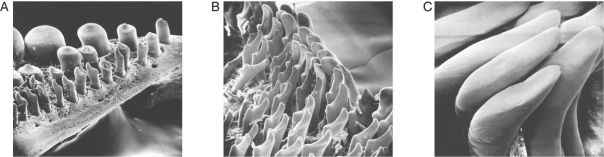 -The process of obtaining food is known as _____ and requires specialized mouthparts.
 (Multiple Choice)
4.9/5 (77)
(77) The active ingredient orlistat acts to decrease the amount of fat that is absorbed by attaching to enzymes that digest fat.Which of the following are potential targets of orlistat?
(Multiple Choice)
4.8/5 (79)
(79) Figure 43.2
-If you found a skull in the woods and the teeth were fang-like,what type of food would you expect this animal to eat?
-If you found a skull in the woods and the teeth were fang-like,what type of food would you expect this animal to eat? (Multiple Choice)
4.9/5 (79)
(79) Helicobacter pylori is a bacterial organism that causes ulcers and digestive disturbances.How might they survive the acid pH of the stomach?
(Multiple Choice)
5.0/5 (72)
(72) Figure 43.1
 -Which of the following are the most likely to have teeth adapted for grinding and/or tearing?
 (Multiple Choice)
4.7/5 (70)
(70) Amino acids,dipeptides,and sugars are transported from intestinal epithelial cells into circulation.Lipids are transported from the intestinal epithelium into _____.
(Multiple Choice)
4.9/5 (85)
(85) Food and its products of degradation move through the alimentary canal by means of peristalsis.What is peristalsis?
(Multiple Choice)
4.9/5 (82)
(82) Figure 43.1
-Three groups of cyclists consumed three different types of diets:
High-carbohydrate,a diet mixed in carbohydrates,fat,and protein,or a diet higher in protein and fat.The average time each group could spend cycling over a 6-hour period is shown in the above graph.
How could an athlete or trainer use the data to improve performance?
-Three groups of cyclists consumed three different types of diets:
High-carbohydrate,a diet mixed in carbohydrates,fat,and protein,or a diet higher in protein and fat.The average time each group could spend cycling over a 6-hour period is shown in the above graph.
How could an athlete or trainer use the data to improve performance? (Multiple Choice)
4.8/5 (80)
(80) Jahasz-Pocsine and co-workers found a correlation between gastric bypass surgery and neurological complications.150 patients at the University of Arkansas for Medical Sciences Neurology Clinic had gastric bypass surgery and 26 of these patients experienced neurological complications related to the surgery.What might be a cause for the neurological complications?
(Multiple Choice)
4.8/5 (87)
(87) 
Filters
- Essay(0)
- Multiple Choice(0)
- Short Answer(0)
- True False(0)
- Matching(0)