



 Chat with AI
Exam 20: Genomics

Exam 1: Biology and the Tree of Life40 Questions
Exam 2: Water and Carbon: the Chemical Basis of Life50 Questions
Exam 3: Protein Structure and Function47 Questions
Exam 4: Nucleic Acids and the Rna World33 Questions
Exam 5: An Introduction to Carbohydrates30 Questions
Exam 6: Lipids, membranes, and the First Cells47 Questions
Exam 7: Inside the Cell28 Questions
Exam 8: Cell-Cell Interactions27 Questions
Exam 9: Cellular Respiration and Fermentation27 Questions
Exam 10: Photosynthesis32 Questions
Exam 11: The Cell Cycle31 Questions
Exam 12: Meiosis34 Questions
Exam 13: Mendel and the Gene32 Questions
Exam 14: Dna and the Gene: Synthesis and Repair37 Questions
Exam 15: How Genes Work34 Questions
Exam 16: Transcription and Translation38 Questions
Exam 17: Control of Gene Expression in Bacteria31 Questions
Exam 18: Control of Gene Expression in Eukaryotes37 Questions
Exam 19: Analyzing and Engineering Genes40 Questions
Exam 20: Genomics38 Questions
Exam 21: Principles of Development25 Questions
Exam 22: An Introduction to Animal Development22 Questions
Exam 23: An Introduction to Plant Development21 Questions
Exam 24: Evolution by Natural Selection32 Questions
Exam 25: Evolutionary Processes32 Questions
Exam 26: Speciation33 Questions
Exam 27: Phylogenies and the History of Life38 Questions
Exam 28: Bacteria and Archaea38 Questions
Exam 29: Protists34 Questions
Exam 30: Green Plants49 Questions
Exam 31: Fungi37 Questions
Exam 32: An Introduction to Animals38 Questions
Exam 33: Protostome Animals38 Questions
Exam 34: Deuterostome Animals46 Questions
Exam 35: Viruses31 Questions
Exam 36: Plant Form and Function39 Questions
Exam 37: Water and Sugar Transport in Plants42 Questions
Exam 38: Plant Nutrition36 Questions
Exam 39: Plant Sensory Systems, signals, and Responses66 Questions
Exam 40: Plant Reproduction41 Questions
Exam 41: Animal Form and Function29 Questions
Exam 42: Water and Electrolyte Balance in Animals38 Questions
Exam 43: Animal Nutrition37 Questions
Exam 44: Gas Exchange and Circulation37 Questions
Exam 45: Electrical Signals in Animals33 Questions
Exam 46: Animal Sensory Systems and Movement36 Questions
Exam 47: Chemical Signals in Animals33 Questions
Exam 48: Animal Reproduction34 Questions
Exam 49: The Immune System in Animals32 Questions
Exam 50: An Introduction to Ecology38 Questions
Exam 51: Behavioral Ecology37 Questions
Exam 52: Population Ecology46 Questions
Exam 53: Community Ecology39 Questions
Exam 54: Ecosystems41 Questions
Exam 55: Biodiversity and Conservation Biology39 Questions
Select questions type


Although transposable elements and simple tandem repeats (STRs)are both repetitive DNAs,they differ in that _____.
(Multiple Choice)
5.0/5  (84)
(84) The following table from the Venter et al.paper presents the numbers of different types of genes discovered in this study.
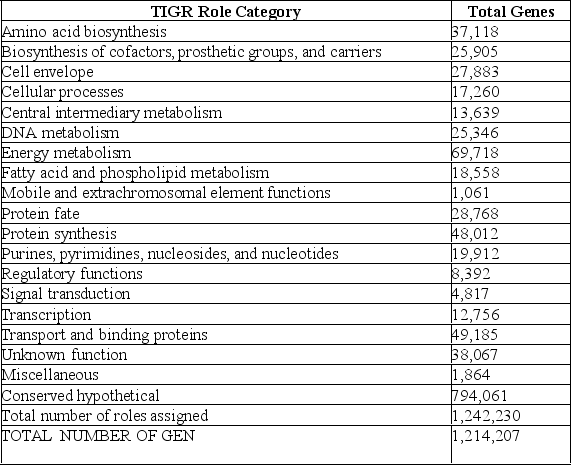 -As with many new endeavors,concerns have been raised by some that genomics will fundamentally change the way biological research is practiced.Examine the full reference for the Venter et al.paper and consider the way this work was done.Now think of some seminal works in the history of biology,for example,Darwin's On the Origin of Species and Watson and Crick's publication on DNA structure.What do you think the concern might be that has been voiced about genomics?
 (Multiple Choice)
4.9/5 (77)
(77) Imagine that you've sequenced the genome of a human pathogenic bacterium.In the early stages of analysis,you discover a stretch of DNA that has a significantly different GC content (the proportion of bases that are G and
(Multiple Choice)
4.9/5 (74)
(74) When comparing the genomes of a bacterial parasite versus a free-living,nonparasitic bacterium,one expects to find _____.
(Multiple Choice)
4.8/5 (89)
(89) When gene duplication occurs to its ultimate extent by doubling all genes in a genome,what has occurred?
(Multiple Choice)
4.8/5 (86)
(86) 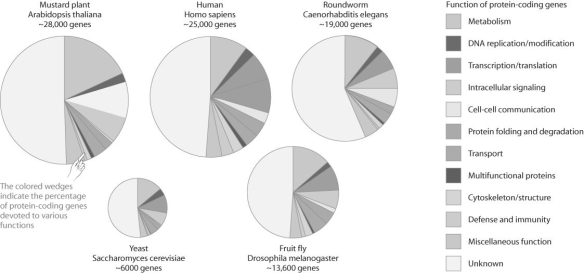 -The figure above compares the proportion of genes devoted to various functions in a set of model organisms.Based on this figure,which one of the following statements is false?
 (Multiple Choice)
4.9/5 (81)
(81) Which of the following questions is asked in functional genomics research?
(Multiple Choice)
4.8/5 (92)
(92) After finding a new medicinal plant,a pharmaceutical company decides to determine if the plant has any genes that are the same or similar to those of other known medicinal plants.To do this,the company annotates the genome which will _____.
(Multiple Choice)
4.9/5 (68)
(68) 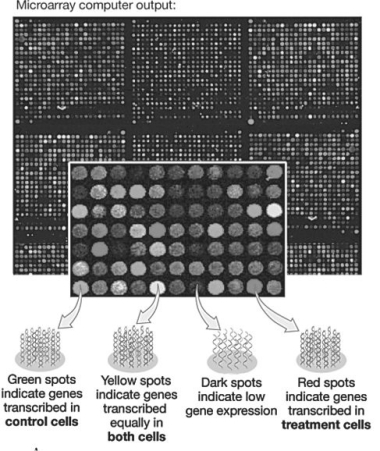 -In the microarray shown in the figure above,if you were searching for genes whose expression was inhibited by hormone treatment,you would search for sequences spotted on the array that showed _____ fluorescence.
 (Multiple Choice)
4.9/5 (89)
(89) A current view of how the human and chimpanzee can share most of their nucleotide sequence yet exhibit significant phenotypic differences is that many of the most important sequence differences alter _____.
(Multiple Choice)
4.8/5 (84)
(84) The bulk of the sequence data in whole genome sequencing comes from _____.
(Multiple Choice)
4.8/5 (85)
(85) Forensic DNA fingerprinting often involves recovery of minute quantities of DNA from a crime scene.What is a concern in analyzing this DNA?
(Multiple Choice)
4.8/5 (84)
(84) The mechanism for the spread of LINES involves some unusual features,including _____.
(Multiple Choice)
4.8/5 (63)
(63) Biologists now routinely test for homology among potentially related species using DNA sequences.These tests reveal if the sequences from each species _____.
(Multiple Choice)
4.9/5 (75)
(75) The following table from the Venter et al.paper presents the numbers of different types of genes discovered in this study.
-Refer to the paragraph on the Venter et al.paper and Table 20.1 If practical applications arise from this or similar metagenomic studies,what might these be?
-Refer to the paragraph on the Venter et al.paper and Table 20.1 If practical applications arise from this or similar metagenomic studies,what might these be? (Multiple Choice)
4.9/5 (75)
(75) Imagine that your goal is to isolate mouse mutants that stabilize microsatellite repeat sequences (i.e. ,lower the frequency at which their repeat number changes).Which of the following mutations would you predict to have this stabilizing effect?
(Multiple Choice)
4.9/5 (87)
(87) If one wished to test the hypothesis that humans and chimps differ due to differences in the expression of a large set of shared genes,the technique to use would be _____.
(Multiple Choice)
4.8/5 (87)
(87) 
Filters
- Essay(0)
- Multiple Choice(0)
- Short Answer(0)
- True False(0)
- Matching(0)