



 Chat with AI
Exam 14: Dna and the Gene: Synthesis and Repair

Exam 1: Biology and the Tree of Life40 Questions
Exam 2: Water and Carbon: the Chemical Basis of Life50 Questions
Exam 3: Protein Structure and Function47 Questions
Exam 4: Nucleic Acids and the Rna World33 Questions
Exam 5: An Introduction to Carbohydrates30 Questions
Exam 6: Lipids, membranes, and the First Cells47 Questions
Exam 7: Inside the Cell28 Questions
Exam 8: Cell-Cell Interactions27 Questions
Exam 9: Cellular Respiration and Fermentation27 Questions
Exam 10: Photosynthesis32 Questions
Exam 11: The Cell Cycle31 Questions
Exam 12: Meiosis34 Questions
Exam 13: Mendel and the Gene32 Questions
Exam 14: Dna and the Gene: Synthesis and Repair37 Questions
Exam 15: How Genes Work34 Questions
Exam 16: Transcription and Translation38 Questions
Exam 17: Control of Gene Expression in Bacteria31 Questions
Exam 18: Control of Gene Expression in Eukaryotes37 Questions
Exam 19: Analyzing and Engineering Genes40 Questions
Exam 20: Genomics38 Questions
Exam 21: Principles of Development25 Questions
Exam 22: An Introduction to Animal Development22 Questions
Exam 23: An Introduction to Plant Development21 Questions
Exam 24: Evolution by Natural Selection32 Questions
Exam 25: Evolutionary Processes32 Questions
Exam 26: Speciation33 Questions
Exam 27: Phylogenies and the History of Life38 Questions
Exam 28: Bacteria and Archaea38 Questions
Exam 29: Protists34 Questions
Exam 30: Green Plants49 Questions
Exam 31: Fungi37 Questions
Exam 32: An Introduction to Animals38 Questions
Exam 33: Protostome Animals38 Questions
Exam 34: Deuterostome Animals46 Questions
Exam 35: Viruses31 Questions
Exam 36: Plant Form and Function39 Questions
Exam 37: Water and Sugar Transport in Plants42 Questions
Exam 38: Plant Nutrition36 Questions
Exam 39: Plant Sensory Systems, signals, and Responses66 Questions
Exam 40: Plant Reproduction41 Questions
Exam 41: Animal Form and Function29 Questions
Exam 42: Water and Electrolyte Balance in Animals38 Questions
Exam 43: Animal Nutrition37 Questions
Exam 44: Gas Exchange and Circulation37 Questions
Exam 45: Electrical Signals in Animals33 Questions
Exam 46: Animal Sensory Systems and Movement36 Questions
Exam 47: Chemical Signals in Animals33 Questions
Exam 48: Animal Reproduction34 Questions
Exam 49: The Immune System in Animals32 Questions
Exam 50: An Introduction to Ecology38 Questions
Exam 51: Behavioral Ecology37 Questions
Exam 52: Population Ecology46 Questions
Exam 53: Community Ecology39 Questions
Exam 54: Ecosystems41 Questions
Exam 55: Biodiversity and Conservation Biology39 Questions
Select questions type


Put the following steps of DNA replication in chronological order.
1)Single-stranded binding proteins attach to DNA strands.
2)Hydrogen bonds between base pairs of antiparallel strands are broken.
3)Primase binds to the site of origin.
4)DNA polymerase binds to the template strand.
5)An RNA primer is created.
(Multiple Choice)
4.8/5  (82)
(82) The bacterial transduction experiments done by Hershey and Chase,and the bacterial transformation experiments done by Griffith,supported the same conclusion,which was _____.
(Multiple Choice)
4.9/5 (92)
(92) What provides the energy for the polymerization reactions in DNA synthesis?
(Multiple Choice)
4.9/5 (86)
(86) Hershey and Chase set out to determine what molecule served as the unit of inheritance.They completed a series of transduction experiments in which E.coli was infected by a T2 virus.Which molecular component of the T2 virus actually ended up inside the cell?
(Multiple Choice)
4.7/5 (82)
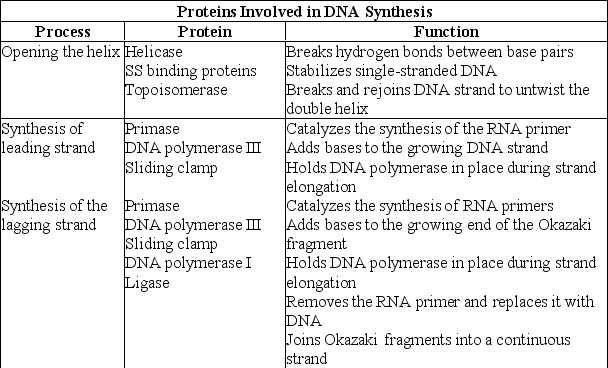
(82) What can you infer from the information presented in this table?
(Multiple Choice)
4.8/5 (76)
(76) Which of the following agents are unlikely to cause mutations in DNA?
(Multiple Choice)
4.8/5 (74)
(74) Recent studies have shown that xeroderma pigmentosum (an error in the nucleotide excision repair process)can result from mutations in one of seven genes.What can you infer from this finding?
(Multiple Choice)
4.7/5 (78)
(78) Researchers found E.coli that had mutation rates 100 times higher than normal.What is a possible explanation for these results?
(Multiple Choice)
4.8/5 (80)
(80) Bodnar et al (1998)used telomerase to extend the life span of normal human cells.Telomere shortening puts a limit on the number of times a cell can divide.How might adding telomerase affect cellular aging?
(Multiple Choice)
4.9/5 (94)
(94) In the polymerization of DNA,a phosphodiester bond is formed between a phosphate group of the nucleotide being added and _____ of the last nucleotide in the polymer.
(Multiple Choice)
4.9/5 (82)
(82) 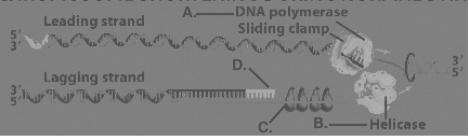 Figure 14.3
-Refer to Figure 14.3.Which structure is responsible for stabilizing DNA in its single-stranded form?
Figure 14.3
-Refer to Figure 14.3.Which structure is responsible for stabilizing DNA in its single-stranded form? (Short Answer)
4.9/5 (80)
(80) If DNA repair mechanisms fail,which of the following is not a direct result?
(Multiple Choice)
4.8/5 (84)
(84) The fact that within a double-stranded DNA molecule,adenine forms two hydrogen bonds with thymine and cytosine forms three hydrogen bonds allows _____.
(Multiple Choice)
4.8/5 (82)
(82) How does the simple primary and secondary structure of DNA hold the information needed to code for the many features of multicellular organisms?
(Multiple Choice)
4.8/5 (85)
(85) In humans,xeroderma pigmentosum is a disorder of the nucleotide excision repair mechanism.These individuals are unable to repair DNA damage caused by ultraviolet light.Which of the following are the most prominent types of mutations in individuals suffering from xeroderma pigmentosum?
(Multiple Choice)
4.9/5 (86)
(86) 
Filters
- Essay(0)
- Multiple Choice(0)
- Short Answer(0)
- True False(0)
- Matching(0)