



 Chat with AI
Exam 24: Evolution by Natural Selection

Exam 1: Biology and the Tree of Life40 Questions
Exam 2: Water and Carbon: the Chemical Basis of Life50 Questions
Exam 3: Protein Structure and Function47 Questions
Exam 4: Nucleic Acids and the Rna World33 Questions
Exam 5: An Introduction to Carbohydrates30 Questions
Exam 6: Lipids, membranes, and the First Cells47 Questions
Exam 7: Inside the Cell28 Questions
Exam 8: Cell-Cell Interactions27 Questions
Exam 9: Cellular Respiration and Fermentation27 Questions
Exam 10: Photosynthesis32 Questions
Exam 11: The Cell Cycle31 Questions
Exam 12: Meiosis34 Questions
Exam 13: Mendel and the Gene32 Questions
Exam 14: Dna and the Gene: Synthesis and Repair37 Questions
Exam 15: How Genes Work34 Questions
Exam 16: Transcription and Translation38 Questions
Exam 17: Control of Gene Expression in Bacteria31 Questions
Exam 18: Control of Gene Expression in Eukaryotes37 Questions
Exam 19: Analyzing and Engineering Genes40 Questions
Exam 20: Genomics38 Questions
Exam 21: Principles of Development25 Questions
Exam 22: An Introduction to Animal Development22 Questions
Exam 23: An Introduction to Plant Development21 Questions
Exam 24: Evolution by Natural Selection32 Questions
Exam 25: Evolutionary Processes32 Questions
Exam 26: Speciation33 Questions
Exam 27: Phylogenies and the History of Life38 Questions
Exam 28: Bacteria and Archaea38 Questions
Exam 29: Protists34 Questions
Exam 30: Green Plants49 Questions
Exam 31: Fungi37 Questions
Exam 32: An Introduction to Animals38 Questions
Exam 33: Protostome Animals38 Questions
Exam 34: Deuterostome Animals46 Questions
Exam 35: Viruses31 Questions
Exam 36: Plant Form and Function39 Questions
Exam 37: Water and Sugar Transport in Plants42 Questions
Exam 38: Plant Nutrition36 Questions
Exam 39: Plant Sensory Systems, signals, and Responses66 Questions
Exam 40: Plant Reproduction41 Questions
Exam 41: Animal Form and Function29 Questions
Exam 42: Water and Electrolyte Balance in Animals38 Questions
Exam 43: Animal Nutrition37 Questions
Exam 44: Gas Exchange and Circulation37 Questions
Exam 45: Electrical Signals in Animals33 Questions
Exam 46: Animal Sensory Systems and Movement36 Questions
Exam 47: Chemical Signals in Animals33 Questions
Exam 48: Animal Reproduction34 Questions
Exam 49: The Immune System in Animals32 Questions
Exam 50: An Introduction to Ecology38 Questions
Exam 51: Behavioral Ecology37 Questions
Exam 52: Population Ecology46 Questions
Exam 53: Community Ecology39 Questions
Exam 54: Ecosystems41 Questions
Exam 55: Biodiversity and Conservation Biology39 Questions
Select questions type


After the drought of 1977,researchers hypothesized that on Daphne Major,medium ground finches with large,deep beaks survived better than those with smaller beaks did because they could more easily crack and eat the tough Tribulus cistoides fruits.If this hypothesis is true,what would you expect to observe if a population of these medium ground finches colonizes a nearby island where Tribulus cistoides is the primary available food in all years?
Assume that (1)even the survivors of the 1977 drought sometimes had difficulty cracking the tough T.cistoides fruits and would eat other seeds when offered a choice;and (2)food availability is the primary limit on finch fitness on this new island.
(Multiple Choice)
4.8/5  (74)
(74) Your text discusses the evolution of antibiotic-resistant M.tuberculosis bacteria in a patient.Researchers discovered that the strain of M.tuberculosis taken from the dead patient has a point mutation in the rpoB gene that codes for part of the RNA polymerase enzyme.This mutant form of RNA polymerase does not normally function as well as the more common form,but a commonly used antibiotic called rifampin does not affect the mutant rpoB.A researcher places M.tuberculosis isolated from the patient a year before death (no rpoB mutation)in cell cultures with M.tuberculosis isolated from the dead patient (with rpoB mutation).Half the cell cultures contain just standard nutrients,and the other cell cultures contain rifampin in addition to the standard nutrients.After many cell generations,the researcher finds that _____.(choose one)
(Multiple Choice)
4.9/5 (91)
(91) The same basic internal organs (kidneys,stomach,heart,lungs)are found in frogs,birds,snakes,and rodents.This is primarily an example of _____.
(Multiple Choice)
4.8/5 (72)
(72) Use the following information when answering the corresponding question(s).
The following question(s)are based on information from Frank M.Frey,"Opposing Natural Selection from Herbivores and Pathogens May Maintain Floral-Color Variation in Claytonia virginica (Portulacaceae)," Evolution 58(11),2004: 2426-37.
-Claytonia virginica is a woodland spring herb with flowers that vary from white to pale pink to bright pink.This plant is primarily pollinated by a bee that prefers pink flowers to white flowers.Claytonia with pink flowers have greater relative fruit set than Claytonia with white flowers.Nevertheless,the percentage of different flower colors remains stable in the study population from year to year.Which of these statements might explain this observation?
(Multiple Choice)
4.7/5 (77)
(77) If two organisms show a developmental homology,you would also definitely expect them to _____.
(Multiple Choice)
4.9/5 (81)
(81) Cotton-topped tamarins are small primates with tufts of long white hair on their heads.While studying these creatures,you notice that males with longer hair get more opportunities to mate and father more offspring.You believe that having longer hair is adaptive to these males.You should _____.
(Multiple Choice)
4.8/5 (77)
(77) Which of the following situations could not lead to evolution via natural selection?
(Multiple Choice)
4.8/5 (80)
(80) Figure 24.1
The following question(s)are based on information in Hopi E.Hoekstra,Kristen E.Drumm,and Michael W.Nachman,"Ecological Genetics of Adaptive Color Polymorphism in Pocket Mice: Geographic Variation in Selected and Neutral Genes," Evolution 58(6),2004: 1329-41.
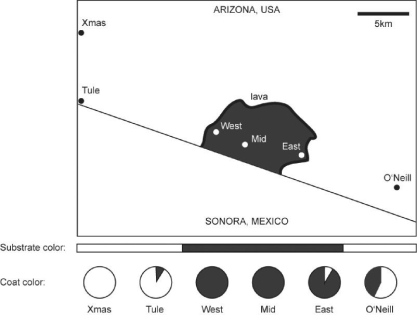 -Refer to Figure 24.1.In their investigation of natural selection on Mc1r alleles (the gene that determines coat color)in Arizona pocket mice,Hoekstra et al.determined the frequency of the D and d alleles in each population.They also determined the frequency of alleles for two neutral mitochondrial DNA genes (genes that do not affect and are not linked to coat color).Why did the researchers include the mitochondrial DNA genes as part of their experimental design?
 (Multiple Choice)
4.8/5 (71)
(71) Parasitic species tend to have simple morphologies.Which of the following statements best explains this observation?
(Multiple Choice)
4.7/5 (78)
(78) Figure 24.2
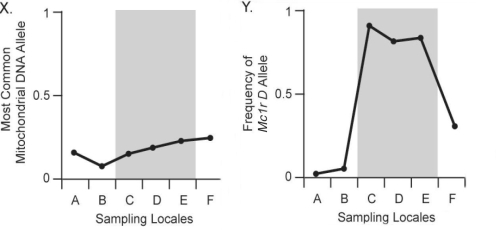 -The distribution of pocket-mouse coat colors in several Arizona populations is associated with substrate color.Some populations live on light-colored granite substrate,and others live on dark volcanic rock.In Figure 24.2,chart A shows the frequency of the melanic (dark)coat phenotype across six populations.Populations C,D,and E live on dark volcanic rock;populations A,B,and F live on light-colored granite.Chart B shows the frequency of the Melanocortin-1 receptor (Mc1r)allele across these populations.The Mc1r alleles,D and d,differ by four amino acids;mice with DD and Dd genotypes have dark coats,whereas mice with dd genotype are light colored.Which of the following statements best interprets the results shown in charts A and B?
 (Multiple Choice)
4.9/5 (74)
(74) Explain how one of the following supports the idea that species change through time:
artificial selection,extinction,transitional forms,vestigial traits,antibiotic resistance.
(Essay)
5.0/5 (76)
(76) 
Filters
- Essay(0)
- Multiple Choice(0)
- Short Answer(0)
- True False(0)
- Matching(0)