



 Chat with AI
Exam 34: Deuterostome Animals

Exam 1: Biology and the Tree of Life40 Questions
Exam 2: Water and Carbon: the Chemical Basis of Life50 Questions
Exam 3: Protein Structure and Function47 Questions
Exam 4: Nucleic Acids and the Rna World33 Questions
Exam 5: An Introduction to Carbohydrates30 Questions
Exam 6: Lipids, membranes, and the First Cells47 Questions
Exam 7: Inside the Cell28 Questions
Exam 8: Cell-Cell Interactions27 Questions
Exam 9: Cellular Respiration and Fermentation27 Questions
Exam 10: Photosynthesis32 Questions
Exam 11: The Cell Cycle31 Questions
Exam 12: Meiosis34 Questions
Exam 13: Mendel and the Gene32 Questions
Exam 14: Dna and the Gene: Synthesis and Repair37 Questions
Exam 15: How Genes Work34 Questions
Exam 16: Transcription and Translation38 Questions
Exam 17: Control of Gene Expression in Bacteria31 Questions
Exam 18: Control of Gene Expression in Eukaryotes37 Questions
Exam 19: Analyzing and Engineering Genes40 Questions
Exam 20: Genomics38 Questions
Exam 21: Principles of Development25 Questions
Exam 22: An Introduction to Animal Development22 Questions
Exam 23: An Introduction to Plant Development21 Questions
Exam 24: Evolution by Natural Selection32 Questions
Exam 25: Evolutionary Processes32 Questions
Exam 26: Speciation33 Questions
Exam 27: Phylogenies and the History of Life38 Questions
Exam 28: Bacteria and Archaea38 Questions
Exam 29: Protists34 Questions
Exam 30: Green Plants49 Questions
Exam 31: Fungi37 Questions
Exam 32: An Introduction to Animals38 Questions
Exam 33: Protostome Animals38 Questions
Exam 34: Deuterostome Animals46 Questions
Exam 35: Viruses31 Questions
Exam 36: Plant Form and Function39 Questions
Exam 37: Water and Sugar Transport in Plants42 Questions
Exam 38: Plant Nutrition36 Questions
Exam 39: Plant Sensory Systems, signals, and Responses66 Questions
Exam 40: Plant Reproduction41 Questions
Exam 41: Animal Form and Function29 Questions
Exam 42: Water and Electrolyte Balance in Animals38 Questions
Exam 43: Animal Nutrition37 Questions
Exam 44: Gas Exchange and Circulation37 Questions
Exam 45: Electrical Signals in Animals33 Questions
Exam 46: Animal Sensory Systems and Movement36 Questions
Exam 47: Chemical Signals in Animals33 Questions
Exam 48: Animal Reproduction34 Questions
Exam 49: The Immune System in Animals32 Questions
Exam 50: An Introduction to Ecology38 Questions
Exam 51: Behavioral Ecology37 Questions
Exam 52: Population Ecology46 Questions
Exam 53: Community Ecology39 Questions
Exam 54: Ecosystems41 Questions
Exam 55: Biodiversity and Conservation Biology39 Questions
Select questions type


It is believed that the coelacanths and lungfish represent a crucial link between other fishes and tetrapods.What is the major feature in these fish in support of this hypothesis?
(Multiple Choice)
4.7/5  (81)
(81) What group of mammals have (a)embryos that spend more time feeding through the placenta than the mother's nipples,(b)young that feed on milk,and (c)a prolonged period of maternal care after leaving the placenta?
(Multiple Choice)
4.8/5 (78)
(78) Mammals and birds eat more often than reptiles.Which of the following traits shared by mammals and birds best explains this habit?
(Multiple Choice)
4.9/5 (70)
(70) Suppose you traveled back in time and located the first animals to have developed feathers.You found that these animals were tree-dwelling ectotherms,able to run quickly but unable to fly.You also noticed that females of the species had no feathers at all,while males had bright blue feathers covering their tails.Which hypothesis of feather evolution would these data most support?
(Multiple Choice)
4.7/5 (73)
(73) As you are walking along a beach,you find an animal and believe that it belongs to the class Asteroidea.Which of the following characteristics would support your hypothesis that the animal is a sea star and not another type of echinoderm?
(Multiple Choice)
4.9/5 (75)
(75) What is believed to be the most significant result of the evolution of the amniotic egg?
(Multiple Choice)
4.9/5 (89)
(89) If you found a fossil fish and had dated it to 400 mya,what feature might indicate that it is actually younger than you first thought?
(Multiple Choice)
4.9/5 (91)
(91) Which of the following groups is classified as Homo sapiens?
(Multiple Choice)
4.9/5 (69)
(69) _____ led to mammals and birds having similar insulating skin coverings such as fur,hair,and feathers.
(Multiple Choice)
4.9/5 (90)
(90) Which of the following is consistent with the out-of-Africa hypothesis?
(Multiple Choice)
4.8/5 (77)
(77) The structure that develops into the vertebrate spinal cord is the _____.
(Multiple Choice)
4.9/5 (85)
(85) How does a swim bladder help the ray-finned fishes maintain buoyancy?
(Multiple Choice)
4.8/5 (84)
(84) 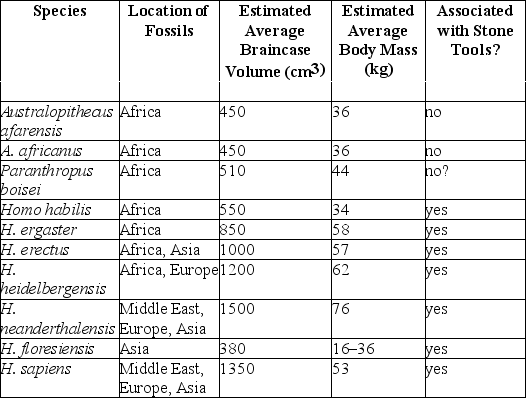 -Refer to the paragraph on Brown et al.and Morwood et al.Which of the following observations would not support the hypothesis that H.floresiensis used symbolic spoken language?
 (Multiple Choice)
4.9/5 (84)
(84) If a kelp farmer wanted to maximize her harvest,which type of echinoderm would she be most concerned about in the habitat?
(Multiple Choice)
4.8/5 (83)
(83) Which of the following characteristics evolved independently in mammals and birds?
(Multiple Choice)
4.9/5 (77)
(77) The discovery of Caudipteryx is significant in evolutionary biology because it strengthened which one of the following hypotheses?
(Multiple Choice)
5.0/5 (80)
(80) How are hemichordates,urochordates,and cephalochordates similar?
(Multiple Choice)
4.9/5 (82)
(82) On the back of your skull you can feel a small bump,below which is an opening where the spinal cord enters the skull.The location of this opening toward the bottom of the skull is significant in evolutionary biology for what reason?
(Multiple Choice)
5.0/5 (78)
(78) Which characteristic is common to all the modern representatives of all major reptilian lineages (Testudinia,Lepidosauria,Crocodilia,or Aves)?
(Multiple Choice)
4.9/5 (81)
(81) 
Filters
- Essay(0)
- Multiple Choice(0)
- Short Answer(0)
- True False(0)
- Matching(0)