



 Chat with AI
Exam 35: Plant Structure,Growth,and Development

Exam 1: Introduction: Evolution and Themes of Biology77 Questions
Exam 2: The Chemical Context of Life98 Questions
Exam 3: Water and Life92 Questions
Exam 4: Carbon and the Molecular Diversity of Life86 Questions
Exam 5: The Structure and Function of Large Biological Molecules131 Questions
Exam 6: A Tour of the Cell111 Questions
Exam 7: Membrane Structure and Function88 Questions
Exam 8: An Introduction to Metabolism92 Questions
Exam 9: Cellular Respiration and Fermentation128 Questions
Exam 10: Photosynthesis103 Questions
Exam 11: Cell Communication85 Questions
Exam 12: The Cell Cycle98 Questions
Exam 13: Meiosis and Sexual Life Cycles90 Questions
Exam 14: Mendel and the Gene Idea92 Questions
Exam 15: The Chromosomal Basis of Inheritance75 Questions
Exam 16: The Molecular Basis of Inheritance84 Questions
Exam 17: From Gene to Protein106 Questions
Exam 18: Regulation of Gene Expression116 Questions
Exam 19: Viruses71 Questions
Exam 20: DNA Tools and Biotechnology78 Questions
Exam 21: Genomes and Their Evolution64 Questions
Exam 22: Descent with Modification: A Darwinian View of Life68 Questions
Exam 23: The Evolution of Populations92 Questions
Exam 24: The Origin of Species76 Questions
Exam 25: The History of Life on Earth89 Questions
Exam 26: Phylogeny and the Tree of Life91 Questions
Exam 27: Bacteria and Archaea96 Questions
Exam 28: Protists82 Questions
Exam 29: Plant Diversity I: How Plants Colonized Land93 Questions
Exam 30: Plant Diversity II: The Evolution of Seed Plants119 Questions
Exam 31: Fungi105 Questions
Exam 32: An Overview of Animal Diversity93 Questions
Exam 33: An Introduction to Invertebrates111 Questions
Exam 34: The Origin and Evolution of Vertebrates126 Questions
Exam 35: Plant Structure,Growth,and Development82 Questions
Exam 36: Resource Acquisition and Transport in Vascular Plants100 Questions
Exam 37: Soil and Plant Nutrition99 Questions
Exam 38: Angiosperm Reproduction and Biotechnology107 Questions
Exam 39: Plant Responses to Internal and External Signals137 Questions
Exam 40: Basic Principles of Animal Form and Function98 Questions
Exam 41: Animal Nutrition87 Questions
Exam 42: Circulation and Gas Exchange112 Questions
Exam 43: The Immune System123 Questions
Exam 44: Osmoregulation and Excretion91 Questions
Exam 45: Hormones and the Endocrine System92 Questions
Exam 46: Animal Reproduction104 Questions
Exam 47: Animal Development106 Questions
Exam 48: Neurons,Synapses,and Signalling93 Questions
Exam 49: Nervous Systems85 Questions
Exam 50: Sensory and Motor Mechanisms106 Questions
Exam 51: Animal Behaviour91 Questions
Exam 52: An Introduction to Ecology and the Biosphere90 Questions
Exam 53: Population Ecology89 Questions
Exam 54: Community Ecology97 Questions
Exam 55: Ecosystems and Restoration Ecology98 Questions
Exam 56: Conservation Biology and Global Change90 Questions
Select questions type


All of the following cell types are correctly matched with their functions except
(Multiple Choice)
4.9/5  (72)
(72) The phase change of an apical meristem from the juvenile to the mature vegetative phase is often revealed by
(Multiple Choice)
4.9/5 (89)
(89) A leaf primordium is initiated as a small mound of tissue on the flank of a dome-shaped shoot apical meristem.The earliest physical evidence of the site of a newly forming leaf primordium would be
(Multiple Choice)
4.8/5 (76)
(76) The following questions are based on the drawing of root or stem cross sections shown below.
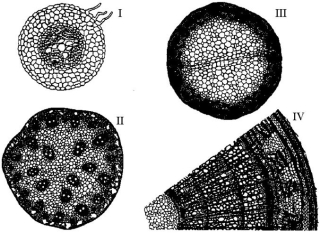 -A plant that is at least three years old is represented by
 (Multiple Choice)
4.9/5 (85)
(85) You find a plant unfamiliar to you and observe that it has vascular bundles scattered throughout the stem cross section.What do you conclude about the plant?
(Multiple Choice)
4.7/5 (77)
(77) The following questions are based on the drawing of root or stem cross sections shown below.
-A woody eudicot is represented by
-A woody eudicot is represented by (Multiple Choice)
4.9/5 (78)
(78) The following question is based on parts of a growing primary root.
I. root cap
II. zone of elongation
III. zone of cell division
IV. zone of cell maturation
V. apical meristem
-Which of the following is the correct sequence from the growing tips of the root upward?
(Multiple Choice)
4.7/5 (83)
(83) Additional vascular tissue produced as secondary growth in a root originates from which cells?
(Multiple Choice)
4.8/5 (70)
(70) One important difference between the anatomy of roots and the anatomy of leaves is that
(Multiple Choice)
4.8/5 (75)
(75) Which of the following would not be seen in a cross section through the woody part of a root?
(Multiple Choice)
5.0/5 (95)
(95) While studying the plant Arabidopsis,a botanist finds that an RNA probe produces coloured spots in the sepals of the plant.From this information,what can be inferred?
(Multiple Choice)
4.9/5 (73)
(73) Which of the following arise,directly or indirectly,from meristematic activity?
(Multiple Choice)
4.7/5 (79)
(79) 
Filters
- Essay(0)
- Multiple Choice(0)
- Short Answer(0)
- True False(0)
- Matching(0)