



 Chat with AI
Exam 23: The Evolution of Populations

Exam 1: Introduction: Evolution and Themes of Biology77 Questions
Exam 2: The Chemical Context of Life98 Questions
Exam 3: Water and Life92 Questions
Exam 4: Carbon and the Molecular Diversity of Life86 Questions
Exam 5: The Structure and Function of Large Biological Molecules131 Questions
Exam 6: A Tour of the Cell111 Questions
Exam 7: Membrane Structure and Function88 Questions
Exam 8: An Introduction to Metabolism92 Questions
Exam 9: Cellular Respiration and Fermentation128 Questions
Exam 10: Photosynthesis103 Questions
Exam 11: Cell Communication85 Questions
Exam 12: The Cell Cycle98 Questions
Exam 13: Meiosis and Sexual Life Cycles90 Questions
Exam 14: Mendel and the Gene Idea92 Questions
Exam 15: The Chromosomal Basis of Inheritance75 Questions
Exam 16: The Molecular Basis of Inheritance84 Questions
Exam 17: From Gene to Protein106 Questions
Exam 18: Regulation of Gene Expression116 Questions
Exam 19: Viruses71 Questions
Exam 20: DNA Tools and Biotechnology78 Questions
Exam 21: Genomes and Their Evolution64 Questions
Exam 22: Descent with Modification: A Darwinian View of Life68 Questions
Exam 23: The Evolution of Populations92 Questions
Exam 24: The Origin of Species76 Questions
Exam 25: The History of Life on Earth89 Questions
Exam 26: Phylogeny and the Tree of Life91 Questions
Exam 27: Bacteria and Archaea96 Questions
Exam 28: Protists82 Questions
Exam 29: Plant Diversity I: How Plants Colonized Land93 Questions
Exam 30: Plant Diversity II: The Evolution of Seed Plants119 Questions
Exam 31: Fungi105 Questions
Exam 32: An Overview of Animal Diversity93 Questions
Exam 33: An Introduction to Invertebrates111 Questions
Exam 34: The Origin and Evolution of Vertebrates126 Questions
Exam 35: Plant Structure,Growth,and Development82 Questions
Exam 36: Resource Acquisition and Transport in Vascular Plants100 Questions
Exam 37: Soil and Plant Nutrition99 Questions
Exam 38: Angiosperm Reproduction and Biotechnology107 Questions
Exam 39: Plant Responses to Internal and External Signals137 Questions
Exam 40: Basic Principles of Animal Form and Function98 Questions
Exam 41: Animal Nutrition87 Questions
Exam 42: Circulation and Gas Exchange112 Questions
Exam 43: The Immune System123 Questions
Exam 44: Osmoregulation and Excretion91 Questions
Exam 45: Hormones and the Endocrine System92 Questions
Exam 46: Animal Reproduction104 Questions
Exam 47: Animal Development106 Questions
Exam 48: Neurons,Synapses,and Signalling93 Questions
Exam 49: Nervous Systems85 Questions
Exam 50: Sensory and Motor Mechanisms106 Questions
Exam 51: Animal Behaviour91 Questions
Exam 52: An Introduction to Ecology and the Biosphere90 Questions
Exam 53: Population Ecology89 Questions
Exam 54: Community Ecology97 Questions
Exam 55: Ecosystems and Restoration Ecology98 Questions
Exam 56: Conservation Biology and Global Change90 Questions
Select questions type


In the formula for determining a population's genotype frequencies,the 2 in the term 2pq is necessary because
(Multiple Choice)
4.8/5  (87)
(87) Use the following information to answer the questions below.
In the year 2500,five male space colonists and five female space colonists (all unrelated to each other)settle on an uninhabited Earthlike planet in the Andromeda galaxy.The colonists and their offspring randomly mate for generations.All ten of the original colonists had free earlobes,and two were heterozygous for that trait.The allele for free earlobes is dominant to the allele for attached earlobes.
-If one assumes that Hardy-Weinberg equilibrium applies to the population of colonists on this planet,about how many people will have attached earlobes when the planet's population reaches 10000?
(Multiple Choice)
4.9/5 (75)
(75) Use the following figure to answer the questions below.
In a very large population,a quantitative trait has the following distribution pattern:
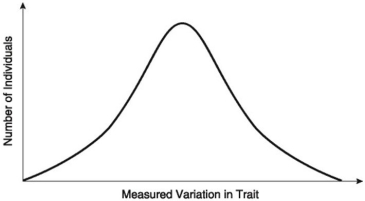 -What would be the most probable cause for a population depicted in the figure above to shift both to the left and to the right?
 (Multiple Choice)
4.8/5 (69)
(69) The following questions refer to the following paragraph.
HIV's genome of RNA includes the code for reverse transcriptase (RT),an enzyme that acts early in infection to synthesize a DNA genome from an RNA template.The HIV genome also codes for protease (PR),an enzyme that acts later in infection by cutting long viral polyproteins into smaller,functional proteins.Both RT and PR represent potential targets for antiretroviral drugs.Drugs called nucleoside analogues (NA)act against RT,whereas drugs called protease inhibitors (PI)act against PR.
-In a hypothetical population's gene pool,an autosomal gene,which had previously been fixed,undergoes a mutation that introduces a new allele,one inherited according to incomplete dominance.Natural selection then causes stabilizing selection at this locus.Consequently,what should happen over the course of many generations?
(Multiple Choice)
4.7/5 (75)
(75) How many of these statements regarding populations are true?
1)Mature males and females of a population can interbreed with each other.
2)Populations are sometimes geographically isolated from other populations.
3)Biological species are made up of populations.
4)Members of a population tend to be genetically more similar to each other than to members of other populations.
5)Populations have genomes,but not gene pools.
(Multiple Choice)
4.9/5 (74)
(74) Use the following information to answer the questions below.
In those parts of equatorial Africa where the malaria parasite is most common,the sickle-cell allele constitutes 20% of the β hemoglobin alleles in the human gene pool.
-With respect to the sickle-cell allele,what should be true of the β hemoglobin locus in U.S.populations of African-Americans whose ancestors were from equatorial Africa?
1)The average heterozygosity at this locus should be decreasing over time.
2)There is an increasing heterozygote advantage at this locus.
3)Diploidy is helping to preserve the sickle-cell allele at this locus.
4)Frequency-dependent selection is helping to preserve the sickle-cell allele at this locus.
(Multiple Choice)
4.8/5 (84)
(84) Which of the following is a fitness trade-off (compromise)?
(Multiple Choice)
4.8/5 (88)
(88) Little nucleotide variability results in phenotypic variation because
(Multiple Choice)
4.8/5 (81)
(81) You are shown caterpillars of the moth Nemoria arizonaria.The caterpillars belong to the same species,but some of the caterpillars that were collected from oak flowers resemble oak flowers,while caterpillars collected from oak twigs resemble oak twigs.What is the most plausible explanation for the phenotypic variation?
(Multiple Choice)
5.0/5 (86)
(86) Use the following figure to answer the questions below.
In a very large population,a quantitative trait has the following distribution pattern:
-What is true of the trait whose frequency distribution in a large population appears in the previous figure? It has probably undergone
-What is true of the trait whose frequency distribution in a large population appears in the previous figure? It has probably undergone (Multiple Choice)
4.8/5 (79)
(79) Which statement about the beak size of finches on the island of Daphne Major during prolonged drought is true?
(Multiple Choice)
4.8/5 (86)
(86) In a Hardy-Weinberg population with two alleles,A and a,that are in equilibrium,the frequency of allele a is 0.2.What is the percentage of the population that is heterozygous for this allele?
(Multiple Choice)
5.0/5 (74)
(74) If global warming permits mosquitoes to live at higher altitudes than they currently do,then in which direction should the entire plot in the correct distribution below be shifted?
a) 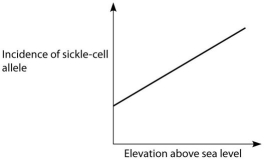 b)
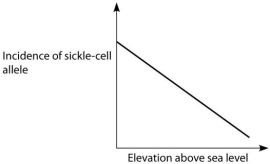 c)
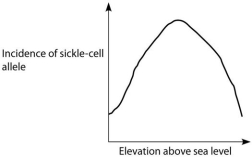 d)
b)
c)
d) (Multiple Choice)
4.9/5 (77)
(77) In the wild,male house finches (Carpodus mexicanus)vary considerably in the amount of red pigmentation in their head and throat feathers,with colours ranging from pale yellow to bright red.These colours come from carotenoid pigments that are found in the birds' diets; no vertebrates are known to synthesize carotenoid pigments.Thus,the brighter red the male's feathers are,the more successful he has been at acquiring the red carotenoid pigment by his food-gathering efforts (all other factors being equal).During breeding season,one should expect female house finches to prefer to mate with males with the brightest red feathers.Which of the following is true of this situation?
(Multiple Choice)
4.9/5 (77)
(77) There are 40 individuals in population 1,all with genotype A1A1,and there are 25 individuals in population 2,all with genotype A2A2.Assume that these populations are located far from each other and that their environmental conditions are very similar.Based on the information given here,the observed genetic variation is most likely an example of
(Multiple Choice)
4.7/5 (67)
(67) Most Swiss starlings produce four to five eggs in each clutch.Starlings producing fewer,or more,than this have reduced fitness.Which of the following terms best describes this situation?
(Multiple Choice)
4.7/5 (69)
(69) You sample a population of butterflies and find that 56% are heterozygous at a particular locus.What should be the frequency of the recessive allele in this population?
(Multiple Choice)
4.8/5 (87)
(87) 
Filters
- Essay(0)
- Multiple Choice(0)
- Short Answer(0)
- True False(0)
- Matching(0)