



 Chat with AI
Exam 23: The Evolution of Populations

Exam 1: Introduction: Evolution and Themes of Biology77 Questions
Exam 2: The Chemical Context of Life98 Questions
Exam 3: Water and Life92 Questions
Exam 4: Carbon and the Molecular Diversity of Life86 Questions
Exam 5: The Structure and Function of Large Biological Molecules131 Questions
Exam 6: A Tour of the Cell111 Questions
Exam 7: Membrane Structure and Function88 Questions
Exam 8: An Introduction to Metabolism92 Questions
Exam 9: Cellular Respiration and Fermentation128 Questions
Exam 10: Photosynthesis103 Questions
Exam 11: Cell Communication85 Questions
Exam 12: The Cell Cycle98 Questions
Exam 13: Meiosis and Sexual Life Cycles90 Questions
Exam 14: Mendel and the Gene Idea92 Questions
Exam 15: The Chromosomal Basis of Inheritance75 Questions
Exam 16: The Molecular Basis of Inheritance84 Questions
Exam 17: From Gene to Protein106 Questions
Exam 18: Regulation of Gene Expression116 Questions
Exam 19: Viruses71 Questions
Exam 20: DNA Tools and Biotechnology78 Questions
Exam 21: Genomes and Their Evolution64 Questions
Exam 22: Descent with Modification: A Darwinian View of Life68 Questions
Exam 23: The Evolution of Populations92 Questions
Exam 24: The Origin of Species76 Questions
Exam 25: The History of Life on Earth89 Questions
Exam 26: Phylogeny and the Tree of Life91 Questions
Exam 27: Bacteria and Archaea96 Questions
Exam 28: Protists82 Questions
Exam 29: Plant Diversity I: How Plants Colonized Land93 Questions
Exam 30: Plant Diversity II: The Evolution of Seed Plants119 Questions
Exam 31: Fungi105 Questions
Exam 32: An Overview of Animal Diversity93 Questions
Exam 33: An Introduction to Invertebrates111 Questions
Exam 34: The Origin and Evolution of Vertebrates126 Questions
Exam 35: Plant Structure,Growth,and Development82 Questions
Exam 36: Resource Acquisition and Transport in Vascular Plants100 Questions
Exam 37: Soil and Plant Nutrition99 Questions
Exam 38: Angiosperm Reproduction and Biotechnology107 Questions
Exam 39: Plant Responses to Internal and External Signals137 Questions
Exam 40: Basic Principles of Animal Form and Function98 Questions
Exam 41: Animal Nutrition87 Questions
Exam 42: Circulation and Gas Exchange112 Questions
Exam 43: The Immune System123 Questions
Exam 44: Osmoregulation and Excretion91 Questions
Exam 45: Hormones and the Endocrine System92 Questions
Exam 46: Animal Reproduction104 Questions
Exam 47: Animal Development106 Questions
Exam 48: Neurons,Synapses,and Signalling93 Questions
Exam 49: Nervous Systems85 Questions
Exam 50: Sensory and Motor Mechanisms106 Questions
Exam 51: Animal Behaviour91 Questions
Exam 52: An Introduction to Ecology and the Biosphere90 Questions
Exam 53: Population Ecology89 Questions
Exam 54: Community Ecology97 Questions
Exam 55: Ecosystems and Restoration Ecology98 Questions
Exam 56: Conservation Biology and Global Change90 Questions
Select questions type


In a Hardy-Weinberg population with two alleles,A and a,that are in equilibrium,the frequency of allele a is 0.1.What is the frequency of individuals with AA genotype?
(Multiple Choice)
4.9/5  (97)
(97) The same gene that causes various coat patterns in wild and domesticated cats also causes the cross-eyed condition in these cats,the cross-eyed condition being slightly maladaptive.In a hypothetical environment,the coat pattern that is associated with crossed eyes is highly adaptive,with the result that both the coat pattern and the cross-eyed condition increase in a feline population over time.Which statement is supported by these observations?
(Multiple Choice)
4.8/5 (80)
(80) Use the following information to answer the questions below.
In those parts of equatorial Africa where the malaria parasite is most common,the sickle-cell allele constitutes 20% of the β hemoglobin alleles in the human gene pool.
-In the United States,the parasite that causes malaria is not present,but African-Americans whose ancestors were from equatorial Africa are present.What should be happening to the sickle-cell allele in the United States,and what should be happening to it in equatorial Africa?
(Multiple Choice)
4.9/5 (63)
(63) Sparrows with average-sized wings survive severe storms better than those with longer or shorter wings,illustrating
(Multiple Choice)
4.9/5 (61)
(61) Which of the following statements best summarizes evolution as it is viewed today?
(Multiple Choice)
4.9/5 (86)
(86) The three main mechanisms that alter allele frequencies and change the genetic composition of populations are
(Multiple Choice)
4.7/5 (78)
(78) During an individual organism's lifetime,which of these is most likely to help the organism respond properly to changes in its environment?
(Multiple Choice)
4.9/5 (78)
(78) Use this information below to answer the following questions.
A large population of laboratory animals has been allowed to breed randomly for a number of generations.After several generations,25% of the animals display a recessive trait (aa),the same percentage as at the beginning of the breeding program.The rest of the animals show the dominant phenotype,with heterozygotes indistinguishable from the homozygous dominants.
-What is the estimated frequency of allele A in the gene pool?
(Multiple Choice)
4.9/5 (79)
(79) Use the following figure to answer the questions below.
In a very large population,a quantitative trait has the following distribution pattern:
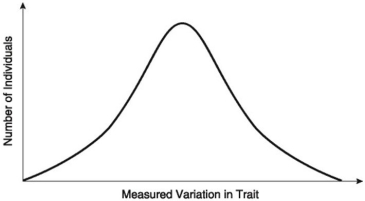 -If the curve in the above figure shifts to the left or to the right,there is no gene flow,and the population size consequently increases over successive generations.Which of the following is (are)probably occurring?
1)immigration or emigration
2)directional selection
3)adaptation
4)genetic drift
5)disruptive selection
-If the curve in the above figure shifts to the left or to the right,there is no gene flow,and the population size consequently increases over successive generations.Which of the following is (are)probably occurring?
1)immigration or emigration
2)directional selection
3)adaptation
4)genetic drift
5)disruptive selection (Multiple Choice)
4.8/5 (78)
(78) Which of the following statements about sexual selection is not true?
(Multiple Choice)
4.8/5 (74)
(74) Swine are vulnerable to infection by bird flu virus and human flu virus,which can both be present in an individual pig at the same time.When this occurs,it is possible for genes from bird flu virus and human flu virus to be combined,thereby producing a genetically distinctive virus,which can subsequently cause widespread disease.The production of new types of flu virus in the manner described above is most similar to the phenomenon of
(Multiple Choice)
5.0/5 (74)
(74) If the original finches that had been blown over to the Galápagos from South America had already been genetically different from the parental population of South American finches,even before adapting to the Galápagos,this would have been an example of
(Multiple Choice)
4.8/5 (73)
(73) Use this information to answer the following questions
Many species once roamed across large areas of continents,and for millions of years these species were "shaped" by their environment.Today,numerous species,especially large carnivores,are found in national parks and nature reserves that are isolated by hundreds or thousands of kilometres of land now occupied by humans.The cheetah is one example of a species that has shown several dramatic decreases in numbers over time,and now occupies a small fraction of its historic range.
-Captive breeding programs have the potential to save species from extinction.Which factor(s)do biologists working with captive cheetahs have to pay particular attention to and why?
(Multiple Choice)
4.8/5 (95)
(95) The following questions refer to the following paragraph.
HIV's genome of RNA includes the code for reverse transcriptase (RT),an enzyme that acts early in infection to synthesize a DNA genome from an RNA template.The HIV genome also codes for protease (PR),an enzyme that acts later in infection by cutting long viral polyproteins into smaller,functional proteins.Both RT and PR represent potential targets for antiretroviral drugs.Drugs called nucleoside analogues (NA)act against RT,whereas drugs called protease inhibitors (PI)act against PR.
-HIV has nine genes in its RNA genome.Every HIV particle contains two RNA molecules,and each molecule contains all nine genes.If,for some reason,the two RNA molecules within a single HIV particle do not have identical sequences,then which of these terms can be applied due to the existence of the nonidentical regions?
(Multiple Choice)
4.9/5 (86)
(86) In modern terminology,diversity is understood to be a result of genetic variation.Which of the following is a recognized source of variation for evolution?
(Multiple Choice)
4.9/5 (81)
(81) The restriction enzymes of bacteria protect the bacteria from successful attack by bacteriophages,whose genomes can be degraded by the restriction enzymes.The bacterial genomes are not vulnerable to these restriction enzymes because bacterial DNA is methylated.This situation selects for bacteriophages whose genomes are also methylated.As new strains of resistant bacteriophages become more prevalent,this in turn selects for bacteria whose genomes are not methylated and whose restriction enzymes instead degrade methylated DNA.The outcome of the conflict between bacteria and bacteriophage at any point in time results from
(Multiple Choice)
4.9/5 (83)
(83) Which of these variables is likely to undergo the largest change in value as the result of a mutation that introduces a brand-new allele into a population's gene pool at a locus that had formerly been fixed?
(Multiple Choice)
4.7/5 (93)
(93) Which of the following is most likely to produce an African butterfly species in the wild whose members have one of two strikingly different colour patterns?
(Multiple Choice)
4.8/5 (71)
(71) A fruit fly population has a gene with two alleles,A1 and A2.Tests show that 70% of the gametes produced in the population contain the A1 allele.If the population is in Hardy-Weinberg equilibrium,what proportion of the flies carry both A1 and A2?
(Multiple Choice)
4.8/5 (81)
(81) Use this information to answer the following questions.
You are studying three populations of birds.Population A has ten birds,of which one is brown (a recessive trait)and nine are red.Population B has 100 birds,of which ten are brown.Population C has 30 birds,and three of them are brown.
-Which population is most likely to be subject to the bottleneck effect?
(Multiple Choice)
4.9/5 (69)
(69) 
Filters
- Essay(0)
- Multiple Choice(0)
- Short Answer(0)
- True False(0)
- Matching(0)