



 Chat with AI
Exam 12: The Cell Cycle

Exam 1: Introduction: Evolution and Themes of Biology77 Questions
Exam 2: The Chemical Context of Life98 Questions
Exam 3: Water and Life92 Questions
Exam 4: Carbon and the Molecular Diversity of Life86 Questions
Exam 5: The Structure and Function of Large Biological Molecules131 Questions
Exam 6: A Tour of the Cell111 Questions
Exam 7: Membrane Structure and Function88 Questions
Exam 8: An Introduction to Metabolism92 Questions
Exam 9: Cellular Respiration and Fermentation128 Questions
Exam 10: Photosynthesis103 Questions
Exam 11: Cell Communication85 Questions
Exam 12: The Cell Cycle98 Questions
Exam 13: Meiosis and Sexual Life Cycles90 Questions
Exam 14: Mendel and the Gene Idea92 Questions
Exam 15: The Chromosomal Basis of Inheritance75 Questions
Exam 16: The Molecular Basis of Inheritance84 Questions
Exam 17: From Gene to Protein106 Questions
Exam 18: Regulation of Gene Expression116 Questions
Exam 19: Viruses71 Questions
Exam 20: DNA Tools and Biotechnology78 Questions
Exam 21: Genomes and Their Evolution64 Questions
Exam 22: Descent with Modification: A Darwinian View of Life68 Questions
Exam 23: The Evolution of Populations92 Questions
Exam 24: The Origin of Species76 Questions
Exam 25: The History of Life on Earth89 Questions
Exam 26: Phylogeny and the Tree of Life91 Questions
Exam 27: Bacteria and Archaea96 Questions
Exam 28: Protists82 Questions
Exam 29: Plant Diversity I: How Plants Colonized Land93 Questions
Exam 30: Plant Diversity II: The Evolution of Seed Plants119 Questions
Exam 31: Fungi105 Questions
Exam 32: An Overview of Animal Diversity93 Questions
Exam 33: An Introduction to Invertebrates111 Questions
Exam 34: The Origin and Evolution of Vertebrates126 Questions
Exam 35: Plant Structure,Growth,and Development82 Questions
Exam 36: Resource Acquisition and Transport in Vascular Plants100 Questions
Exam 37: Soil and Plant Nutrition99 Questions
Exam 38: Angiosperm Reproduction and Biotechnology107 Questions
Exam 39: Plant Responses to Internal and External Signals137 Questions
Exam 40: Basic Principles of Animal Form and Function98 Questions
Exam 41: Animal Nutrition87 Questions
Exam 42: Circulation and Gas Exchange112 Questions
Exam 43: The Immune System123 Questions
Exam 44: Osmoregulation and Excretion91 Questions
Exam 45: Hormones and the Endocrine System92 Questions
Exam 46: Animal Reproduction104 Questions
Exam 47: Animal Development106 Questions
Exam 48: Neurons,Synapses,and Signalling93 Questions
Exam 49: Nervous Systems85 Questions
Exam 50: Sensory and Motor Mechanisms106 Questions
Exam 51: Animal Behaviour91 Questions
Exam 52: An Introduction to Ecology and the Biosphere90 Questions
Exam 53: Population Ecology89 Questions
Exam 54: Community Ecology97 Questions
Exam 55: Ecosystems and Restoration Ecology98 Questions
Exam 56: Conservation Biology and Global Change90 Questions
Select questions type


What causes the decrease in the amount of cyclin at a specific point in the cell cycle?
(Multiple Choice)
4.8/5  (86)
(86) After which checkpoint is the cell first committed to continue the cell cycle through M?
(Multiple Choice)
4.9/5 (75)
(75) The following questions are based on the following figure.
 -G₁ is represented by which numbered part(s)of the cycle?
 (Multiple Choice)
4.8/5 (85)
(85) Measurements of the amount of DNA per nucleus were taken on a large number of cells from a growing fungus.The measured DNA levels ranged from 3 to 6 picograms per nucleus.In which stage of the cell cycle did the nucleus contain 6 picograms of DNA?
(Multiple Choice)
4.9/5 (74)
(74) A research team began a study of a cultured cell line.Their preliminary observations showed them that the cell line did not exhibit either density-dependent inhibition or anchorage dependence.What could they conclude right away?
(Multiple Choice)
4.7/5 (83)
(83) Scientists isolate cells in various phases of the cell cycle.They find a group of cells that have 1.5 times more DNA than G₁ phase cells.What phase of the cell cycle are these cells in?
(Multiple Choice)
4.8/5 (81)
(81) Which of the following is a function of those spindle microtubules that do not attach to kinetochores?
(Multiple Choice)
4.8/5 (77)
(77) Which of the following eukaryotic proteins appear to have related proteins involved in binary fission?
(Multiple Choice)
4.8/5 (74)
(74) Exposure of zebrafish nuclei to meiotic cytosol resulted in phosphorylation of NEP55 and L68 proteins by cyclin-dependent kinase 2.NEP55 is a protein of the inner nuclear membrane,and L68 is a protein of the nuclear lamina.What is the most likely role of phosphorylation of these proteins in the process of mitosis?
(Multiple Choice)
4.9/5 (61)
(61) Density-dependent inhibition depends on the binding of a cell-surface protein to its counterpart on an adjoining cell's surface.A growth inhibiting signal is sent to both cells,preventing them from dividing.Certain external physical factors can affect this inhibition mechanism.Select the statement that makes a correct prediction about natural phenomena that could occur during the cell cycle to prevent cell growth.
(Multiple Choice)
5.0/5 (73)
(73) FtsZ is a bacterial cytoskeletal protein that forms a contractile ring involved in bacterial cytokinesis.What is its function analogous to?
(Multiple Choice)
4.7/5 (86)
(86) Use the following information to answer the questions below.
The lettered circle in the figure below shows a diploid nucleus with four chromosomes.There are two pairs of homologous chromosomes,one long and the other short.One haploid set is symbolized as black and the other haploid set is grey.The chromosomes in the unlettered circle have not yet replicated.Choose the correct chromosomal conditions for the following stages.
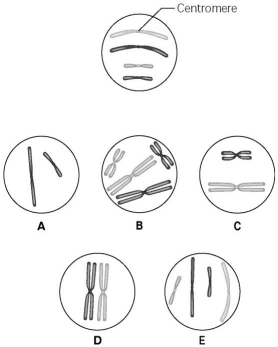 -What is the correct chromosomal condition for one daughter nucleus at telophase of mitosis?
 (Multiple Choice)
4.9/5 (67)
(67) How is plant cell cytokinesis different from animal cell cytokinesis?
(Multiple Choice)
4.9/5 (77)
(77) In which group of eukaryotic organisms does the nuclear envelope remain intact during mitosis?
(Multiple Choice)
4.8/5 (72)
(72) A particular cyclin called cyclin E forms a complex with Cdk 2 (cyclin-dependent kinase 2).This complex is important for the progression of the cell from G₁ into the S phase of the cell cycle.Which of the following statements is correct?
(Multiple Choice)
4.8/5 (74)
(74) Nucleotides can be radiolabelled before they are incorporated into newly forming DNA and can therefore be assayed to track their incorporation.In a set of experiments,a student-faculty research team used labelled T nucleotides and introduced these into the culture of dividing human cells at specific times.
-Once they had determined which cells were dividing,the team wanted to use a non-radioactive method to track whether various physiological factors (such as food or body temperature)affected the action of the pathogen.Which of the following would be effective,simple,and safe?
(Multiple Choice)
4.8/5 (69)
(69) 
Filters
- Essay(0)
- Multiple Choice(0)
- Short Answer(0)
- True False(0)
- Matching(0)