



 Chat with AI
Exam 10: Photosynthesis

Exam 1: Introduction: Evolution and Themes of Biology77 Questions
Exam 2: The Chemical Context of Life98 Questions
Exam 3: Water and Life92 Questions
Exam 4: Carbon and the Molecular Diversity of Life86 Questions
Exam 5: The Structure and Function of Large Biological Molecules131 Questions
Exam 6: A Tour of the Cell111 Questions
Exam 7: Membrane Structure and Function88 Questions
Exam 8: An Introduction to Metabolism92 Questions
Exam 9: Cellular Respiration and Fermentation128 Questions
Exam 10: Photosynthesis103 Questions
Exam 11: Cell Communication85 Questions
Exam 12: The Cell Cycle98 Questions
Exam 13: Meiosis and Sexual Life Cycles90 Questions
Exam 14: Mendel and the Gene Idea92 Questions
Exam 15: The Chromosomal Basis of Inheritance75 Questions
Exam 16: The Molecular Basis of Inheritance84 Questions
Exam 17: From Gene to Protein106 Questions
Exam 18: Regulation of Gene Expression116 Questions
Exam 19: Viruses71 Questions
Exam 20: DNA Tools and Biotechnology78 Questions
Exam 21: Genomes and Their Evolution64 Questions
Exam 22: Descent with Modification: A Darwinian View of Life68 Questions
Exam 23: The Evolution of Populations92 Questions
Exam 24: The Origin of Species76 Questions
Exam 25: The History of Life on Earth89 Questions
Exam 26: Phylogeny and the Tree of Life91 Questions
Exam 27: Bacteria and Archaea96 Questions
Exam 28: Protists82 Questions
Exam 29: Plant Diversity I: How Plants Colonized Land93 Questions
Exam 30: Plant Diversity II: The Evolution of Seed Plants119 Questions
Exam 31: Fungi105 Questions
Exam 32: An Overview of Animal Diversity93 Questions
Exam 33: An Introduction to Invertebrates111 Questions
Exam 34: The Origin and Evolution of Vertebrates126 Questions
Exam 35: Plant Structure,Growth,and Development82 Questions
Exam 36: Resource Acquisition and Transport in Vascular Plants100 Questions
Exam 37: Soil and Plant Nutrition99 Questions
Exam 38: Angiosperm Reproduction and Biotechnology107 Questions
Exam 39: Plant Responses to Internal and External Signals137 Questions
Exam 40: Basic Principles of Animal Form and Function98 Questions
Exam 41: Animal Nutrition87 Questions
Exam 42: Circulation and Gas Exchange112 Questions
Exam 43: The Immune System123 Questions
Exam 44: Osmoregulation and Excretion91 Questions
Exam 45: Hormones and the Endocrine System92 Questions
Exam 46: Animal Reproduction104 Questions
Exam 47: Animal Development106 Questions
Exam 48: Neurons,Synapses,and Signalling93 Questions
Exam 49: Nervous Systems85 Questions
Exam 50: Sensory and Motor Mechanisms106 Questions
Exam 51: Animal Behaviour91 Questions
Exam 52: An Introduction to Ecology and the Biosphere90 Questions
Exam 53: Population Ecology89 Questions
Exam 54: Community Ecology97 Questions
Exam 55: Ecosystems and Restoration Ecology98 Questions
Exam 56: Conservation Biology and Global Change90 Questions
Select questions type


In metabolic processes of cell respiration and photosynthesis,what do the prosthetic groups such as heme and iron-sulphur complexes in components of the electron transport chain do?
(Multiple Choice)
4.7/5  (72)
(72) Halobacterium has a photosynthetic membrane that is coloured purple.Its photosynthetic action spectrum is exactly complementary (opposite to)the action spectrum for green plants.What wavelengths of light do the Halobacterium photosynthetic pigments absorb?
(Multiple Choice)
4.9/5 (85)
(85) Use the following figure to answer the questions below.
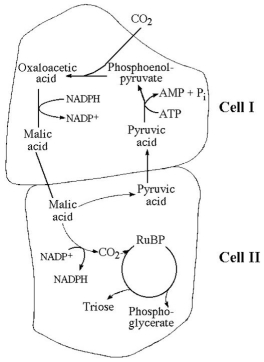 -Referring to the figure above,oxygen would inhibit the CO₂ fixation reactions in
 (Multiple Choice)
4.8/5 (76)
(76) When pigments in an excited state relax back to ground state,they
(Multiple Choice)
4.8/5 (76)
(76) Use the following information to answer the questions below.
Theodor W.Engelmann illuminated a filament of algae with light that passed through a prism,thus exposing different segments of algae to different wavelengths of light.He added aerobic bacteria and then noted in which areas the bacteria congregated.He noted that the largest groups were found in the areas illuminated by the red and blue light.
-What did Engelmann conclude about the congregation of bacteria in the red and blue areas?
(Multiple Choice)
4.8/5 (74)
(74) Which of the following statements best represents the relationships between the light reactions and the Calvin cycle?
(Multiple Choice)
4.9/5 (75)
(75) Generation of proton gradients across membranes occurs during
(Multiple Choice)
4.8/5 (73)
(73) As electrons are passed through the system of electron carriers associated with photosystem II,they lose energy.What happens to this energy?
(Multiple Choice)
4.8/5 (78)
(78) Which of the following sequences correctly represents the flow of electrons during photosynthesis?
(Multiple Choice)
4.9/5 (73)
(73) Use the following information to answer the questions below.
You have learned about research conducted during the 1930s by van Niel,who studied photosynthesis in bacteria,which were observed to not release O₂ even though they fixed CO₂.
-From his experiments,van Niel concluded that
(Multiple Choice)
4.8/5 (78)
(78) Where do the oxygen molecules come from in the O₂ produced by photosynthesis?
(Multiple Choice)
4.7/5 (77)
(77) It is a particularly hot,dry summer.The town has banned excessive water use and so you cannot water your lawn.After a few weeks the grass has gone brown,except a few patches where the grass seems to be doing fine.You notice that this grass has a broader leaf and is not the same species as most of your lawn.You conclude that this grass is a
(Multiple Choice)
4.7/5 (82)
(82) In C₃ photosynthesis,the reactions that require ATP take place in
(Multiple Choice)
4.9/5 (89)
(89) 
Filters
- Essay(0)
- Multiple Choice(0)
- Short Answer(0)
- True False(0)
- Matching(0)