



 Chat with AI
Exam 15: Monopoly

Exam 1: Ten Principles of Economics455 Questions
Exam 2: Thinking Like an Economist645 Questions
Exam 3: Interdependence and the Gains From Trade550 Questions
Exam 4: The Market Forces of Supply and Demand693 Questions
Exam 5: Elasticity and Its Application625 Questions
Exam 6: Supply, Demand, and Government Policies671 Questions
Exam 7: Consumers, Producers, and the Efficiency of Markets547 Questions
Exam 8: Application: The Costs of Taxation507 Questions
Exam 9: Application: International Trade521 Questions
Exam 10: Externalities543 Questions
Exam 11: Public Goods and Common Resources453 Questions
Exam 12: The Design of the Tax System563 Questions
Exam 13: The Costs of Production649 Questions
Exam 14: Firms in Competitive Markets608 Questions
Exam 15: Monopoly662 Questions
Exam 16: Monopolistic Competition649 Questions
Exam 17: Oligopoly522 Questions
Exam 18: The Markets for the Factors of Production592 Questions
Exam 19: Earnings and Discrimination511 Questions
Exam 20: Income Inequality and Poverty478 Questions
Exam 21: The Theory of Consumer Choice568 Questions
Exam 22: Frontiers in Microeconomics461 Questions
Select questions type


Which of the following is not an example of a barrier to entry?
(Multiple Choice)
4.8/5  (66)
(66) Figure 15-2 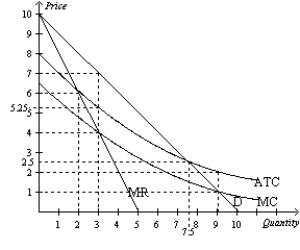 -Refer to Figure 15-2. If the firm profit-maximizes, how much profit will it earn?
 (Short Answer)
4.9/5 (78)
(78) For a monopolist, when does marginal revenue exceed average revenue?
(Multiple Choice)
4.9/5 (87)
(87) Which of the following is not one of the ways that antitrust laws promote competition?
(Multiple Choice)
4.9/5 (94)
(94) Which of the following is not a difference between monopolies and perfectly competitive markets?
(Multiple Choice)
4.9/5 (66)
(66) Comparing firms in perfectly competitive markets to monopoly firms, which results in a deadweight loss?
(Short Answer)
4.9/5 (81)
(81) Scenario 15-4
Suppose a monopolist has a demand curve that can be expressed as P=90-Q. The monopolist's marginal revenue curve can be expressed as MR=90-2Q. The monopolist has constant marginal costs and average total costs of $10.
-Refer to Scenario 15-4. The profit-maximizing monopolist will charge a price of
(Multiple Choice)
4.9/5 (85)
(85) When a certain monopoly sets its price at $8 it sells 64 units. When the monopoly sets its price at $10 it sells 60 units. The marginal revenue for the firm over this range is
(Multiple Choice)
4.7/5 (73)
(73) Table 15-4
A monopolist faces the following demand curve: 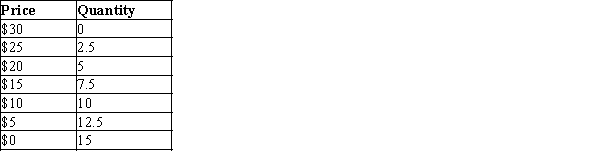 -Refer to Table 15-4. If the monopolist produces 10 units, what is its average revenue?
 (Multiple Choice)
4.8/5 (99)
(99) Figure 15-3 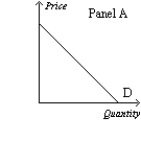
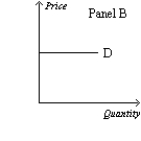
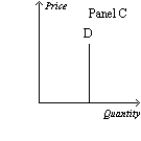
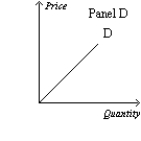 -Refer to Figure 15-3. Which of the following statements is correct?
 (Multiple Choice)
4.7/5 (81)
(81) Table 15-5
A monopolist faces the following demand curve: 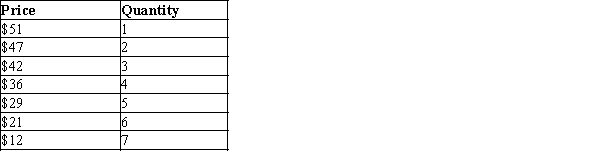 -Refer to Table 15-5. The monopolist has total fixed costs of $60 and has a constant marginal cost of $15. What is the profit-maximizing level of production?
 (Multiple Choice)
4.9/5 (89)
(89) Scenario 15-1
Vincent operates a scenic tour business in Boston. He has one bus which can fit 50 people per tour and each tour lasts 2 hours. His total cost of operating one tour is fixed at $450. Vincent's cost is not reduced if he runs a tour with a partially full bus. While his cost is the same for all tours, Vincent charges each passenger his/her willingness to pay: adults $18 per trip, children $10 per trip, and senior citizens $12 per trip. At those rates, on a typical day Vincent's demand is:  Assume that Vincent's customers are always available for the tour; therefore, he can fill his bus for each tour as long as there is sufficient total demand for the day.
-Refer to Scenario 15-1. Vincent uses a pricing practice called
Assume that Vincent's customers are always available for the tour; therefore, he can fill his bus for each tour as long as there is sufficient total demand for the day.
-Refer to Scenario 15-1. Vincent uses a pricing practice called (Short Answer)
4.7/5 (88)
(88) 
Filters
- Essay(0)
- Multiple Choice(0)
- Short Answer(0)
- True False(0)
- Matching(0)