



 Chat with AI
Exam 15: Monopoly

Exam 1: Ten Principles of Economics455 Questions
Exam 2: Thinking Like an Economist645 Questions
Exam 3: Interdependence and the Gains From Trade550 Questions
Exam 4: The Market Forces of Supply and Demand693 Questions
Exam 5: Elasticity and Its Application625 Questions
Exam 6: Supply, Demand, and Government Policies671 Questions
Exam 7: Consumers, Producers, and the Efficiency of Markets547 Questions
Exam 8: Application: The Costs of Taxation507 Questions
Exam 9: Application: International Trade521 Questions
Exam 10: Externalities543 Questions
Exam 11: Public Goods and Common Resources453 Questions
Exam 12: The Design of the Tax System563 Questions
Exam 13: The Costs of Production649 Questions
Exam 14: Firms in Competitive Markets608 Questions
Exam 15: Monopoly662 Questions
Exam 16: Monopolistic Competition649 Questions
Exam 17: Oligopoly522 Questions
Exam 18: The Markets for the Factors of Production592 Questions
Exam 19: Earnings and Discrimination511 Questions
Exam 20: Income Inequality and Poverty478 Questions
Exam 21: The Theory of Consumer Choice568 Questions
Exam 22: Frontiers in Microeconomics461 Questions
Select questions type


If a pharmaceutical company discovers a new drug and successfully patents it, patent law gives the firm
(Multiple Choice)
4.9/5  (94)
(94) The practice of selling the same goods to different customers at different prices, but with the same marginal cost, is known as
(Multiple Choice)
4.9/5 (85)
(85) Figure 15-2 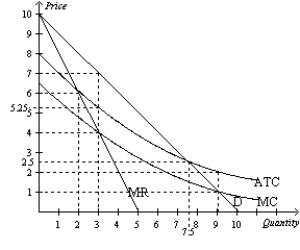 -Refer to Figure 15-2. If a regulator requires the firm to charge an average cost price, what quantity will the firm produce?
 (Short Answer)
4.9/5 (74)
(74) If the government regulates the price a natural monopolist can charge to be equal to the firm's average total cost, the firm has no incentive to reduce costs.
(True/False)
4.8/5 (80)
(80) Table 15-19
A monopolist faces the following demand curve: 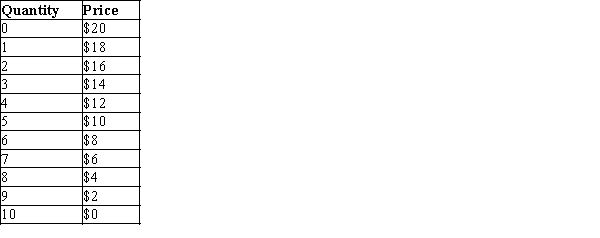 -Refer to Table 15-19. If a monopolist faces a constant marginal cost of $5, how much output should the firm produce in order to equate marginal revenue with marginal cost?
 (Multiple Choice)
4.8/5 (81)
(81) Which of the following is an example of a barrier to entry?
(Multiple Choice)
4.9/5 (88)
(88) Which of the following is not an example of a barrier to entry?
(Multiple Choice)
4.9/5 (80)
(80) Table 15-21
Tommy's Tie Company, a monopolist, has the following cost and revenue information. Assume that Tommy's is able to engage in perfect price discrimination. 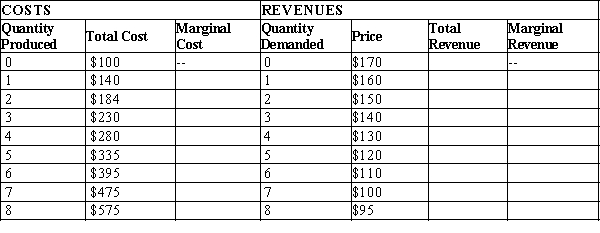 -Refer to Table 15-21. What are Tommy's Ties Company's fixed costs?
 (Multiple Choice)
4.9/5 (67)
(67) A monopolist that can practice perfect price discrimination will not impose a deadweight loss on society.
(True/False)
4.8/5 (82)
(82) The socially efficient quantity is found where the demand curve intersects the marginal cost curve.
(True/False)
5.0/5 (75)
(75) Deadweight loss measures the loss in society's welfare that occurs because a monopolist can earn profits without the concern of new firms entering its industry.
(True/False)
4.7/5 (72)
(72) Figure 15-3 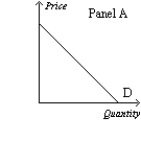
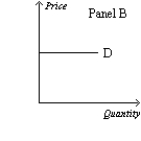
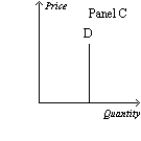
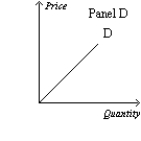 -Refer to Figure 15-3. Which of the following statements is correct?
 (Multiple Choice)
4.8/5 (86)
(86) Movie theatres charge different prices to different groups of people based on the differing marginal costs that exist from group to group.
(True/False)
4.8/5 (79)
(79) Table 15-3
Consider the following demand and cost information for a monopoly. 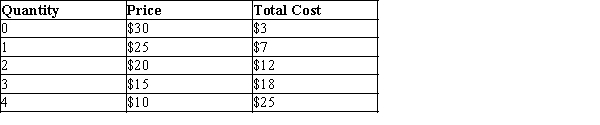 -Refer to Table 15-3. To maximize profit, the monopolist sets price at
 (Multiple Choice)
4.7/5 (64)
(64) Figure 15-22
The diagram depicts the market situation for a monopoly pastry shop called Bearclaws. 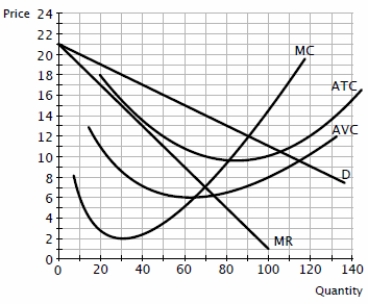 -Refer to Figure 15-22. Based upon the information shown, how many units will Bearclaws produce to maximize profits?
 (Multiple Choice)
4.7/5 (88)
(88) Table 15-12
The following table provides information on the price, quantity, and average total cost for a monopoly. 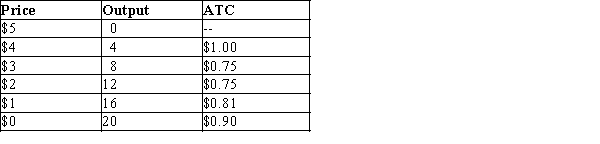 -Refer to Table 15-12. In order to maximize profits, the firm should produce
 (Multiple Choice)
4.7/5 (77)
(77) Because a monopolist does not face competition from other firms, the outcome in a market with a monopoly
(Multiple Choice)
5.0/5 (81)
(81) If a monopolist's marginal costs increase by $1 for all levels of output, then the monopoly price will
(Multiple Choice)
4.9/5 (73)
(73) 
Filters
- Essay(0)
- Multiple Choice(0)
- Short Answer(0)
- True False(0)
- Matching(0)