



 Chat with AI
Exam 15: Monopoly

Exam 1: Ten Principles of Economics455 Questions
Exam 2: Thinking Like an Economist645 Questions
Exam 3: Interdependence and the Gains From Trade550 Questions
Exam 4: The Market Forces of Supply and Demand693 Questions
Exam 5: Elasticity and Its Application625 Questions
Exam 6: Supply, Demand, and Government Policies671 Questions
Exam 7: Consumers, Producers, and the Efficiency of Markets547 Questions
Exam 8: Application: The Costs of Taxation507 Questions
Exam 9: Application: International Trade521 Questions
Exam 10: Externalities543 Questions
Exam 11: Public Goods and Common Resources453 Questions
Exam 12: The Design of the Tax System563 Questions
Exam 13: The Costs of Production649 Questions
Exam 14: Firms in Competitive Markets608 Questions
Exam 15: Monopoly662 Questions
Exam 16: Monopolistic Competition649 Questions
Exam 17: Oligopoly522 Questions
Exam 18: The Markets for the Factors of Production592 Questions
Exam 19: Earnings and Discrimination511 Questions
Exam 20: Income Inequality and Poverty478 Questions
Exam 21: The Theory of Consumer Choice568 Questions
Exam 22: Frontiers in Microeconomics461 Questions
Select questions type


Copyrights and patents are examples of barriers to entry that give firms monopoly pricing powers.
(True/False)
5.0/5  (97)
(97) For a monopoly, marginal revenue is often greater than the price it charges for its good.
(True/False)
4.8/5 (83)
(83) State one benefit of government-granted monopolies like patents and copyrights.
(Short Answer)
4.9/5 (77)
(77) Figure 15-20 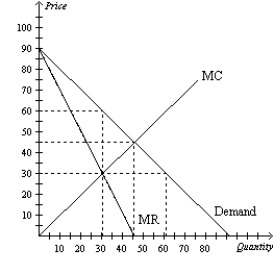 -Refer to Figure 15-20. The consumer surplus at the monopolist's profit-maximizing price is
 (Multiple Choice)
4.8/5 (84)
(84) During the holiday season, high-end retailers frequently place a high price on merchandise on weekends and discount the price during the week. They do this because they believe that two groups of customers exist: shoppers with little free time and bargain hunters. Bargain hunters have time to shop around and frequently shop during the week. What do economists call this price strategy used by high-end retailers?
(Multiple Choice)
4.9/5 (82)
(82) Suppose when a monopolist produces 75 units its average revenue is $10 per unit, its marginal revenue is $5 per unit, its marginal cost is $6 per unit, and its average total cost is $5 per unit. What can we conclude about this monopolist?
(Multiple Choice)
4.8/5 (76)
(76) Comparing firms in perfectly competitive markets to monopoly firms, which charges a price equal to marginal cost?
(Short Answer)
4.9/5 (80)
(80) Table 15-21
Tommy's Tie Company, a monopolist, has the following cost and revenue information. Assume that Tommy's is able to engage in perfect price discrimination. 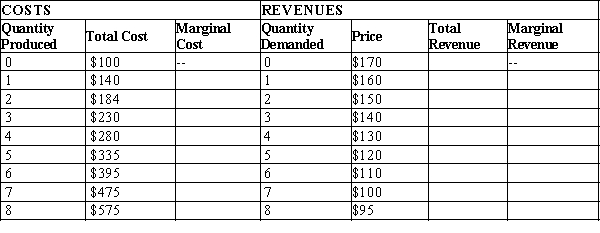 -Refer to Table 15-21. If the monopolist can engage in perfect price discrimination, what is the average revenue when 7 ties are sold?
 (Multiple Choice)
4.9/5 (87)
(87) At the profit-maximizing quantity of output for a monopolist, average revenue, marginal revenue, and price are all equal.
(True/False)
4.9/5 (80)
(80) When a local grocery store offers discount coupons in the Sunday paper it is most likely trying to
(Multiple Choice)
4.9/5 (76)
(76) Figure 15-9 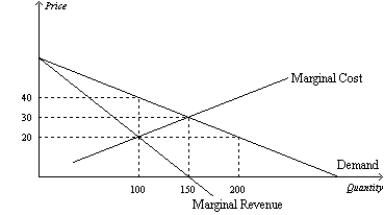 -Refer to Figure 15-9. The deadweight loss caused by a profit-maximizing monopoly amounts to
 (Multiple Choice)
4.8/5 (86)
(86) In order for antitrust laws to raise social welfare, the government must
(Multiple Choice)
4.8/5 (64)
(64) Figure 15-3 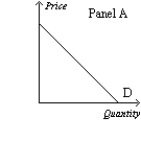
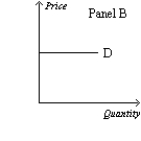
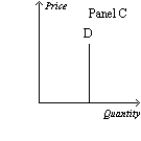
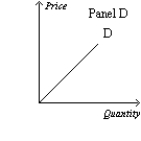 -Refer to Figure 15-3. Which panel could represent the demand curve facing a local cable television provider if that firm in a monopolist?
 (Multiple Choice)
4.8/5 (87)
(87) If the distribution of water is a natural monopoly, then (i)
Multiple firms would likely each have to pay large fixed costs to develop their own network of pipes.
(ii)
Allowing for competition among different firms in the water-distribution industry is efficient.
(iii)
A single firm can serve the market at the lowest possible average total cost.
(Multiple Choice)
4.8/5 (78)
(78) If the government regulates the price that a natural monopolist can charge to be equal to the firm's marginal cost, the firm will
(Multiple Choice)
5.0/5 (81)
(81) When a monopolist increases the quantity that it sells, price decreases, which, all else equal, decreases total revenue; this is called the price effect.
(True/False)
4.8/5 (95)
(95) Table 15-8
The following table provides information on the price, quantity, and average total cost for a monopoly. 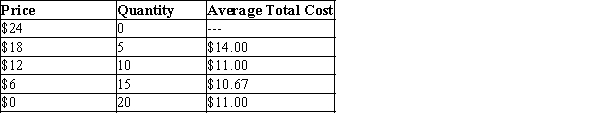 -Refer to Table 15-8. What is the additional cost to the firm when the monopolist lowers the price from $18 to $12?
 (Multiple Choice)
4.9/5 (79)
(79) Table 15-11
The following table shows quantity, price, and marginal cost information for a monopoly: 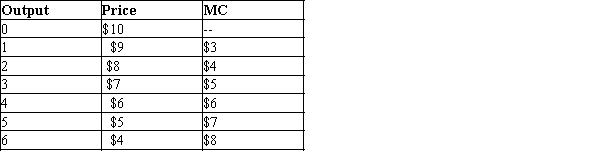 -Refer to Table 15-11. What level of output should the firm produce to maximize its profit?
 (Multiple Choice)
4.8/5 (77)
(77) 
Filters
- Essay(0)
- Multiple Choice(0)
- Short Answer(0)
- True False(0)
- Matching(0)