



 Chat with AI
Exam 15: Monopoly

Exam 1: Ten Principles of Economics455 Questions
Exam 2: Thinking Like an Economist645 Questions
Exam 3: Interdependence and the Gains From Trade550 Questions
Exam 4: The Market Forces of Supply and Demand693 Questions
Exam 5: Elasticity and Its Application625 Questions
Exam 6: Supply, Demand, and Government Policies671 Questions
Exam 7: Consumers, Producers, and the Efficiency of Markets547 Questions
Exam 8: Application: The Costs of Taxation507 Questions
Exam 9: Application: International Trade521 Questions
Exam 10: Externalities543 Questions
Exam 11: Public Goods and Common Resources453 Questions
Exam 12: The Design of the Tax System563 Questions
Exam 13: The Costs of Production649 Questions
Exam 14: Firms in Competitive Markets608 Questions
Exam 15: Monopoly662 Questions
Exam 16: Monopolistic Competition649 Questions
Exam 17: Oligopoly522 Questions
Exam 18: The Markets for the Factors of Production592 Questions
Exam 19: Earnings and Discrimination511 Questions
Exam 20: Income Inequality and Poverty478 Questions
Exam 21: The Theory of Consumer Choice568 Questions
Exam 22: Frontiers in Microeconomics461 Questions
Select questions type


Scenario 15-4
Suppose a monopolist has a demand curve that can be expressed as P=90-Q. The monopolist's marginal revenue curve can be expressed as MR=90-2Q. The monopolist has constant marginal costs and average total costs of $10.
-Refer to Scenario 15-4. The profit-maximizing monopolist will earn profits of
(Multiple Choice)
4.7/5  (62)
(62) Because many good substitutes exist for a competitive firm's product, the demand curve that it faces is
(Multiple Choice)
4.9/5 (81)
(81) Table 15-1 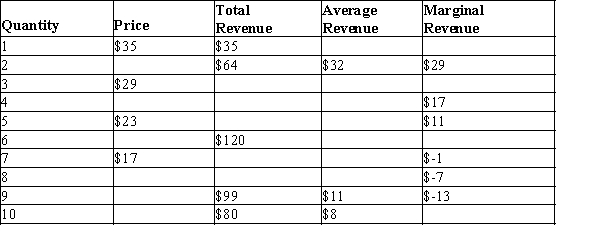 -Refer to Table 15-1. Assume this monopolist's marginal cost is constant at $12. What quantity of output (Q) will it produce and what price (P) will it charge?
 (Multiple Choice)
5.0/5 (68)
(68) Scenario 15-9
Suppose executives at an art museum know that 100 adults are willing to pay $12 for admission to the museum on a weekday. Suppose the executives also know that 200 students are willing to pay $8 for admission on a weekday. The cost of operating the museum on a weekday is $2,000.
-Refer to Scenario 15-9. How much profit will the museum earn if it engages in price discrimination?
(Multiple Choice)
4.7/5 (75)
(75) Which of the following is not a reason for the existence of a monopoly?
(Multiple Choice)
4.8/5 (98)
(98) The De Beers Diamond company is not worried about differentiating its product from all other gemstones.
(True/False)
4.8/5 (77)
(77) Figure 15-3 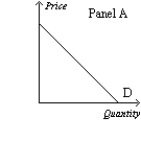
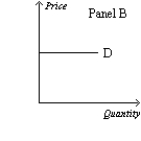
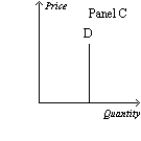
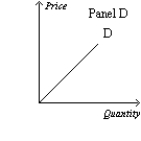 -Refer to Figure 15-3. Which of the following statements is correct?
 (Multiple Choice)
4.8/5 (80)
(80) Figure 15-4 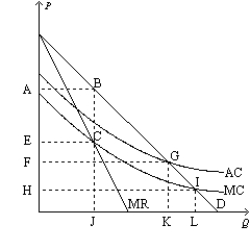 -Refer to Figure 15-4. If this firm profit maximizes, which letter represents the quantity it will produce?
 (Short Answer)
4.9/5 (86)
(86) Authors are allowed to be monopolists in the sale of their books in order to
(Multiple Choice)
4.9/5 (72)
(72) Figure 15-19 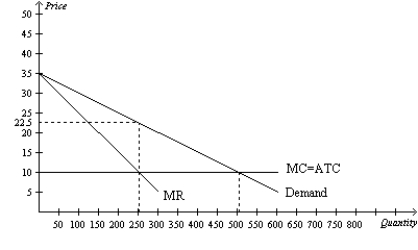 -Refer to Figure 15-19. If the monopoly firm is not allowed to price discriminate, then the deadweight loss amounts to
 (Multiple Choice)
4.7/5 (86)
(86) During the life of a drug patent, the monopoly pharmaceutical firm maximizes profit by producing the quantity at which marginal revenue equals marginal cost.
(True/False)
4.9/5 (82)
(82) Scenario 15-10
Vincent operates a scenic tour business in Boston. He has one bus which can fit 50 people per tour and each tour lasts 2 hours. His total cost of operating one tour is fixed at $450. Vincent's cost is not reduced if he runs a tour with a partially full bus. While his cost is the same for all tours, Vincent charges each passenger his/her willingness to pay: adults $18 per trip, children $10 per trip, and senior citizens $12 per trip. At those rates, on a typical day Vincent's demand is:  Assume that Vincent's customers are always available for the tour; therefore, he can fill his bus for each tour as long as there is sufficient total demand for the day.
-Refer to Scenario 15-10. What is Vincent's profit on a typical day?
Assume that Vincent's customers are always available for the tour; therefore, he can fill his bus for each tour as long as there is sufficient total demand for the day.
-Refer to Scenario 15-10. What is Vincent's profit on a typical day? (Multiple Choice)
4.9/5 (73)
(73) When there are economies of scale over the relevant range of output for a monopoly, the monopoly
(Multiple Choice)
4.9/5 (91)
(91) Even with market power, monopolists cannot achieve any level of profit they desire because they will sell lower quantities at higher prices.
(True/False)
4.8/5 (87)
(87) When we compare economic welfare in a monopoly market to a competitive market, the profits earned by the monopolist represent
(Multiple Choice)
4.9/5 (81)
(81) Suppose that the DeBeers company faces very little competition from other firms in the wholesale diamond market. Why isn't the price of wholesale diamonds $10,000 per carat?
(Multiple Choice)
4.9/5 (84)
(84) When a monopolist increases the amount of output that it produces and sells, the price of its output
(Multiple Choice)
4.9/5 (61)
(61) 
Filters
- Essay(0)
- Multiple Choice(0)
- Short Answer(0)
- True False(0)
- Matching(0)