



 Chat with AI
Exam 15: Monopoly

Exam 1: Ten Principles of Economics455 Questions
Exam 2: Thinking Like an Economist645 Questions
Exam 3: Interdependence and the Gains From Trade550 Questions
Exam 4: The Market Forces of Supply and Demand693 Questions
Exam 5: Elasticity and Its Application625 Questions
Exam 6: Supply, Demand, and Government Policies671 Questions
Exam 7: Consumers, Producers, and the Efficiency of Markets547 Questions
Exam 8: Application: The Costs of Taxation507 Questions
Exam 9: Application: International Trade521 Questions
Exam 10: Externalities543 Questions
Exam 11: Public Goods and Common Resources453 Questions
Exam 12: The Design of the Tax System563 Questions
Exam 13: The Costs of Production649 Questions
Exam 14: Firms in Competitive Markets608 Questions
Exam 15: Monopoly662 Questions
Exam 16: Monopolistic Competition649 Questions
Exam 17: Oligopoly522 Questions
Exam 18: The Markets for the Factors of Production592 Questions
Exam 19: Earnings and Discrimination511 Questions
Exam 20: Income Inequality and Poverty478 Questions
Exam 21: The Theory of Consumer Choice568 Questions
Exam 22: Frontiers in Microeconomics461 Questions
Select questions type


Table 15-9
Consider the following demand and cost information for a monopoly. 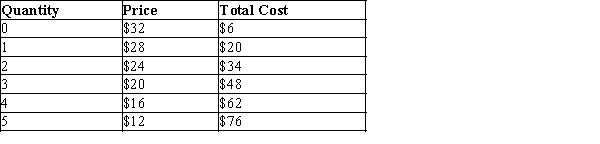 -Refer to Table 15-9. What is the monopolist's average total cost of production at the profit-maximizing price?
 (Multiple Choice)
4.9/5  (80)
(80) Which of the following is an example of a barrier to entry?
(Multiple Choice)
4.9/5 (66)
(66) Figure 15-18 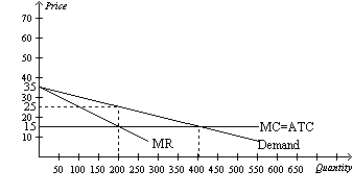 -Refer to Figure 15-18. If the monopoly firm perfectly price discriminates, then consumer surplus amounts to
 (Multiple Choice)
4.8/5 (78)
(78) The proper level of government intervention is unclear when dealing with a monopoly.
(True/False)
4.9/5 (85)
(85) Table 15-3
Consider the following demand and cost information for a monopoly. 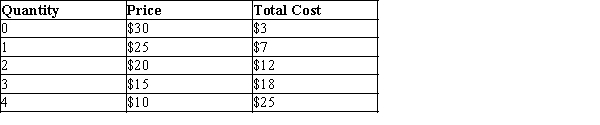 -Refer to Table 15-3. The marginal revenue of the 2nd unit is
 (Multiple Choice)
4.9/5 (94)
(94) Figure 15-2 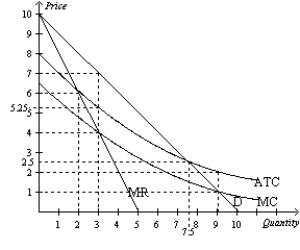 -Refer to Figure 15-2. If the firm profit-maximizes, what price will it charge?
 (Short Answer)
4.9/5 (61)
(61) Figure 15-8 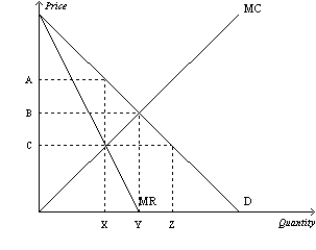 -Refer to Figure 15-8. What is the socially efficient price and quantity?
 (Multiple Choice)
4.9/5 (77)
(77) What is the defining characteristic of a natural monopoly? Give an example of a natural monopoly.
(Essay)
4.8/5 (86)
(86) Figure 15-1 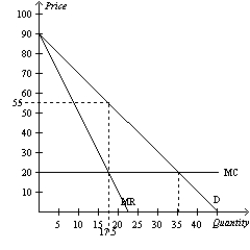 -Refer to Figure 15-1. If the monopolist uses perfect price discrimination, how much output does the firm produce?
 (Short Answer)
4.9/5 (89)
(89) Price discrimination can increase both the monopolist's profits and society's welfare.
(True/False)
5.0/5 (70)
(70) Scenario 15-4
Suppose a monopolist has a demand curve that can be expressed as P=90-Q. The monopolist's marginal revenue curve can be expressed as MR=90-2Q. The monopolist has constant marginal costs and average total costs of $10.
-Refer to Scenario 15-4. The profit-maximizing monopolist will have a deadweight loss of
(Multiple Choice)
4.9/5 (74)
(74) Table 15-12
The following table provides information on the price, quantity, and average total cost for a monopoly. 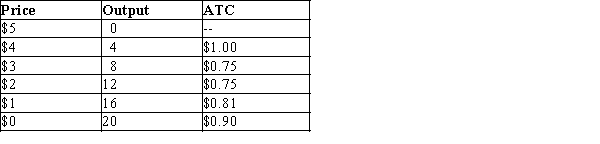 -Refer to Table 15-12. At what price will the firm maximize its profit?
 (Multiple Choice)
4.8/5 (81)
(81) Figure 15-4 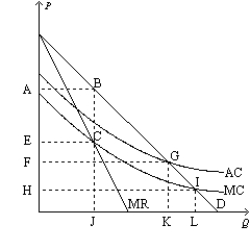 -Refer to Figure 15-4. If a regulator requires this firm to charge a socially optimal price, how much deadweight loss results?
 (Short Answer)
4.7/5 (85)
(85) A profit-maximizing monopolist charges a price of $12. The intersection of the marginal revenue and marginal cost curves occurs where output is 10 units and marginal cost is $6. Average total cost for 10 units of output is $5. What is the monopolist's profit?
(Multiple Choice)
4.9/5 (75)
(75) 
Filters
- Essay(0)
- Multiple Choice(0)
- Short Answer(0)
- True False(0)
- Matching(0)