



 Chat with AI
Exam 15: Monopoly

Exam 1: Ten Principles of Economics455 Questions
Exam 2: Thinking Like an Economist645 Questions
Exam 3: Interdependence and the Gains From Trade550 Questions
Exam 4: The Market Forces of Supply and Demand693 Questions
Exam 5: Elasticity and Its Application625 Questions
Exam 6: Supply, Demand, and Government Policies671 Questions
Exam 7: Consumers, Producers, and the Efficiency of Markets547 Questions
Exam 8: Application: The Costs of Taxation507 Questions
Exam 9: Application: International Trade521 Questions
Exam 10: Externalities543 Questions
Exam 11: Public Goods and Common Resources453 Questions
Exam 12: The Design of the Tax System563 Questions
Exam 13: The Costs of Production649 Questions
Exam 14: Firms in Competitive Markets608 Questions
Exam 15: Monopoly662 Questions
Exam 16: Monopolistic Competition649 Questions
Exam 17: Oligopoly522 Questions
Exam 18: The Markets for the Factors of Production592 Questions
Exam 19: Earnings and Discrimination511 Questions
Exam 20: Income Inequality and Poverty478 Questions
Exam 21: The Theory of Consumer Choice568 Questions
Exam 22: Frontiers in Microeconomics461 Questions
Select questions type


Table 15-4
A monopolist faces the following demand curve: 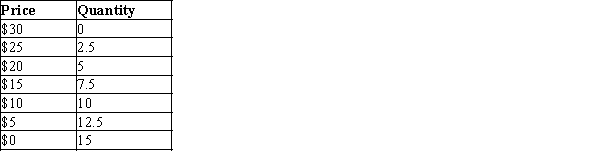 -Refer to Table 15-4. If the monopolist increases production from 2.5 to 5 units, what is its marginal revenue?
 (Multiple Choice)
4.8/5  (91)
(91) Figure 15-9 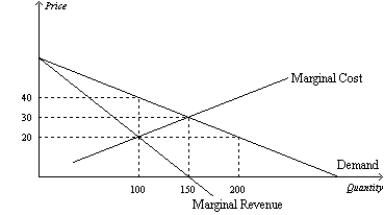 -Refer to Figure 15-9. To maximize its profit, a monopolist would choose which of the following outcomes?
 (Multiple Choice)
4.9/5 (78)
(78) Table 15-10
The monopolist faces the following demand curve: 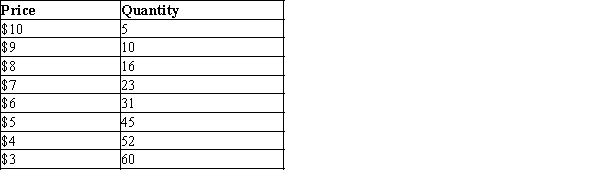 -Refer to Table 15-10. If the monopolist has total fixed costs of $40 and a constant marginal cost of $5, how much profit can the firm earn at the profit-maximizing level of output?
 (Multiple Choice)
4.9/5 (85)
(85) Scenario 15-1
Consider a transportation corporation named Reading's that has just completed the development of a new light rail system in Minneapolis. Currently, there are plenty of seats on the train, and it is never crowded. Its capacity far exceeds the needs of the city. After just a few years of operation, the shareholders of Reading's experienced incredibly high rates of return on their investment due to the profitability of the corporation.
-Refer to Scenario 15-1. Which of the following statements is most likely to be true? (i)
New entrants to the market know they will have a smaller market share than Reading's currently has.
(ii)
Reading's is most likely experiencing decreasing average total cost.
(iii)
Reading's is a natural monopoly.
(Multiple Choice)
4.9/5 (83)
(83) Because a monopolist is the sole producer in its market, it can necessarily alter the price of its good (i)
Without affecting the quantity sold.(ii)
Without affecting its average total cost.
(iii)
By adjusting the quantity it supplies to the market.
(Multiple Choice)
4.8/5 (84)
(84) Table 15-6
A monopolist faces the following demand curve: 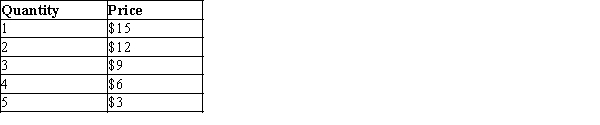 -Refer to Table 15-6. Suppose the monopolist has total fixed costs equal to $5 and a variable cost equal to $4 per unit for all units produced. What is the profit-maximizing price?
 (Multiple Choice)
4.8/5 (77)
(77) Table 15-19
A monopolist faces the following demand curve: 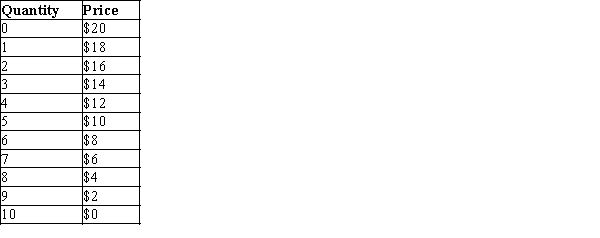 -Refer to Table 15-19. If a monopolist faces a constant marginal cost of $7, how much output should the firm produce?
 (Multiple Choice)
4.9/5 (84)
(84) Figure 15-16 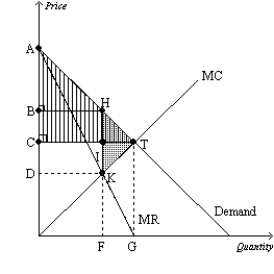 -Refer to Figure 15-16. Which triangle represents the monopoly deadweight loss?
 (Multiple Choice)
4.8/5 (67)
(67) Figure 15-20 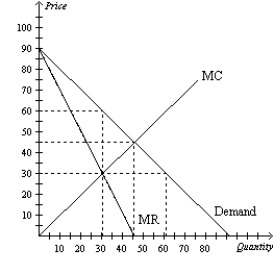 -Refer to Figure 15-20. The deadweight loss caused by a profit-maximizing monopoly amounts to
 (Multiple Choice)
4.8/5 (76)
(76) Table 15-19
A monopolist faces the following demand curve:
-Refer to Table 15-19. If a monopolist faces a constant marginal cost of $1, how much output should the firm produce in order to equate marginal revenue with marginal cost?
-Refer to Table 15-19. If a monopolist faces a constant marginal cost of $1, how much output should the firm produce in order to equate marginal revenue with marginal cost? (Multiple Choice)
5.0/5 (82)
(82) Table 15-6
A monopolist faces the following demand curve:
-Refer to Table 15-6. What is the marginal revenue from the sale of the 2nd unit?
-Refer to Table 15-6. What is the marginal revenue from the sale of the 2nd unit? (Multiple Choice)
4.9/5 (60)
(60) Figure 15-7 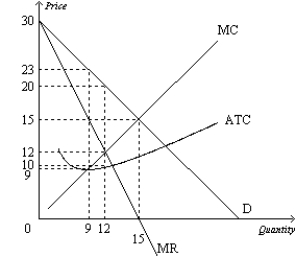 -Refer to Figure 15-7. A profit-maximizing monopolist would earn profits of
 (Multiple Choice)
4.9/5 (77)
(77) Figure 15-18 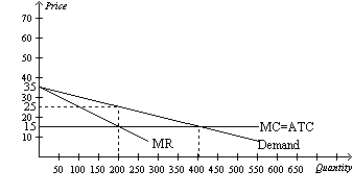 -Refer to Figure 15-18. If there are no fixed costs of production, monopoly profit with perfect price discrimination equals
 (Multiple Choice)
4.8/5 (86)
(86) One example of price discrimination occurs in the publishing industry when a publisher initially releases an expensive hardcover edition of a popular novel and later releases a cheaper paperback edition. Use this example to demonstrate the benefits and potential pitfalls of a price discrimination pricing strategy.
(Essay)
4.9/5 (72)
(72) When a monopolist reduces the quantity of output it produces and sells, the
(Multiple Choice)
4.9/5 (69)
(69) Describe how government is involved in creating a monopoly. Why might the government create one? Give an example.
(Essay)
5.0/5 (89)
(89) Table 15-13
The following table gives information on the price, quantity, and total cost of production for a monopolist. 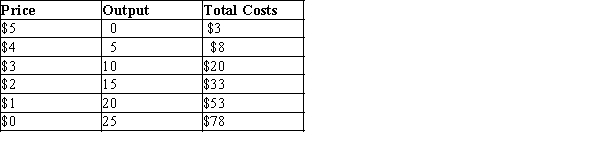 -Refer to Table 15-13. How much profit will the firm earn at the profit-maximizing price?
 (Multiple Choice)
4.8/5 (68)
(68) 
Filters
- Essay(0)
- Multiple Choice(0)
- Short Answer(0)
- True False(0)
- Matching(0)