



 Chat with AI
Exam 15: Monopoly

Exam 1: Ten Principles of Economics455 Questions
Exam 2: Thinking Like an Economist645 Questions
Exam 3: Interdependence and the Gains From Trade550 Questions
Exam 4: The Market Forces of Supply and Demand693 Questions
Exam 5: Elasticity and Its Application625 Questions
Exam 6: Supply, Demand, and Government Policies671 Questions
Exam 7: Consumers, Producers, and the Efficiency of Markets547 Questions
Exam 8: Application: The Costs of Taxation507 Questions
Exam 9: Application: International Trade521 Questions
Exam 10: Externalities543 Questions
Exam 11: Public Goods and Common Resources453 Questions
Exam 12: The Design of the Tax System563 Questions
Exam 13: The Costs of Production649 Questions
Exam 14: Firms in Competitive Markets608 Questions
Exam 15: Monopoly662 Questions
Exam 16: Monopolistic Competition649 Questions
Exam 17: Oligopoly522 Questions
Exam 18: The Markets for the Factors of Production592 Questions
Exam 19: Earnings and Discrimination511 Questions
Exam 20: Income Inequality and Poverty478 Questions
Exam 21: The Theory of Consumer Choice568 Questions
Exam 22: Frontiers in Microeconomics461 Questions
Select questions type


If the monopolist's linear demand curve intersects the quantity axis at Q = 30, then the monopolist's marginal revenue will be equal to zero at
(Multiple Choice)
4.7/5  (81)
(81) Table 15-18
A monopolist faces the following demand curve: 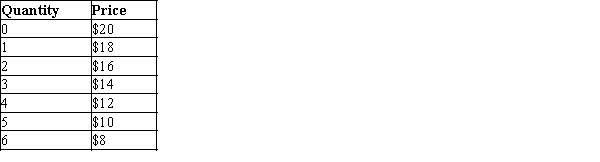 Suppose marginal cost is constant at $8 per unit.
-Refer to Table 15-18. Suppose the firm depicted in the table is selling a prescription drug for which it had a patent, but the patent has expired. As new firms enter the market and sell the generic version of this drug competitively, what quantity will be sold?
Suppose marginal cost is constant at $8 per unit.
-Refer to Table 15-18. Suppose the firm depicted in the table is selling a prescription drug for which it had a patent, but the patent has expired. As new firms enter the market and sell the generic version of this drug competitively, what quantity will be sold? (Multiple Choice)
4.9/5 (77)
(77) The economic inefficiency of a monopolist can be measured by the
(Multiple Choice)
4.9/5 (93)
(93) When a monopolist decreases the price of its good, consumers
(Multiple Choice)
4.8/5 (78)
(78) When a firm experiences continually declining average total costs, the firm is a
(Multiple Choice)
4.7/5 (91)
(91) Table 15-8
The following table provides information on the price, quantity, and average total cost for a monopoly. 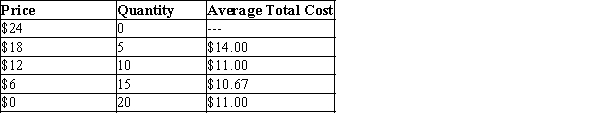 -Refer to Table 15-8. What is the maximum profit that the monopolist can earn?
 (Multiple Choice)
4.8/5 (76)
(76) Figure 15-4 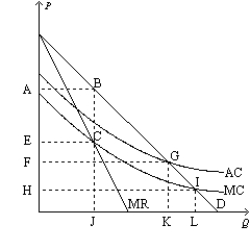 -Refer to Figure 15-4. If a regulator requires this firm to charge a socially optimal price, which letter represents the amount of output it will produce?
 (Short Answer)
4.8/5 (89)
(89) When the government creates a monopoly, the social loss may include
(Multiple Choice)
4.9/5 (84)
(84) Figure 15-19 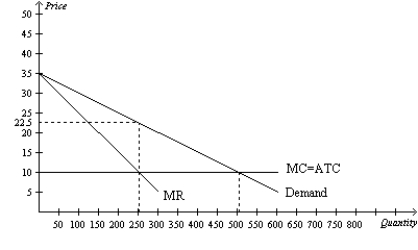 -Refer to Figure 15-19. If the monopoly firm perfectly price discriminates, then consumer surplus amounts to
 (Multiple Choice)
4.8/5 (91)
(91) Why might economists prefer private ownership of monopolies over public ownership of monopolies?
(Essay)
4.8/5 (86)
(86) Figure 15-22
The diagram depicts the market situation for a monopoly pastry shop called Bearclaws. 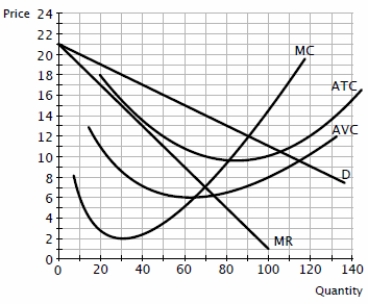 -Refer to Figure 15-22. Based upon the information shown, what is the deadweight loss created by Bearclaws?
 (Multiple Choice)
4.9/5 (82)
(82) Scenario 15-6
The concert promoters of a heavy-metal band, WeR2Loud, know that there are two types of concert-goers: die-hard fans and casual fans. For a particular WeR2Loud concert, there are 1,000 die-hard fans who will pay $150 for a ticket and 500 casual fans who will pay $50 for a ticket. There are 1,500 seats available at the concert venue. Suppose the cost of putting on the concert is $50,000, which includes the cost of the band, lighting, security, etc.
-Refer to Scenario 15-6. How much profit will the concert promoters earn if they set the price of each ticket at $50?
(Multiple Choice)
4.8/5 (80)
(80) Natural monopolies differ from other forms of monopoly because they are
(Multiple Choice)
4.8/5 (89)
(89) Perfect price discrimination describes a situation in which the monopolist
(Multiple Choice)
4.9/5 (74)
(74) Suppose a profit-maximizing monopolist faces a constant marginal cost of $10, produces an output level of 100 units, and charges a price of $50. The socially efficient level of output is 200 units. Assume that the demand curve and marginal revenue curve are the typical downward-sloping straight lines. The monopoly deadweight loss equals $2,000.
(True/False)
4.8/5 (64)
(64) A monopoly chooses to supply the market with a quantity of a product that is determined by the intersection of the
(Multiple Choice)
5.0/5 (63)
(63) It is difficult in a natural monopoly market for the firm to achieve both efficiency and zero economic profit simultaneously, even with regulation.
(True/False)
4.7/5 (91)
(91) 
Filters
- Essay(0)
- Multiple Choice(0)
- Short Answer(0)
- True False(0)
- Matching(0)