



 Chat with AI
Exam 15: Monopoly

Exam 1: Ten Principles of Economics455 Questions
Exam 2: Thinking Like an Economist645 Questions
Exam 3: Interdependence and the Gains From Trade550 Questions
Exam 4: The Market Forces of Supply and Demand693 Questions
Exam 5: Elasticity and Its Application625 Questions
Exam 6: Supply, Demand, and Government Policies671 Questions
Exam 7: Consumers, Producers, and the Efficiency of Markets547 Questions
Exam 8: Application: The Costs of Taxation507 Questions
Exam 9: Application: International Trade521 Questions
Exam 10: Externalities543 Questions
Exam 11: Public Goods and Common Resources453 Questions
Exam 12: The Design of the Tax System563 Questions
Exam 13: The Costs of Production649 Questions
Exam 14: Firms in Competitive Markets608 Questions
Exam 15: Monopoly662 Questions
Exam 16: Monopolistic Competition649 Questions
Exam 17: Oligopoly522 Questions
Exam 18: The Markets for the Factors of Production592 Questions
Exam 19: Earnings and Discrimination511 Questions
Exam 20: Income Inequality and Poverty478 Questions
Exam 21: The Theory of Consumer Choice568 Questions
Exam 22: Frontiers in Microeconomics461 Questions
Select questions type


Table 15-6
A monopolist faces the following demand curve: 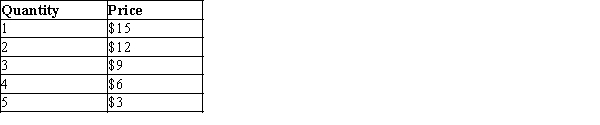 -Refer to Table 15-6. What is the marginal revenue from the sale of the 3rd unit?
 (Multiple Choice)
4.9/5  (78)
(78) Authors are allowed to be monopolists in the sale of their books in order to
(Multiple Choice)
4.8/5 (83)
(83) When a monopolist chooses the output that maximizes profits, we know that MR = MC and also that P > MR. This is inefficient because
(Multiple Choice)
4.8/5 (83)
(83) Round-trip airline tickets are usually cheaper if you stay over a Saturday night before you fly back. What is the reason for this price discrepancy?
(Multiple Choice)
4.9/5 (89)
(89) Table 15-8
The following table provides information on the price, quantity, and average total cost for a monopoly. 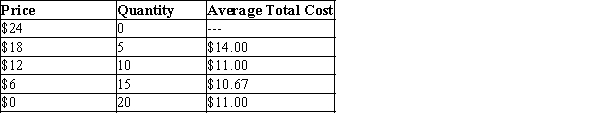 -Refer to Table 15-8. At what price will the monopolist maximize his profit?
 (Multiple Choice)
4.9/5 (74)
(74) Figure 15-17 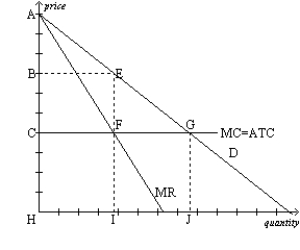 -Refer to Figure 15-17. Which of the following areas represents the deadweight loss from this profit-maximizing monopolist?
 (Multiple Choice)
4.9/5 (88)
(88) Suppose a monopolist charges a price of $27 for its product and sells 10 units at that price. At 10 units of production the firm has average fixed cost equal to $10 and average variable cost equal to $12. How much total profit is the firm earning at this price?
(Multiple Choice)
4.8/5 (72)
(72) Figure 15-8 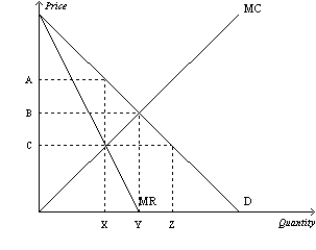 -Refer to Figure 15-8. What is the monopoly price and quantity?
 (Multiple Choice)
4.9/5 (77)
(77) Figure 15-2 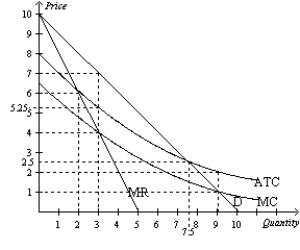 -Refer to Figure 15-2. If a regulator requires the firm to charge a marginal cost price, what quantity will the firm produce?
 (Short Answer)
4.8/5 (78)
(78) For a monopolist, when the output effect is greater than the price effect, marginal revenue is
(Multiple Choice)
4.8/5 (73)
(73) Scenario 15-9
Suppose executives at an art museum know that 100 adults are willing to pay $12 for admission to the museum on a weekday. Suppose the executives also know that 200 students are willing to pay $8 for admission on a weekday. The cost of operating the museum on a weekday is $2,000.
-Refer to Scenario 15-9. How much profit will the museum earn if it charges all customers $12 for admission?
(Multiple Choice)
4.7/5 (76)
(76) Figure 15-14 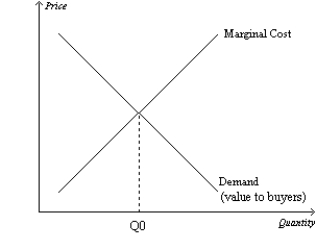 -Refer to Figure 15-14. A benevolent social planner would have the monopoly operate at an output level
 (Multiple Choice)
4.8/5 (81)
(81) Figure 15-6 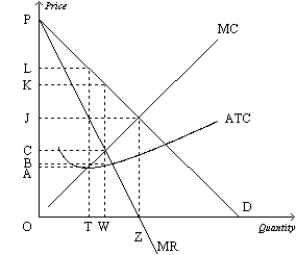 -Refer to Figure 15-6. How much output will the monopolist produce?
 (Multiple Choice)
4.9/5 (81)
(81) Figure 15-1 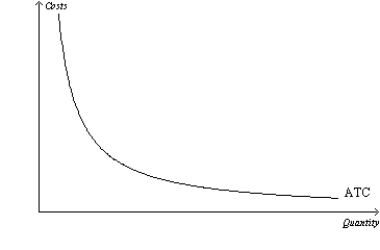 -Refer to Figure 15-1. Considering the relationship between average total cost and marginal cost, the marginal cost curve for this firm must
 (Multiple Choice)
4.8/5 (78)
(78) For a long while, electricity producers were thought to be a classic example of a natural monopoly. People held this view because
(Multiple Choice)
4.9/5 (75)
(75) 
Filters
- Essay(0)
- Multiple Choice(0)
- Short Answer(0)
- True False(0)
- Matching(0)