



 Chat with AI
Exam 15: Monopoly

Exam 1: Ten Principles of Economics455 Questions
Exam 2: Thinking Like an Economist645 Questions
Exam 3: Interdependence and the Gains From Trade550 Questions
Exam 4: The Market Forces of Supply and Demand693 Questions
Exam 5: Elasticity and Its Application625 Questions
Exam 6: Supply, Demand, and Government Policies671 Questions
Exam 7: Consumers, Producers, and the Efficiency of Markets547 Questions
Exam 8: Application: The Costs of Taxation507 Questions
Exam 9: Application: International Trade521 Questions
Exam 10: Externalities543 Questions
Exam 11: Public Goods and Common Resources453 Questions
Exam 12: The Design of the Tax System563 Questions
Exam 13: The Costs of Production649 Questions
Exam 14: Firms in Competitive Markets608 Questions
Exam 15: Monopoly662 Questions
Exam 16: Monopolistic Competition649 Questions
Exam 17: Oligopoly522 Questions
Exam 18: The Markets for the Factors of Production592 Questions
Exam 19: Earnings and Discrimination511 Questions
Exam 20: Income Inequality and Poverty478 Questions
Exam 21: The Theory of Consumer Choice568 Questions
Exam 22: Frontiers in Microeconomics461 Questions
Select questions type


Scenario 15-6
The concert promoters of a heavy-metal band, WeR2Loud, know that there are two types of concert-goers: die-hard fans and casual fans. For a particular WeR2Loud concert, there are 1,000 die-hard fans who will pay $150 for a ticket and 500 casual fans who will pay $50 for a ticket. There are 1,500 seats available at the concert venue. Suppose the cost of putting on the concert is $50,000, which includes the cost of the band, lighting, security, etc.
-Refer to Scenario 15-6. How much profit will the concert promoters earn if they engage in price discrimination?
(Multiple Choice)
4.7/5  (88)
(88) The monopolist's profit-maximizing quantity of output is determined by the intersection of which of the following two curves?
(Multiple Choice)
4.7/5 (80)
(80) Table 15-7
Sally owns the only shoe store in town. She has the following cost and revenue information. 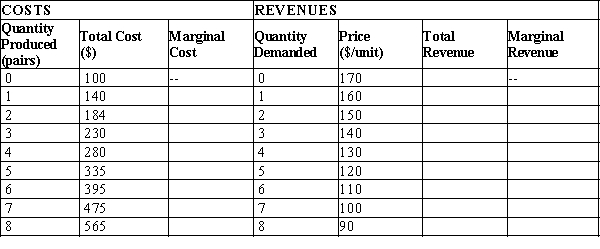 -Refer to Table 15-7. What is the marginal cost of the 8th pair of shoes?
 (Multiple Choice)
4.9/5 (60)
(60) Government intervention is always preferable to doing nothing when reducing the social inefficiencies of monopoly.
(True/False)
5.0/5 (80)
(80) Government intervention always reduces monopoly deadweight loss.
(True/False)
4.9/5 (72)
(72) Figure 15-4 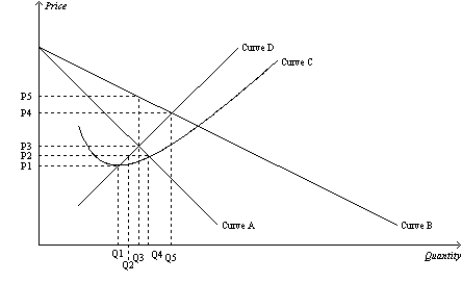 -Refer to Figure 15-4. The marginal cost curve for a monopoly firm is depicted by curve
 (Multiple Choice)
4.8/5 (75)
(75) In the majority of cases where there is a natural monopoly in the United States, the government usually deals with the problem
(Multiple Choice)
4.9/5 (80)
(80) Monopolists can practice price discrimination in all monopoly markets.
(True/False)
4.7/5 (79)
(79) Figure 15-7 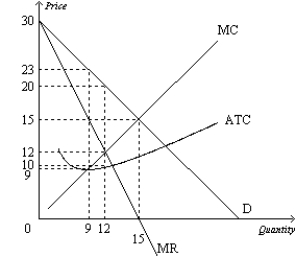 -Refer to Figure 15-7. In order to maximize profits, the monopolist should produce
 (Multiple Choice)
4.8/5 (86)
(86) Table 15-20
A monopolist faces the following demand curve: 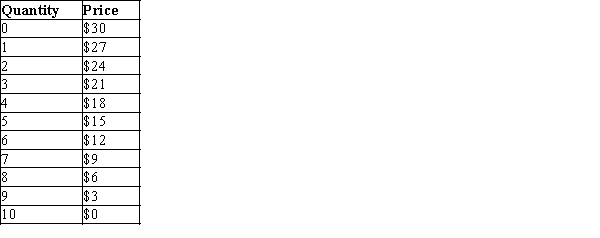 -Refer to Table 15-20. If a monopolist faces a constant marginal cost of $2, how much output should the firm produce in order to maximize profit?
 (Multiple Choice)
4.8/5 (77)
(77) Figure 15-15 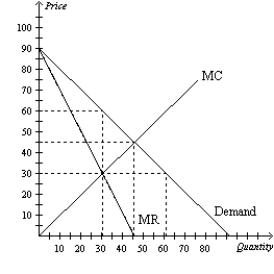 -Refer to Figure 15-15. To maximize its profit, a monopolist would choose which of the following outcomes?
 (Multiple Choice)
4.9/5 (84)
(84) Average revenue for a monopoly is the total revenue divided by the quantity produced.
(True/False)
4.8/5 (79)
(79) By selling hardcover books to die-hard fans and paperback books to less enthusiastic readers, the publisher is able to price discriminate and raise its profits.
(True/False)
4.9/5 (85)
(85) What are the three main sources of barriers to entry for monopolies?
(Essay)
4.8/5 (89)
(89) Figure 15-13 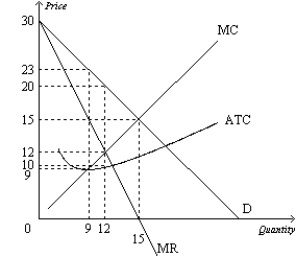 -Refer to Figure 15-13. A profit-maximizing monopolist would create a deadweight loss to society valued at
 (Multiple Choice)
4.8/5 (73)
(73) Which of the following formulas would correctly calculate a monopolist's profit?
(Multiple Choice)
4.8/5 (77)
(77) Table 15-16
A monopolist faces the following demand curve: 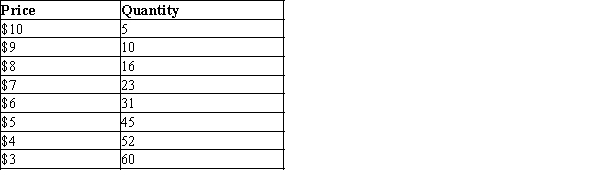 -Refer to Table 15-16. The monopolist has total fixed costs of $40 and a constant marginal cost of $5. At the profit-maximizing level of output, the monopolist's average total cost is
 (Multiple Choice)
4.9/5 (73)
(73) Scenario 15-6
The concert promoters of a heavy-metal band, WeR2Loud, know that there are two types of concert-goers: die-hard fans and casual fans. For a particular WeR2Loud concert, there are 1,000 die-hard fans who will pay $150 for a ticket and 500 casual fans who will pay $50 for a ticket. There are 1,500 seats available at the concert venue. Suppose the cost of putting on the concert is $50,000, which includes the cost of the band, lighting, security, etc.
-Refer to Scenario 15-6. How much additional profit can the concert promoters earn by charging each customer their willingness to pay relative to charging a flat price of $50 per ticket?
(Multiple Choice)
4.9/5 (79)
(79) 
Filters
- Essay(0)
- Multiple Choice(0)
- Short Answer(0)
- True False(0)
- Matching(0)