



 Chat with AI
Exam 16: Monopolistic Competition

Exam 1: Ten Principles of Economics455 Questions
Exam 2: Thinking Like an Economist645 Questions
Exam 3: Interdependence and the Gains From Trade550 Questions
Exam 4: The Market Forces of Supply and Demand693 Questions
Exam 5: Elasticity and Its Application625 Questions
Exam 6: Supply, Demand, and Government Policies671 Questions
Exam 7: Consumers, Producers, and the Efficiency of Markets547 Questions
Exam 8: Application: The Costs of Taxation507 Questions
Exam 9: Application: International Trade521 Questions
Exam 10: Externalities543 Questions
Exam 11: Public Goods and Common Resources453 Questions
Exam 12: The Design of the Tax System563 Questions
Exam 13: The Costs of Production649 Questions
Exam 14: Firms in Competitive Markets608 Questions
Exam 15: Monopoly662 Questions
Exam 16: Monopolistic Competition649 Questions
Exam 17: Oligopoly522 Questions
Exam 18: The Markets for the Factors of Production592 Questions
Exam 19: Earnings and Discrimination511 Questions
Exam 20: Income Inequality and Poverty478 Questions
Exam 21: The Theory of Consumer Choice568 Questions
Exam 22: Frontiers in Microeconomics461 Questions
Select questions type


Scenario 16-3
Peter operates an ice cream shop in the center of Fairfield. He sells several unusual flavors of organic, homemade ice cream so he has a monopoly over his own ice cream, though he competes with many other firms selling ice cream in Fairfield for the same customers. Peter's demand and cost values for sales per day are given in the table below. (Everyone who purchases Peter's ice cream buys a double scoop cone because it's so delicious.) 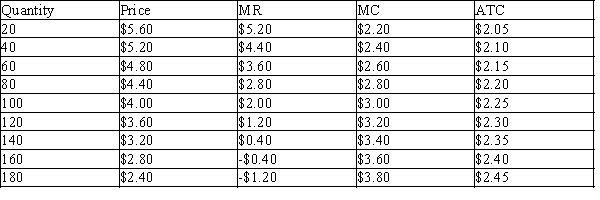 -Refer to Scenario 16-3. What price should Peter charge per double scoop ice cream cone to maximize his profit?
Free
(Multiple Choice)
4.9/5  (76)
(76) Correct Answer: Verified
B
A new Mexican restaurant opens in the city of Manchester. The other restaurant owners are not happy about this new restaurant because they are experiencing what externality?
Free
(Short Answer)
4.8/5 (64)
(64) Correct Answer:Verified
Verifiedbusiness-stealing externality
Figure 16-7 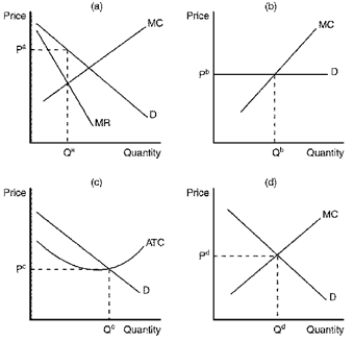 -Refer to Figure 16-7. Which of the graphs depicts the situation for a profit-maximizing firm in a monopolistically competitive market?
Free
(Multiple Choice)
4.8/5 (78)
(78) Correct Answer:Verified
VerifiedA
Table 16-6
Beatrice's Birthday Cakes is one bakery among many in the market for birthday cakes. The following table presents cost and revenue data for birthday cakes at Beatrice's. 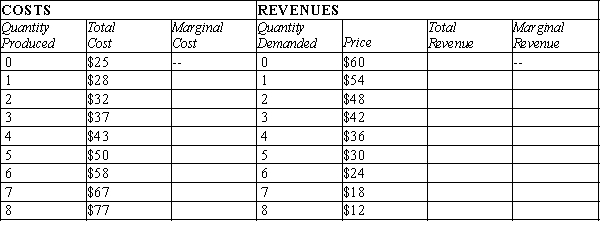 -Refer to Table 16-6. At the profit-maximizing quantity, what is Beatrice's total profit?
 (Multiple Choice)
4.8/5 (84)
(84) Which market structure would likely have the highest concentration ratio?
(Multiple Choice)
4.8/5 (71)
(71) In the long run, a profit-maximizing firm in a monopolistically competitive market operates at
(Multiple Choice)
4.9/5 (68)
(68) In a monopolistically competitive market, the demand curves faced by incumbent firms are unaffected by the entry of new firms into the market.
(True/False)
4.9/5 (70)
(70) The term excess capacity refers to the fact that a firm produces a lower quantity than it would if it operated at the efficient scale.
(True/False)
4.9/5 (71)
(71) Table 16-5
This table shows the demand schedule, marginal cost, and average total cost for a monopolistically competitive firm. 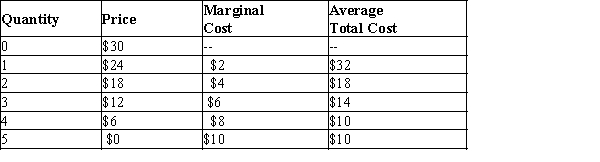 -Refer to Table 16-5. Which of the following statements regarding this monopolistically competitive firm is correct?
 (Multiple Choice)
4.7/5 (82)
(82) In the short run, a firm operating in a monopolistically competitive market
(Multiple Choice)
4.9/5 (66)
(66) Most businesses advertise their products and services. Some business use SPAM emails to advertise because the cost of a mass e-mail is close to zero. Other business spend millions of dollars to advertise in a 30-second spot during the Super Bowl. Having observed this real world data, economists argue that the amount of money that a business spends on advertising is a proxy for a good or service's
(Multiple Choice)
4.7/5 (88)
(88) Suppose the point of tangency that characterizes long-run equilibrium for a monopolistically competitive firm occurs at Q1 units of output. This level of output, Q1,
(Multiple Choice)
4.8/5 (86)
(86) Scenario 16-3
Peter operates an ice cream shop in the center of Fairfield. He sells several unusual flavors of organic, homemade ice cream so he has a monopoly over his own ice cream, though he competes with many other firms selling ice cream in Fairfield for the same customers. Peter's demand and cost values for sales per day are given in the table below. (Everyone who purchases Peter's ice cream buys a double scoop cone because it's so delicious.) 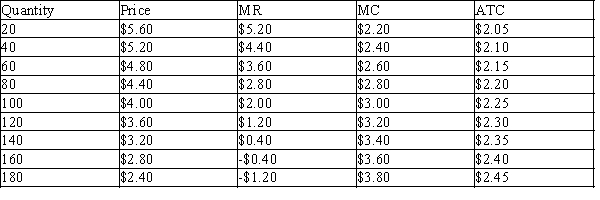 -Refer to Scenario 16-3. What price should Peter charge to maximize his profits?
 (Short Answer)
4.8/5 (74)
(74) Scenario 16-8
Burger Bonanza, a major national burger chain, recently decided to spend $4 million on an advertising campaign featuring a world famous actor to promote its new Bomber Burger.
-Refer to Scenario 16-8. What two benefits are conveyed by the brand name Burger Bonanza?
(Essay)
4.8/5 (74)
(74) Select the type of market that is described by the following attributes: many firms, differentiated products, and free entry.
(Multiple Choice)
4.7/5 (86)
(86) Entry of new firms in monopolistically competitive industries can convey a positive externality on consumers because new products result in more consumer surplus. This externality is called the
(Short Answer)
4.8/5 (79)
(79) Monopolistic competition is characterized by many buyers and sellers, product differentiation, and barriers to entry.
(True/False)
4.9/5 (65)
(65) 
Filters
- Essay(0)
- Multiple Choice(0)
- Short Answer(0)
- True False(0)
- Matching(0)