



 Chat with AI
Exam 16: Monopolistic Competition

Exam 1: Ten Principles of Economics455 Questions
Exam 2: Thinking Like an Economist645 Questions
Exam 3: Interdependence and the Gains From Trade550 Questions
Exam 4: The Market Forces of Supply and Demand693 Questions
Exam 5: Elasticity and Its Application625 Questions
Exam 6: Supply, Demand, and Government Policies671 Questions
Exam 7: Consumers, Producers, and the Efficiency of Markets547 Questions
Exam 8: Application: The Costs of Taxation507 Questions
Exam 9: Application: International Trade521 Questions
Exam 10: Externalities543 Questions
Exam 11: Public Goods and Common Resources453 Questions
Exam 12: The Design of the Tax System563 Questions
Exam 13: The Costs of Production649 Questions
Exam 14: Firms in Competitive Markets608 Questions
Exam 15: Monopoly662 Questions
Exam 16: Monopolistic Competition649 Questions
Exam 17: Oligopoly522 Questions
Exam 18: The Markets for the Factors of Production592 Questions
Exam 19: Earnings and Discrimination511 Questions
Exam 20: Income Inequality and Poverty478 Questions
Exam 21: The Theory of Consumer Choice568 Questions
Exam 22: Frontiers in Microeconomics461 Questions
Select questions type


Figure 16-11 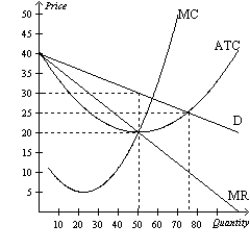 -Refer to Figure 16-11. If this firm profit-maximizes, how much cost will it incur?
 (Short Answer)
4.9/5  (78)
(78) Advertising during the Super Bowl is an example of information about quality contained primarily in the existence and expense of the advertising.
(True/False)
4.8/5 (79)
(79) Figure 16-13 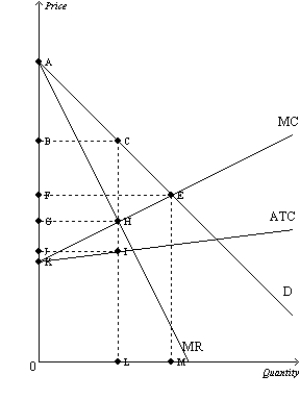 -Refer to Figure 16-13. Use the letters to identify the deadweight loss associated with this firm's profit-maximizing production.
 (Short Answer)
4.8/5 (83)
(83) Critics of advertising argue that in some markets advertising may
(Multiple Choice)
4.8/5 (77)
(77) Scenario 16-3
Peter operates an ice cream shop in the center of Fairfield. He sells several unusual flavors of organic, homemade ice cream so he has a monopoly over his own ice cream, though he competes with many other firms selling ice cream in Fairfield for the same customers. Peter's demand and cost values for sales per day are given in the table below. (Everyone who purchases Peter's ice cream buys a double scoop cone because it's so delicious.) 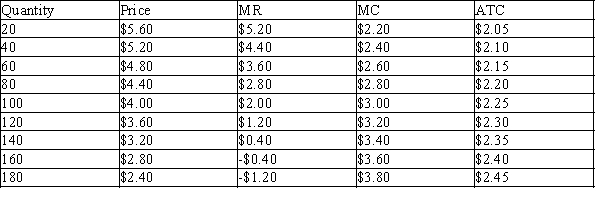 -Refer to Scenario 16-3. When Peter maximizes his profits, what is his total cost per day?
 (Short Answer)
5.0/5 (84)
(84) Table 16-6
Beatrice's Birthday Cakes is one bakery among many in the market for birthday cakes. The following table presents cost and revenue data for birthday cakes at Beatrice's. 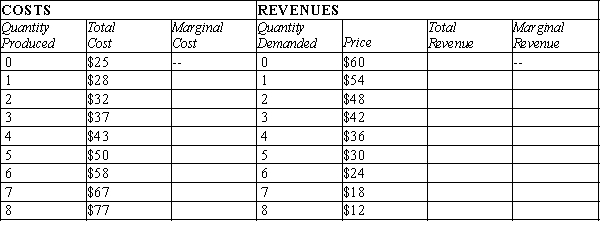 -Refer to Table 16-6. When maximizing profit, what price does Beatrice's charge for a cake?
 (Multiple Choice)
4.9/5 (92)
(92) Figure 16-12 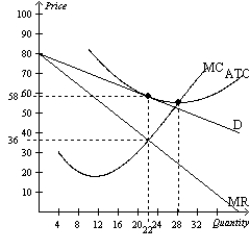 -Refer to Figure 16-12. If this firm profit-maximizes, how much output will it produce?
 (Short Answer)
4.9/5 (95)
(95) Crude oil is primarily supplied to the world market by a few Middle Eastern countries. Such a market is an example of a(n) (i)
Imperfectly competitive market.
(ii)
Monopoly market.
(iii)
Oligopoly market.
(Multiple Choice)
4.8/5 (77)
(77) A monopolistically competitive firm faces the following demand schedule for its product:  The firm has total fixed costs of $9 and a constant marginal cost of $3 per unit. The firm will maximize profit with
 (Multiple Choice)
4.9/5 (70)
(70) Scenario 16-9
Dean goes to the grocery store to buy chips and soda for a party. He purchases brand name products even though generic versions are available at lower prices. His friend John says he was irrational to spend more for a nearly identical product. His friend Martina agreed with Dean's decision to spend more for the brand name products.
-Refer to Scenario 16-9. Martina offers two reasons for agreeing with Dean's decision. What are they?
(Essay)
5.0/5 (86)
(86) Table 16-4
This table shows the demand schedule, marginal cost, and average total cost for a monopolistically competitive firm. 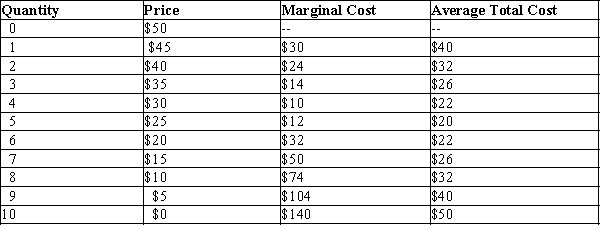 -Refer to Table 16-4. If the government forces this firm to produce at its efficient output level, how much output will this firm produce?
 (Multiple Choice)
4.9/5 (84)
(84) Firms that spend the greatest percentage of their revenue on advertising tend to be firms that sell
(Multiple Choice)
4.9/5 (74)
(74) Which of the following statements regarding brand names in advertising is not correct?
(Multiple Choice)
4.9/5 (67)
(67) Scenario 16-3
Peter operates an ice cream shop in the center of Fairfield. He sells several unusual flavors of organic, homemade ice cream so he has a monopoly over his own ice cream, though he competes with many other firms selling ice cream in Fairfield for the same customers. Peter's demand and cost values for sales per day are given in the table below. (Everyone who purchases Peter's ice cream buys a double scoop cone because it's so delicious.) 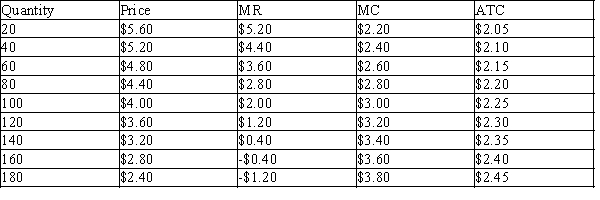 -Refer to Scenario 16-3. What is the maximum amount of profit that Peter can earn per day?
 (Short Answer)
4.9/5 (83)
(83) Figure 16-10
The figure is drawn for a monopolistically-competitive firm. 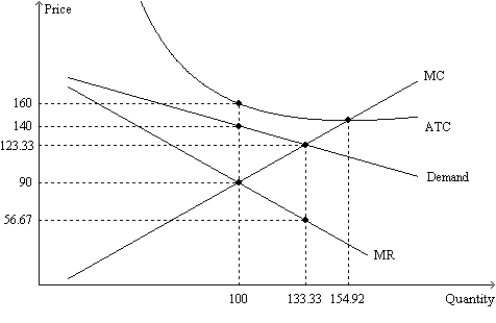 -Refer to Figure 16-10. At what quantity of output does average revenue exceed marginal revenue by $66.66?
 (Multiple Choice)
4.9/5 (85)
(85) In which of the following market structures do firms produce the welfare-maximizing level of output?
(Multiple Choice)
4.9/5 (84)
(84) 
Filters
- Essay(0)
- Multiple Choice(0)
- Short Answer(0)
- True False(0)
- Matching(0)