



 Chat with AI
Exam 16: Monopolistic Competition

Exam 1: Ten Principles of Economics455 Questions
Exam 2: Thinking Like an Economist645 Questions
Exam 3: Interdependence and the Gains From Trade550 Questions
Exam 4: The Market Forces of Supply and Demand693 Questions
Exam 5: Elasticity and Its Application625 Questions
Exam 6: Supply, Demand, and Government Policies671 Questions
Exam 7: Consumers, Producers, and the Efficiency of Markets547 Questions
Exam 8: Application: The Costs of Taxation507 Questions
Exam 9: Application: International Trade521 Questions
Exam 10: Externalities543 Questions
Exam 11: Public Goods and Common Resources453 Questions
Exam 12: The Design of the Tax System563 Questions
Exam 13: The Costs of Production649 Questions
Exam 14: Firms in Competitive Markets608 Questions
Exam 15: Monopoly662 Questions
Exam 16: Monopolistic Competition649 Questions
Exam 17: Oligopoly522 Questions
Exam 18: The Markets for the Factors of Production592 Questions
Exam 19: Earnings and Discrimination511 Questions
Exam 20: Income Inequality and Poverty478 Questions
Exam 21: The Theory of Consumer Choice568 Questions
Exam 22: Frontiers in Microeconomics461 Questions
Select questions type


A monopolistically competitive firm cannot earn an economic profit in the long run.
(True/False)
4.9/5  (81)
(81) Table 16-1
The following table shows the percentage of output supplied by the top eight firms in four different industries. 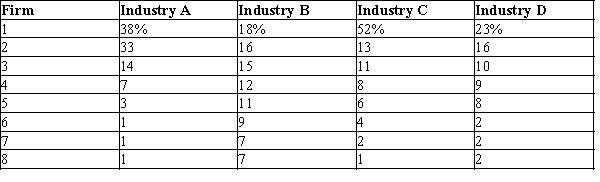 -Refer to Table 16-1. Which industry is the least competitive?
 (Multiple Choice)
4.8/5 (77)
(77) The deadweight loss that is associated with a monopolistically competitive market is a result of
(Multiple Choice)
4.8/5 (80)
(80) Figure 16-2. The figure is drawn for a monopolistically competitive firm.
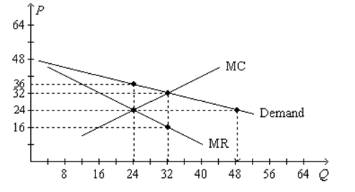 -Refer to Figure 16-2. In order to maximize profit, the firm will charge a price of
 (Multiple Choice)
4.7/5 (71)
(71) Monopolistically competitive firms, like monopoly firms, maximize their profits by charging a price that exceeds marginal cost.
(True/False)
4.8/5 (85)
(85) Figure 16-11 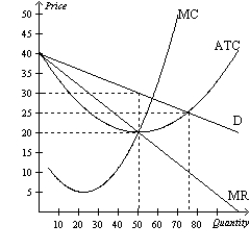 -Refer to Figure 16-11. How much consumer surplus will be derived from the purchase of this product at the monopolistically competitive price?
 (Multiple Choice)
4.8/5 (79)
(79) A firm in a monopolistically competitive market is similar to a monopoly in the sense that (i)
They both face downward-sloping demand curves.
(ii)
They both charge a price that exceeds marginal cost.
(iii)
Free entry and exit determines the long-run equilibrium.
(Multiple Choice)
4.8/5 (77)
(77) Scenario 16-4
Delish, a moderately priced restaurant, has recently announced intentions to open a restaurant in Boston, MA. Assume that the restaurant market in Boston is characterized by monopolistic competition.
-Refer to Scenario 16-4. As a result of the new restaurant, diners in Boston are likely to experience a
(Multiple Choice)
4.9/5 (76)
(76) List five goods that are likely sold in a monopolistically competitive market.
(Essay)
4.9/5 (73)
(73) Scenario 16-1
Suppose the following are the sales for all of the firms in two different industries. 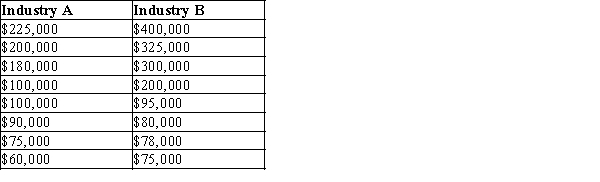 -Refer to Scenario 16-1. What are the concentration ratios for these industries?
 (Multiple Choice)
4.8/5 (88)
(88) Table 16-4
This table shows the demand schedule, marginal cost, and average total cost for a monopolistically competitive firm. 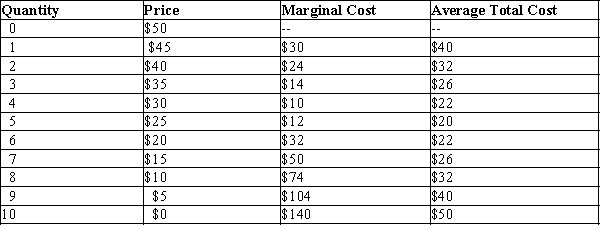 -Refer to Table 16-4. Which of the following is likely to happen in the long run in this market?
 (Multiple Choice)
4.8/5 (64)
(64) Figure 16-5 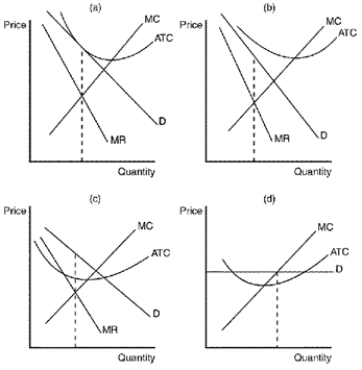 -Refer to Figure 16-5. Which of the graphs depicts a short-run equilibrium that will encourage the entry of other firms into a monopolistically competitive industry?
 (Multiple Choice)
4.9/5 (84)
(84) Figure 16-5
-Refer to Figure 16-5. Which of the panels shown could illustrate the short-run situation for a monopolistically competitive firm?
-Refer to Figure 16-5. Which of the panels shown could illustrate the short-run situation for a monopolistically competitive firm? (Multiple Choice)
4.9/5 (88)
(88) A monopolistically competitive market is characterized by barriers to entry.
(True/False)
4.9/5 (91)
(91) In a long-run equilibrium, a firm in a monopolistically competitive market operates
(Multiple Choice)
4.8/5 (68)
(68) Monopolistic competition is an inefficient market structure because
(Multiple Choice)
4.9/5 (71)
(71) Assume the role of a defender of advertising. Describe the characteristics of advertising that enhance the effectiveness of markets and increase the social welfare of society.
(Essay)
4.8/5 (92)
(92) Figure 16-12 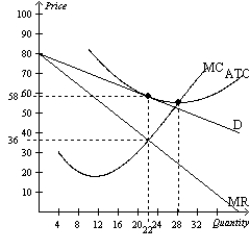 -Refer to Figure 16-12. Does this monopolistically competitive market produce the welfare-maximizing level of output?
 (Short Answer)
4.9/5 (92)
(92) 
Filters
- Essay(0)
- Multiple Choice(0)
- Short Answer(0)
- True False(0)
- Matching(0)