



 Chat with AI
Exam 16: Monopolistic Competition

Exam 1: Ten Principles of Economics455 Questions
Exam 2: Thinking Like an Economist645 Questions
Exam 3: Interdependence and the Gains From Trade550 Questions
Exam 4: The Market Forces of Supply and Demand693 Questions
Exam 5: Elasticity and Its Application625 Questions
Exam 6: Supply, Demand, and Government Policies671 Questions
Exam 7: Consumers, Producers, and the Efficiency of Markets547 Questions
Exam 8: Application: The Costs of Taxation507 Questions
Exam 9: Application: International Trade521 Questions
Exam 10: Externalities543 Questions
Exam 11: Public Goods and Common Resources453 Questions
Exam 12: The Design of the Tax System563 Questions
Exam 13: The Costs of Production649 Questions
Exam 14: Firms in Competitive Markets608 Questions
Exam 15: Monopoly662 Questions
Exam 16: Monopolistic Competition649 Questions
Exam 17: Oligopoly522 Questions
Exam 18: The Markets for the Factors of Production592 Questions
Exam 19: Earnings and Discrimination511 Questions
Exam 20: Income Inequality and Poverty478 Questions
Exam 21: The Theory of Consumer Choice568 Questions
Exam 22: Frontiers in Microeconomics461 Questions
Select questions type


Which of the following industries has the lowest concentration ratio?
(Multiple Choice)
4.8/5  (83)
(83) Monopolistically competitive firms could reduce the average total cost of producing by increasing output; therefore, these firms have
(Short Answer)
4.9/5 (78)
(78) In a monopolistically competitive industry, a firm's demand curve also represent its
(Multiple Choice)
4.8/5 (70)
(70) The market for wheat is most likely considered a monopolistically competitive market.
(True/False)
4.8/5 (92)
(92) If firms in a monopolistically competitive market are incurring economic losses, which of the following statements describes the changes that occur as the market adjusts to the long-run equilibrium?
(Multiple Choice)
4.9/5 (75)
(75) Figure 16-7 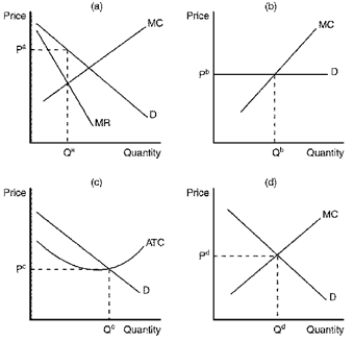 -Refer to Figure 16-7. If a firm in a monopolistically competitive market was producing the level of output depicted as Qd in panel (d), it would
 (Multiple Choice)
4.7/5 (71)
(71) Table 16-3
The following table shows the output produced by each of the top eight firms in four industries as well as the total industry output for those industries. 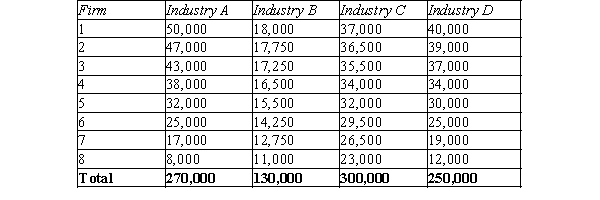 -Refer to Table 16-3. What is the concentration ratio for Industry C?
 (Multiple Choice)
4.8/5 (73)
(73) Which of the following represents the best government policy to reduce the deadweight loss associated with a monopolistically competitive market?
(Multiple Choice)
5.0/5 (84)
(84) Scenario 16-9
Dean goes to the grocery store to buy chips and soda for a party. He purchases brand name products even though generic versions are available at lower prices. His friend John says he was irrational to spend more for a nearly identical product. His friend Martina agreed with Dean's decision to spend more for the brand name products.
-Refer to Scenario 16-9. Which friend is a critic of brand names?
(Short Answer)
4.8/5 (84)
(84) Figure 16-10
The figure is drawn for a monopolistically-competitive firm. 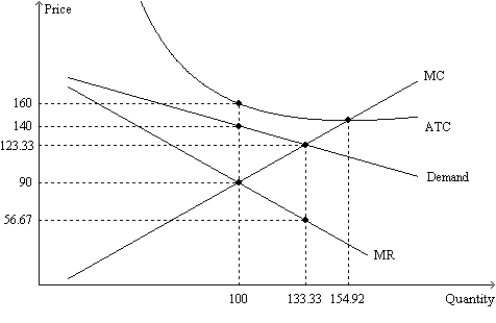 -Refer to Figure 16-10. In order to maximize its profit, the firm will choose to produce
 (Multiple Choice)
4.8/5 (83)
(83) Which of the following industries has the highest concentration ratio?
(Multiple Choice)
4.8/5 (83)
(83) Table 16-6
Beatrice's Birthday Cakes is one bakery among many in the market for birthday cakes. The following table presents cost and revenue data for birthday cakes at Beatrice's. 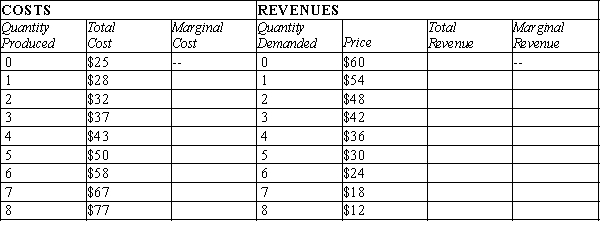 -Refer to Table 16-6. Given the cost and revenue data, Beatrice's is
 (Multiple Choice)
4.7/5 (88)
(88) Free entry eliminates long-run profits for firms in competitive and monopolistic industries.
(True/False)
4.7/5 (86)
(86) How does advertising signal to consumers that the product is a good one?
(Multiple Choice)
4.9/5 (70)
(70) Suppose there is a market in which the firms hold the following market shares: 25%, 20%, 18%, 15%, 8%, 7%, 4%, 2%, 1%. What is the concentration ratio for this market?
(Short Answer)
4.7/5 (67)
(67) Entry of new firms in monopolistically competitive industries can convey a negative externality on producers because firms lose customers and profits from the entry of new competitors. This externality is called the
(Short Answer)
4.9/5 (81)
(81) Firm A produces and sells in a market that is characterized by highly differentiated consumer goods. Firm B produces and sells industrial products. Firm C produces and sells an agricultural commodity. Which firm is likely to spend the greatest portion of its total revenue on advertising?
(Multiple Choice)
4.8/5 (90)
(90) 
Filters
- Essay(0)
- Multiple Choice(0)
- Short Answer(0)
- True False(0)
- Matching(0)