



 Chat with AI
Exam 16: Monopolistic Competition

Exam 1: Ten Principles of Economics455 Questions
Exam 2: Thinking Like an Economist645 Questions
Exam 3: Interdependence and the Gains From Trade550 Questions
Exam 4: The Market Forces of Supply and Demand693 Questions
Exam 5: Elasticity and Its Application625 Questions
Exam 6: Supply, Demand, and Government Policies671 Questions
Exam 7: Consumers, Producers, and the Efficiency of Markets547 Questions
Exam 8: Application: The Costs of Taxation507 Questions
Exam 9: Application: International Trade521 Questions
Exam 10: Externalities543 Questions
Exam 11: Public Goods and Common Resources453 Questions
Exam 12: The Design of the Tax System563 Questions
Exam 13: The Costs of Production649 Questions
Exam 14: Firms in Competitive Markets608 Questions
Exam 15: Monopoly662 Questions
Exam 16: Monopolistic Competition649 Questions
Exam 17: Oligopoly522 Questions
Exam 18: The Markets for the Factors of Production592 Questions
Exam 19: Earnings and Discrimination511 Questions
Exam 20: Income Inequality and Poverty478 Questions
Exam 21: The Theory of Consumer Choice568 Questions
Exam 22: Frontiers in Microeconomics461 Questions
Select questions type


Under which of the following market structures would consumers likely pay the highest price for a product?
(Multiple Choice)
4.9/5  (69)
(69) Scenario 16-8
Burger Bonanza, a major national burger chain, recently decided to spend $4 million on an advertising campaign featuring a world famous actor to promote its new Bomber Burger.
-Refer to Scenario 16-8. What can consumers conclude from Burger Bonanza's willingness to spend $4 million on an advertising campaign?
(Short Answer)
4.9/5 (77)
(77) Scenario 16-3
Peter operates an ice cream shop in the center of Fairfield. He sells several unusual flavors of organic, homemade ice cream so he has a monopoly over his own ice cream, though he competes with many other firms selling ice cream in Fairfield for the same customers. Peter's demand and cost values for sales per day are given in the table below. (Everyone who purchases Peter's ice cream buys a double scoop cone because it's so delicious.) 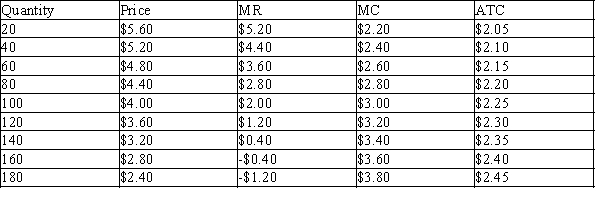 -Refer to Scenario 16-3. What is the maximum amount of profit that Peter can earn per day?
 (Short Answer)
5.0/5 (88)
(88) Figure 16-9
The figure is drawn for a monopolistically-competitive firm. 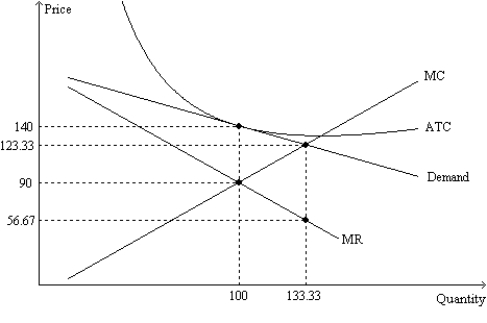 -Refer to Figure 16-9. In order to maximize its profit, the firm will choose to produce
 (Multiple Choice)
5.0/5 (79)
(79) Critics of advertising argue that advertising leads to less elastic demand for products and a larger markup of price over marginal cost.
(True/False)
4.9/5 (78)
(78) Figure 16-2. The figure is drawn for a monopolistically competitive firm.
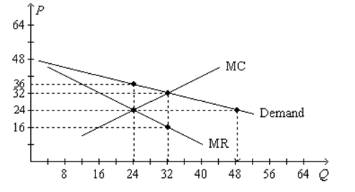 -Refer to Figure 16-2. Suppose that average total cost is $36 when Q=24. What is the profit-maximizing price and resulting profit?
 (Multiple Choice)
4.7/5 (69)
(69) Suppose that monopolistically competitive firms in a certain market are earning positive profits. In the transition from this initial situation to a long-run equilibrium,
(Multiple Choice)
4.8/5 (84)
(84) Table 16-3
The following table shows the output produced by each of the top eight firms in four industries as well as the total industry output for those industries. 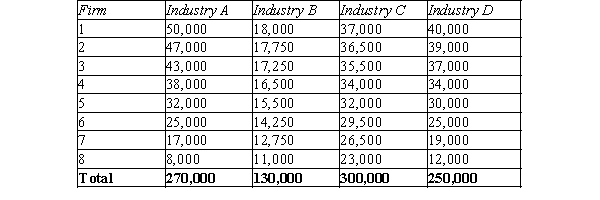 -Refer to Table 16-3. What is the concentration ratio for Industry B?
 (Multiple Choice)
4.9/5 (79)
(79) Figure 16-2. The figure is drawn for a monopolistically competitive firm.
-Refer to Figure 16-2. If the ATC=40 at the profit-maximizing level of output, which of the following will occur in the long run in this industry?
-Refer to Figure 16-2. If the ATC=40 at the profit-maximizing level of output, which of the following will occur in the long run in this industry? (Multiple Choice)
4.7/5 (73)
(73) In the long run, a monopolistically competitive firm's demand curve becomes more elastic and shifts to the left
(True/False)
4.9/5 (89)
(89) On a vacation to China, you find yourself eating every meal at the local Burger King rather than buying a meal from one of the street vendors. Your traveling companion claims that you are irrational, since you never eat Burger King hamburgers when you are home, and Burger King's hamburgers cost more than the meals prepared and sold by China's street vendors. An economist would most likely explain your behavior by suggesting that
(Multiple Choice)
4.9/5 (88)
(88) There is general disagreement among economists about the role of advertising, but there is widespread agreement about the role of brand names on market efficiency.
(True/False)
4.8/5 (78)
(78) Economists are unanimous in their belief that advertising is socially inefficient.
(True/False)
4.9/5 (76)
(76) Examples of monopolistically competitive markets include the markets for
(Multiple Choice)
4.7/5 (72)
(72) Firms in monopolistically competitive markets and monopolies can earn long-run profits due to barriers to entry.
(True/False)
4.7/5 (79)
(79) Critics of advertising argue that firms use advertising to manipulate consumers' tastes.
(True/False)
4.8/5 (92)
(92) 
Filters
- Essay(0)
- Multiple Choice(0)
- Short Answer(0)
- True False(0)
- Matching(0)