



 Chat with AI
Exam 16: Monopolistic Competition

Exam 1: Ten Principles of Economics455 Questions
Exam 2: Thinking Like an Economist645 Questions
Exam 3: Interdependence and the Gains From Trade550 Questions
Exam 4: The Market Forces of Supply and Demand693 Questions
Exam 5: Elasticity and Its Application625 Questions
Exam 6: Supply, Demand, and Government Policies671 Questions
Exam 7: Consumers, Producers, and the Efficiency of Markets547 Questions
Exam 8: Application: The Costs of Taxation507 Questions
Exam 9: Application: International Trade521 Questions
Exam 10: Externalities543 Questions
Exam 11: Public Goods and Common Resources453 Questions
Exam 12: The Design of the Tax System563 Questions
Exam 13: The Costs of Production649 Questions
Exam 14: Firms in Competitive Markets608 Questions
Exam 15: Monopoly662 Questions
Exam 16: Monopolistic Competition649 Questions
Exam 17: Oligopoly522 Questions
Exam 18: The Markets for the Factors of Production592 Questions
Exam 19: Earnings and Discrimination511 Questions
Exam 20: Income Inequality and Poverty478 Questions
Exam 21: The Theory of Consumer Choice568 Questions
Exam 22: Frontiers in Microeconomics461 Questions
Select questions type


Figure 16-5 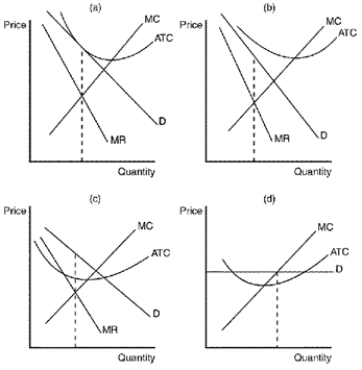 -Refer to Figure 16-5. Panel b is consistent with a firm in a monopolistically competitive market that is
 (Multiple Choice)
4.9/5  (74)
(74) Oligopoly is characterized by a few sellers offering similar products, whereas monopolistic competition is characterized by many sellers offering differentiated products.
(True/False)
4.9/5 (92)
(92) A new Mexican restaurant opens in the city of Manchester. The residents are happy about this new restaurant because they are experiencing what externality?
(Short Answer)
4.7/5 (74)
(74) Figure 16-14 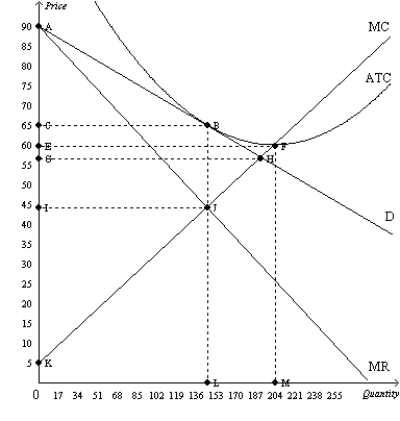 -Refer to Figure 16-14. Which letter identifies the efficient level of output for this firm?
 (Short Answer)
4.9/5 (67)
(67) Scenario 16-7
Consider the problem facing two firms, YumYum and Bertollini, in the frozen food market. Each firm has just come up with an idea for a new "frozen meal for two" which it would sell for $9. Assume that the marginal cost for each new product is a constant $2, and the only fixed cost is for advertising. Each company knows that if it spends $12 million on advertising it will get 1.5 million consumers to try its new product. YumYum has done market research which suggests that its product does not have any "staying" power in the market. Even though it could get 1.5 million consumers to buy the product once, it is unlikely that they will continue to buy the product in the future. Bertollini's market research suggests that its product is very good, and consumers who try the product will continue to be consumers over the ensuing year. On the basis of its market research, Bertollini estimates that its initial 1.5 million customers will buy one unit of the product each month in the coming year, for a total of 18 million units.
-Refer to Scenario 16-7. On the basis of a theory that people buy a product because it is advertised, the content of advertisements for Bertollini's product
(Multiple Choice)
4.9/5 (86)
(86) In which of the following market structures does free entry and exit play an important role in the long-run equilibrium outcome? (i)
Perfect competition
(ii)
Monopolistic competition
(iii)
Monopoly
(Multiple Choice)
4.7/5 (79)
(79) Which of the following best describes the idea of excess capacity in monopolistic competition?
(Multiple Choice)
4.9/5 (79)
(79) Scenario 16-2
Suppose market demand for a product is given by the equation P = 20 - Q. For this market demand curve, marginal revenue is MR = 20 - 2Q.
-Refer to Scenario 16-2. If the marginal cost of producing this good is 0, what price would a profit-maximizing monopolist charge for the product?
(Multiple Choice)
4.7/5 (81)
(81) Figure 16-7 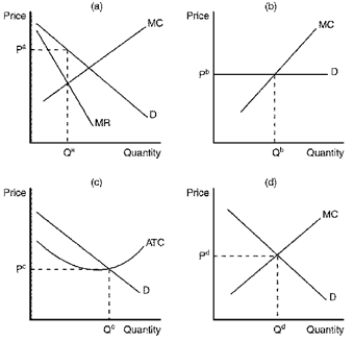 -Refer to Figure 16-7. The firm depicted in panel b faces a horizontal demand curve. If panel b depicts a profit-maximizing firm,
 (Multiple Choice)
4.9/5 (64)
(64) Figure 16-11 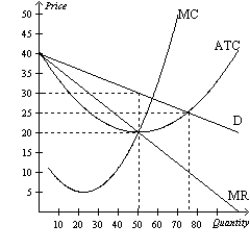 -Refer to Figure 16-11. If this firm profit-maximizes, what price will it charge?
 (Short Answer)
4.9/5 (85)
(85) Considering perfect competition, monopolistic competition, and monopoly, which of the market structures results in production of the welfare-maximizing level of output?
(Short Answer)
4.8/5 (90)
(90) In monopolistically competitive markets, free entry and exit suggests that
(Multiple Choice)
4.9/5 (88)
(88) Table 16-7
A monopolistically competitive firm faces the following demand schedule for its product. In addition, the firm has total fixed costs equal to 20.  -Refer to Table 16-7. If the firm has a constant marginal cost of $7 per unit, how much profit will the firm earn at the profit-maximizing level of output?
 (Multiple Choice)
4.9/5 (87)
(87) Figure 16-5
-Refer to Figure 16-5. Panel a shows a profit-maximizing monopolistically competitive firm that is
-Refer to Figure 16-5. Panel a shows a profit-maximizing monopolistically competitive firm that is (Multiple Choice)
4.8/5 (78)
(78) Which two curves are tangent to each other in a monopolistically competitive market with zero economic profit?
(Multiple Choice)
4.7/5 (83)
(83) Critics of markets that are characterized by firms that sell brand name products argue that brand names encourage consumers to pay more for branded products that
(Multiple Choice)
4.9/5 (79)
(79) Table 16-4
This table shows the demand schedule, marginal cost, and average total cost for a monopolistically competitive firm. 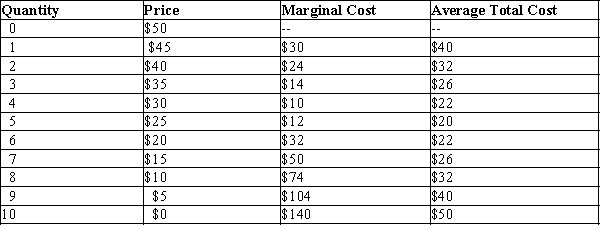 -Refer to Table 16-4. How much profit will this firm earn when it chooses its output to maximize profit?
 (Multiple Choice)
4.9/5 (94)
(94) Assume the role of a critic of advertising. Describe the characteristics of advertising that reduce the effectiveness of markets and decrease the social welfare of society.
(Essay)
5.0/5 (96)
(96) The "competition" in monopolistically competitive markets is most likely a result of having many sellers in the market.
(True/False)
4.8/5 (77)
(77) 
Filters
- Essay(0)
- Multiple Choice(0)
- Short Answer(0)
- True False(0)
- Matching(0)