



 Chat with AI
Exam 16: Monopolistic Competition

Exam 1: Ten Principles of Economics455 Questions
Exam 2: Thinking Like an Economist645 Questions
Exam 3: Interdependence and the Gains From Trade550 Questions
Exam 4: The Market Forces of Supply and Demand693 Questions
Exam 5: Elasticity and Its Application625 Questions
Exam 6: Supply, Demand, and Government Policies671 Questions
Exam 7: Consumers, Producers, and the Efficiency of Markets547 Questions
Exam 8: Application: The Costs of Taxation507 Questions
Exam 9: Application: International Trade521 Questions
Exam 10: Externalities543 Questions
Exam 11: Public Goods and Common Resources453 Questions
Exam 12: The Design of the Tax System563 Questions
Exam 13: The Costs of Production649 Questions
Exam 14: Firms in Competitive Markets608 Questions
Exam 15: Monopoly662 Questions
Exam 16: Monopolistic Competition649 Questions
Exam 17: Oligopoly522 Questions
Exam 18: The Markets for the Factors of Production592 Questions
Exam 19: Earnings and Discrimination511 Questions
Exam 20: Income Inequality and Poverty478 Questions
Exam 21: The Theory of Consumer Choice568 Questions
Exam 22: Frontiers in Microeconomics461 Questions
Select questions type


Entry and exit drive each firm in a monopolistically competitive market to a point of tangency between its
(Multiple Choice)
4.8/5  (89)
(89) Which of the following goods are not likely to be sold in monopolistically competitive markets?
(Multiple Choice)
4.8/5 (86)
(86) In Lee Benham's 1972 article examining the impact of advertising on the average price paid for a pair of eyeglasses, Benham found that
(Multiple Choice)
4.8/5 (95)
(95) Which of the following conditions distinguishes monopolistic competition from perfect competition?
(Multiple Choice)
4.9/5 (76)
(76) A study of the market for optometrists' services in the 1960s showed that
(Multiple Choice)
4.8/5 (68)
(68) When a monopolistically competitive firm is in a long-run equilibrium, the values of marginal cost, average total cost, and price are all the same.
(True/False)
4.9/5 (86)
(86) Which of the following is not an argument made by critics of advertising?
(Multiple Choice)
4.8/5 (85)
(85) Because monopolistically competitive firms produce differentiated products, each firm
(Multiple Choice)
5.0/5 (80)
(80) Figure 16-12 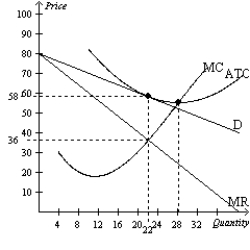 -Refer to Figure 16-12. If this firm minimized cost, how much output will it produce?
 (Short Answer)
4.8/5 (78)
(78) 
Filters
- Essay(0)
- Multiple Choice(0)
- Short Answer(0)
- True False(0)
- Matching(0)