



 Chat with AI
Exam 15: Monopoly

Exam 1: Ten Principles of Economics455 Questions
Exam 2: Thinking Like an Economist645 Questions
Exam 3: Interdependence and the Gains From Trade550 Questions
Exam 4: The Market Forces of Supply and Demand693 Questions
Exam 5: Elasticity and Its Application625 Questions
Exam 6: Supply, Demand, and Government Policies671 Questions
Exam 7: Consumers, Producers, and the Efficiency of Markets547 Questions
Exam 8: Application: The Costs of Taxation507 Questions
Exam 9: Application: International Trade521 Questions
Exam 10: Externalities543 Questions
Exam 11: Public Goods and Common Resources453 Questions
Exam 12: The Design of the Tax System563 Questions
Exam 13: The Costs of Production649 Questions
Exam 14: Firms in Competitive Markets608 Questions
Exam 15: Monopoly662 Questions
Exam 16: Monopolistic Competition649 Questions
Exam 17: Oligopoly522 Questions
Exam 18: The Markets for the Factors of Production592 Questions
Exam 19: Earnings and Discrimination511 Questions
Exam 20: Income Inequality and Poverty478 Questions
Exam 21: The Theory of Consumer Choice568 Questions
Exam 22: Frontiers in Microeconomics461 Questions
Select questions type


University financial aid can be viewed as a type of price discrimination.

Free
(True/False)
4.9/5  (77)
(77) Correct Answer: Verified
True
Figure 15-1 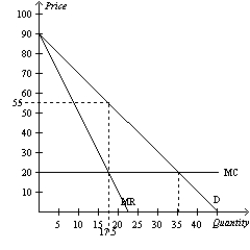 -Refer to Figure 15-1. How much profit will this monopolist earn if it charges each consumer the same price?
Free
(Short Answer)
4.8/5 (78)
(78) Correct Answer:Verified
Verified$612.50
Which of the following statements is not correct?
Free
(Multiple Choice)
5.0/5 (77)
(77) Correct Answer:Verified
VerifiedC
Table 15-20
A monopolist faces the following demand curve: 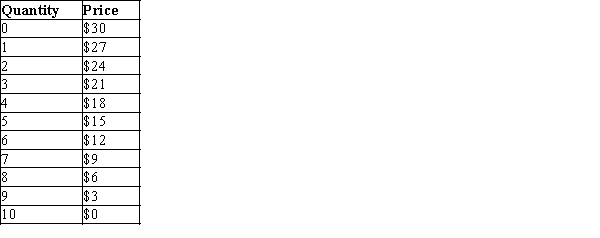 -Refer to Table 15-20. If a monopolist faces a constant marginal cost of $10, how much output should the firm produce in order to maximize profit?
 (Multiple Choice)
4.9/5 (94)
(94) Table 15-1 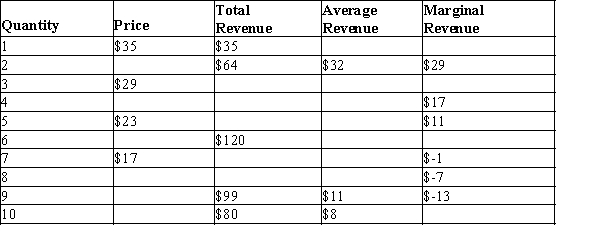 -Refer to Table 15-1. What is the marginal revenue for the monopolist for the sixth unit sold?
 (Multiple Choice)
4.9/5 (93)
(93) When a certain monopoly sets its price at $8 it sells 64 units. When the monopoly sets its price at $9 it sells 62 units. The marginal revenue for the firm over this range is
(Multiple Choice)
4.8/5 (81)
(81) Monopolies are socially inefficient because the price they charge is
(Multiple Choice)
4.8/5 (72)
(72) Table 15-6
A monopolist faces the following demand curve: 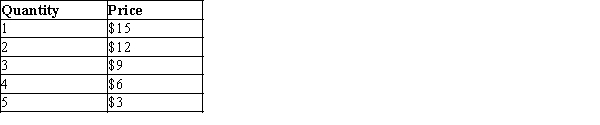 -Refer to Table 15-6. Suppose the monopolist has total fixed costs equal to $5 and a variable cost equal to $4 per unit for all units produced. What is the total profit if she operates at her profit-maximizing price?
 (Multiple Choice)
5.0/5 (78)
(78) Table 15-18
A monopolist faces the following demand curve: 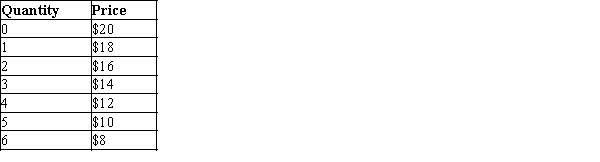 Suppose marginal cost is constant at $8 per unit.
-Refer to Table 15-18 The monopolist's profit-maximizing level of output is
Suppose marginal cost is constant at $8 per unit.
-Refer to Table 15-18 The monopolist's profit-maximizing level of output is (Multiple Choice)
4.7/5 (101)
(101) Scenario 15-2
Consider a local, privately-owned electrical cooperative named Poweshiek Power Company (PPCo). PPCo has just completed a clean-coal-burning electrical power plant in Iowa. Currently, PPCo can meet the electricity needs of all residents in the county. In fact, its capacity far exceeds the needs of the county. After just a few years of operation, the shareholders of PPCo experienced incredibly high rates of return on their investment due to the profitability of the corporation.
-Refer to Scenario 15-2. Which of the following statements is most likely to be true? (i)
New entrants to the market know they will have a smaller market share than PPCo currently has.
(ii)
PPCo is a natural monopoly.
(iii)
PPCo would experience higher profits if it were government-run.
(Multiple Choice)
4.8/5 (80)
(80) An industry is a natural monopoly when (i)
The government assists the firm in maintaining the monopoly.
(ii)
A single firm owns a key resource.(iii)
A single firm can supply a good or service to an entire market at a smaller cost than could two or more firms.
(Multiple Choice)
4.8/5 (82)
(82) A monopolist's profit is equal to (Price - Marginal Cost) × Quantity.
(True/False)
4.8/5 (78)
(78) When a single firm can supply a product to an entire market at a lower cost than could two or more firms, the industry is called a
(Multiple Choice)
4.9/5 (66)
(66) A movie theater can increase its profits through price discrimination by charging a higher price to adults and a lower price to children if it
(Multiple Choice)
4.8/5 (84)
(84) Figure 15-8 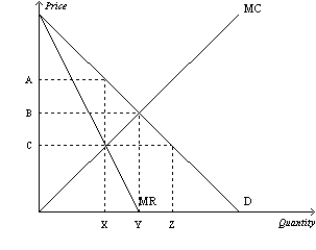 -Refer to Figure 15-8. What area represents the total surplus lost due to monopoly pricing?
 (Multiple Choice)
4.8/5 (82)
(82) Scenario 15-3
A monopoly firm maximizes its profit by producing Q = 500 units of output. At that level of output, its marginal revenue is $30, its average revenue is $60, and its average total cost is $34.
-Refer to Scenario 15-3. The firm's profit-maximizing price is
(Multiple Choice)
4.7/5 (80)
(80) Figure 15-5 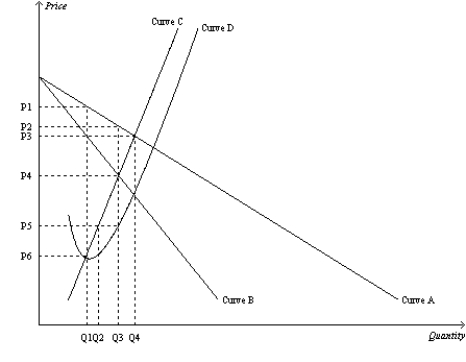 -Refer to Figure 15-5. A profit-maximizing monopoly's profit is equal to
 (Multiple Choice)
4.9/5 (61)
(61) Table 15-7
Sally owns the only shoe store in town. She has the following cost and revenue information. 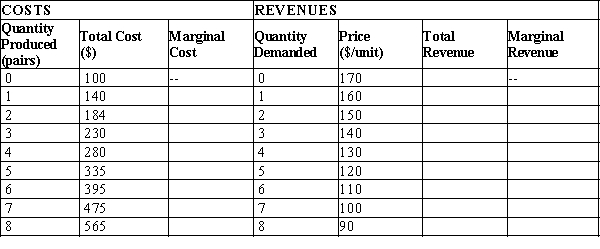 -Refer to Table 15-7. What is total profit at the profit-maximizing quantity?
 (Multiple Choice)
4.8/5 (71)
(71) For a monopoly, the socially efficient level of output occurs where
(Multiple Choice)
4.8/5 (70)
(70) 
Filters
- Essay(0)
- Multiple Choice(0)
- Short Answer(0)
- True False(0)
- Matching(0)