



 Chat with AI
Exam 15: Monopoly

Exam 1: Ten Principles of Economics455 Questions
Exam 2: Thinking Like an Economist645 Questions
Exam 3: Interdependence and the Gains From Trade550 Questions
Exam 4: The Market Forces of Supply and Demand693 Questions
Exam 5: Elasticity and Its Application625 Questions
Exam 6: Supply, Demand, and Government Policies671 Questions
Exam 7: Consumers, Producers, and the Efficiency of Markets547 Questions
Exam 8: Application: The Costs of Taxation507 Questions
Exam 9: Application: International Trade521 Questions
Exam 10: Externalities543 Questions
Exam 11: Public Goods and Common Resources453 Questions
Exam 12: The Design of the Tax System563 Questions
Exam 13: The Costs of Production649 Questions
Exam 14: Firms in Competitive Markets608 Questions
Exam 15: Monopoly662 Questions
Exam 16: Monopolistic Competition649 Questions
Exam 17: Oligopoly522 Questions
Exam 18: The Markets for the Factors of Production592 Questions
Exam 19: Earnings and Discrimination511 Questions
Exam 20: Income Inequality and Poverty478 Questions
Exam 21: The Theory of Consumer Choice568 Questions
Exam 22: Frontiers in Microeconomics461 Questions
Select questions type


Because natural monopolies have a declining average cost curve, regulating natural monopolies by setting price equal to marginal cost would
(Multiple Choice)
4.9/5  (69)
(69) Amanda inherited the only local cable TV/Internet company in town after her father passed away. The company has a local monopoly on the delivery of high-speed Internet service. The company is completely unregulated by the government and is therefore free to operate as it wishes. Assume that Amanda understands the true power of her new monopoly. Which of the following statements is (are) correct? (i)
She will be able to set the price of high-speed Internet service at whatever level she wishes.
(ii)
The customers will be forced to purchase high-speed Internet service at whatever price she wants to set.
(iii)
She will be able to achieve any profit level that she desires.
(Multiple Choice)
4.8/5 (70)
(70) Sizable economic profits can persist over time under monopoly if the monopolist
(Multiple Choice)
4.8/5 (89)
(89) When a single firm can supply a good or service to an entire market at a lower cost than could two or more firms, the industry is known as a
(Short Answer)
4.9/5 (78)
(78) Figure 15-1 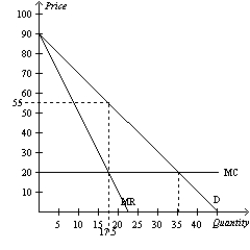 -Refer to Figure 15-1. If the monopolist uses perfect price discrimination, how much deadweight loss results?
 (Short Answer)
4.8/5 (87)
(87) Table 15-1 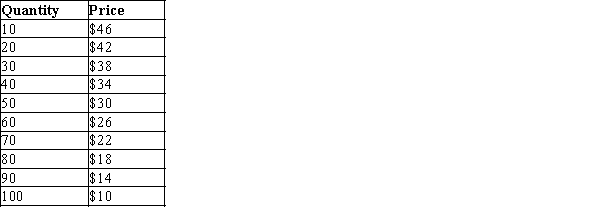 -Refer to Table 15-1. The average revenue of the 50th unit of output is
 (Short Answer)
4.8/5 (89)
(89) Suppose a firm has a monopoly on the sale of a computer game and faces a downward-sloping demand curve. When selling the 50th game, the firm will always receive
(Multiple Choice)
4.8/5 (80)
(80) Antitrust laws give the Justice Department the authority to challenge potential mergers between companies in an effort to safeguard society from monopoly power.
(True/False)
4.8/5 (61)
(61) Table 15-14
The following table gives information on the price, quantity, and total cost of production for a monopolist. 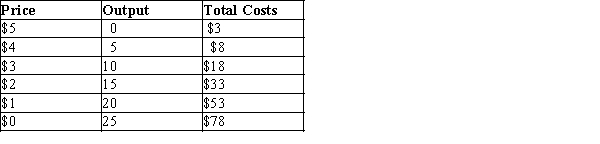 -Refer to Table 15-14. At what price does marginal revenue equal marginal cost?
 (Multiple Choice)
4.9/5 (77)
(77) For a monopolist, when the price effect is greater than the output effect, marginal revenue is
(Multiple Choice)
4.9/5 (77)
(77) Which of the following statements is correct? Monopolies are socially inefficient because they (i)
Charge a price above marginal cost.
(ii)
Produce too little output.
(iii)
Earn profits at the expense of consumers.
(iv)
Maximize the market's total surplus.
(Multiple Choice)
4.7/5 (89)
(89) Figure 15-3 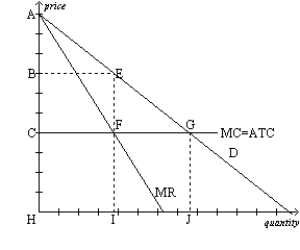 -Refer to Figure 15-3. Use the letters in the figure to identify the profit area for the single price monopolist.
 (Short Answer)
4.9/5 (68)
(68) Table 15-4
A monopolist faces the following demand curve: 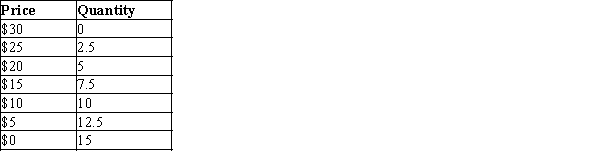 -Refer to Table 15-4. If the monopolist increases production from 7.5 to 10 units, what is its marginal revenue?
 (Multiple Choice)
4.9/5 (83)
(83) 
Filters
- Essay(0)
- Multiple Choice(0)
- Short Answer(0)
- True False(0)
- Matching(0)