



 Chat with AI
Exam 15: Monopoly

Exam 1: Ten Principles of Economics455 Questions
Exam 2: Thinking Like an Economist645 Questions
Exam 3: Interdependence and the Gains From Trade550 Questions
Exam 4: The Market Forces of Supply and Demand693 Questions
Exam 5: Elasticity and Its Application625 Questions
Exam 6: Supply, Demand, and Government Policies671 Questions
Exam 7: Consumers, Producers, and the Efficiency of Markets547 Questions
Exam 8: Application: The Costs of Taxation507 Questions
Exam 9: Application: International Trade521 Questions
Exam 10: Externalities543 Questions
Exam 11: Public Goods and Common Resources453 Questions
Exam 12: The Design of the Tax System563 Questions
Exam 13: The Costs of Production649 Questions
Exam 14: Firms in Competitive Markets608 Questions
Exam 15: Monopoly662 Questions
Exam 16: Monopolistic Competition649 Questions
Exam 17: Oligopoly522 Questions
Exam 18: The Markets for the Factors of Production592 Questions
Exam 19: Earnings and Discrimination511 Questions
Exam 20: Income Inequality and Poverty478 Questions
Exam 21: The Theory of Consumer Choice568 Questions
Exam 22: Frontiers in Microeconomics461 Questions
Select questions type


Monopoly pricing prevents some mutually beneficial trades from taking place. These unrealized, mutually beneficial trades are
(Multiple Choice)
4.8/5  (65)
(65) Consider a profit-maximizing monopoly pricing under the following conditions. The profit-maximizing price charged for goods produced is $12.The intersection of the marginal revenue and marginal cost curves occurs where output is 10 units and marginal cost is $6. The socially efficient level of production is 12 units. The demand curve and marginal cost curves are linear. What is the value of the deadweight loss created by the monopolist?
(Multiple Choice)
4.8/5 (85)
(85) Customers who purchase an audio CD from Sally's Sounds are charged 20% more than customers who purchase the audio CD from the Sally's Sounds website. This is an example of
(Multiple Choice)
4.9/5 (78)
(78) Figure 15-5  -Refer to Figure 15-5. A profit-maximizing monopoly's total revenue is equal to
 (Multiple Choice)
4.8/5 (68)
(68) The marginal revenue curve for a monopoly firm starts at the same point on the vertical axis as the (i)
Average revenue curve.(ii)
Marginal cost curve.(iii)
Demand curve.
(Multiple Choice)
4.9/5 (73)
(73) Table 15-17
A monopolist faces the following demand curve: 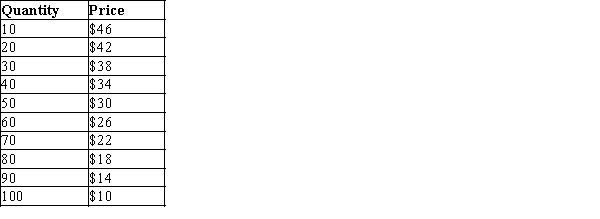 -Refer to Table 15-17. If the marginal cost of production is constant at $18 per unit, this profit-maximizing monopolist will choose to produce
 (Multiple Choice)
4.9/5 (84)
(84) Figure 15-3 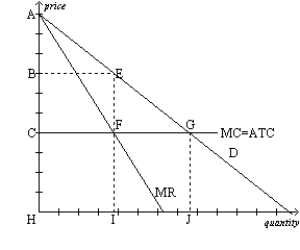 -Refer to Figure 15-3. If this firm were able to perfectly price discriminate, which letter represents the amount of output it would produce?
 (Short Answer)
4.9/5 (79)
(79) When deciding what price to charge consumers, the monopolist may choose to charge them different prices based on the customers'
(Multiple Choice)
4.9/5 (65)
(65) Which of the following statements is correct for both a monopolist and a perfectly competitive firm? (i)
The firm maximizes profits by equating marginal revenue with marginal cost.
(ii)
The firm maximizes profits by equating price with marginal cost.
(iii)
Demand equals marginal revenue.(iv)
Average revenue equals price.
(Multiple Choice)
5.0/5 (82)
(82) After the patent runs out on a brand name drug, generic drugs enter the market. What happens next in the market?
(Multiple Choice)
4.8/5 (78)
(78) Graphically depict the deadweight loss caused by a monopoly. How is this similar to the deadweight loss from taxation?
(Essay)
4.8/5 (90)
(90) When a monopolist increases the amount of output that it produces and sells, average revenue
(Multiple Choice)
5.0/5 (84)
(84) Deadweight loss measures the loss in society's welfare that occurs because a monopolist does not produce the socially efficient level of output.
(True/False)
4.9/5 (60)
(60) Many movie theaters allow discount tickets to be sold to senior citizens because
(Multiple Choice)
4.9/5 (84)
(84) To maximize total surplus with a monopoly firm, a benevolent social planner would choose the level of output where
(Multiple Choice)
4.8/5 (96)
(96) Drug companies are allowed to be monopolists in the drugs they discover in order to
(Multiple Choice)
4.7/5 (72)
(72) Figure 15-9 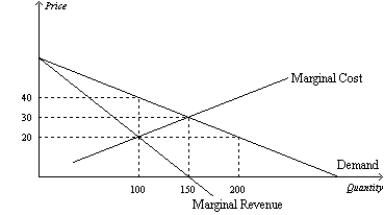 -Refer to Figure 15-9. To maximize total surplus, a benevolent social planner would choose which of the following outcomes?
 (Multiple Choice)
4.8/5 (68)
(68) 
Filters
- Essay(0)
- Multiple Choice(0)
- Short Answer(0)
- True False(0)
- Matching(0)