



 Chat with AI
Exam 15: Monopoly

Exam 1: Ten Principles of Economics455 Questions
Exam 2: Thinking Like an Economist645 Questions
Exam 3: Interdependence and the Gains From Trade550 Questions
Exam 4: The Market Forces of Supply and Demand693 Questions
Exam 5: Elasticity and Its Application625 Questions
Exam 6: Supply, Demand, and Government Policies671 Questions
Exam 7: Consumers, Producers, and the Efficiency of Markets547 Questions
Exam 8: Application: The Costs of Taxation507 Questions
Exam 9: Application: International Trade521 Questions
Exam 10: Externalities543 Questions
Exam 11: Public Goods and Common Resources453 Questions
Exam 12: The Design of the Tax System563 Questions
Exam 13: The Costs of Production649 Questions
Exam 14: Firms in Competitive Markets608 Questions
Exam 15: Monopoly662 Questions
Exam 16: Monopolistic Competition649 Questions
Exam 17: Oligopoly522 Questions
Exam 18: The Markets for the Factors of Production592 Questions
Exam 19: Earnings and Discrimination511 Questions
Exam 20: Income Inequality and Poverty478 Questions
Exam 21: The Theory of Consumer Choice568 Questions
Exam 22: Frontiers in Microeconomics461 Questions
Select questions type


Figure 15-2 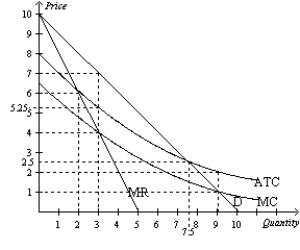 -Refer to Figure 15-2. If a regulator requires the firm to charge an average cost price, what price will the firm charge?
 (Short Answer)
4.9/5  (71)
(71) Suppose when a monopolist produces 50 units its average revenue is $8 per unit, its marginal revenue is $4 per unit, its marginal cost is $4 per unit, and its average total cost is $3 per unit. What can we conclude about this monopolist?
(Multiple Choice)
4.9/5 (74)
(74) Table 15-13
The following table gives information on the price, quantity, and total cost of production for a monopolist. 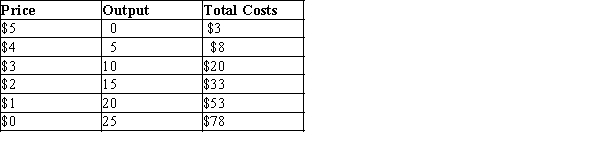 -Refer to Table 15-13. If the monopolist maximizes profits, he will charge a price of
 (Multiple Choice)
4.9/5 (87)
(87) Monopolies are inefficient because they (i)
Eliminate barriers to entry.
(ii)
Price their product at a level where marginal revenue exceeds marginal cost.
(iii)
Restrict output below the socially efficient level of production.
(Multiple Choice)
4.9/5 (87)
(87) Scenario 15-1
Vincent operates a scenic tour business in Boston. He has one bus which can fit 50 people per tour and each tour lasts 2 hours. His total cost of operating one tour is fixed at $450. Vincent's cost is not reduced if he runs a tour with a partially full bus. While his cost is the same for all tours, Vincent charges each passenger his/her willingness to pay: adults $18 per trip, children $10 per trip, and senior citizens $12 per trip. At those rates, on a typical day Vincent's demand is:  Assume that Vincent's customers are always available for the tour; therefore, he can fill his bus for each tour as long as there is sufficient total demand for the day.
-Refer to Scenario 15-1. What is Vincent's profit on a typical day?
Assume that Vincent's customers are always available for the tour; therefore, he can fill his bus for each tour as long as there is sufficient total demand for the day.
-Refer to Scenario 15-1. What is Vincent's profit on a typical day? (Short Answer)
5.0/5 (83)
(83) Table 15-19
A monopolist faces the following demand curve: 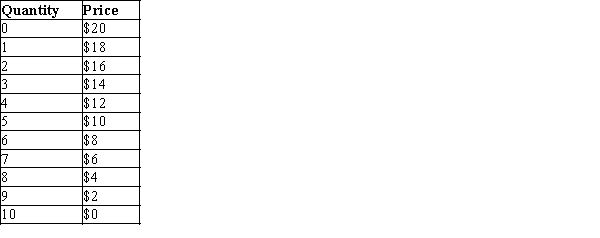 -Refer to Table 15-19. If a monopolist faces a constant marginal cost of $9, how much output should the firm produce?
 (Multiple Choice)
4.8/5 (75)
(75) Figure 15-17 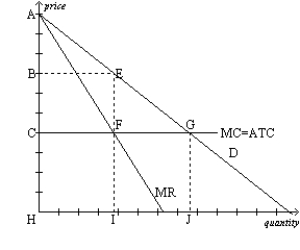 -Refer to Figure 15-17. Which of the following areas represents the profit earned by this profit-maximizing monopolist?
 (Multiple Choice)
4.9/5 (78)
(78) Financial aid to college students, quantity discounts, and senior citizen discounts are all examples of
(Multiple Choice)
4.8/5 (89)
(89) Drug companies are allowed to be monopolists in the drugs they discover in order to
(Multiple Choice)
5.0/5 (68)
(68) Figure 15-14 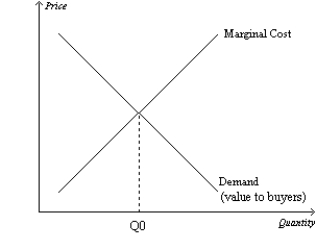 -Refer to Figure 15-14. If the monopoly operates at an output level less than Q0, then an increase in output toward (but not exceeding) Q0 would
 (Multiple Choice)
4.7/5 (75)
(75) A monopoly firm can sell 150 units of output for $10 per unit. Alternatively, it can sell 151 units of output for $9.90 per unit. The marginal revenue of the 151st unit of output is
(Multiple Choice)
4.8/5 (81)
(81) What are the four ways that government policymakers can respond to the problem of monopoly?
(Essay)
4.8/5 (84)
(84) Which of the following is not an example of a barrier to entry?
(Multiple Choice)
4.9/5 (88)
(88) Some prescription drugs sell for more in the United States than they do in other countries. Which of the following statements about this issue is most likely to be true?
(Multiple Choice)
4.8/5 (82)
(82) Figure 15-2 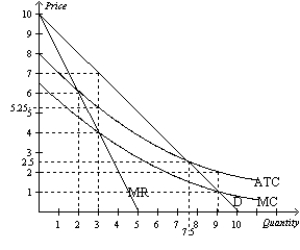 -Refer to Figure 15-2. Which of the following reasons describes the fundamental barrier to entry for the monopoly in the figure?
 (Multiple Choice)
4.8/5 (75)
(75) The George Stigler quote, "...the degree of 'market failure' for the American economy is much smaller than the 'political failure' arising from the imperfections of economic policies ..." illustrates the advantage of which type of public policy toward monopolies?
(Multiple Choice)
4.7/5 (76)
(76) Which of the following can eliminate the inefficiency inherent in monopoly pricing?
(Multiple Choice)
4.8/5 (82)
(82) 
Filters
- Essay(0)
- Multiple Choice(0)
- Short Answer(0)
- True False(0)
- Matching(0)