



 Chat with AI
Exam 15: Monopoly

Exam 1: Ten Principles of Economics455 Questions
Exam 2: Thinking Like an Economist645 Questions
Exam 3: Interdependence and the Gains From Trade550 Questions
Exam 4: The Market Forces of Supply and Demand693 Questions
Exam 5: Elasticity and Its Application625 Questions
Exam 6: Supply, Demand, and Government Policies671 Questions
Exam 7: Consumers, Producers, and the Efficiency of Markets547 Questions
Exam 8: Application: The Costs of Taxation507 Questions
Exam 9: Application: International Trade521 Questions
Exam 10: Externalities543 Questions
Exam 11: Public Goods and Common Resources453 Questions
Exam 12: The Design of the Tax System563 Questions
Exam 13: The Costs of Production649 Questions
Exam 14: Firms in Competitive Markets608 Questions
Exam 15: Monopoly662 Questions
Exam 16: Monopolistic Competition649 Questions
Exam 17: Oligopoly522 Questions
Exam 18: The Markets for the Factors of Production592 Questions
Exam 19: Earnings and Discrimination511 Questions
Exam 20: Income Inequality and Poverty478 Questions
Exam 21: The Theory of Consumer Choice568 Questions
Exam 22: Frontiers in Microeconomics461 Questions
Select questions type


Which of the following is a characteristic of a natural monopoly?
(Multiple Choice)
4.9/5  (81)
(81) In the market for "home heating" consumers typically have several options (e.g., electricity, heating fuel, natural gas, propane, etc.), yet we often think of firms in this industry as behaving like monopolists. Discuss the context in which your electricity provider is a monopolist. Is this characterization universally applicable? Explain your answer.
(Essay)
4.7/5 (93)
(93) Table 15-4
A monopolist faces the following demand curve: 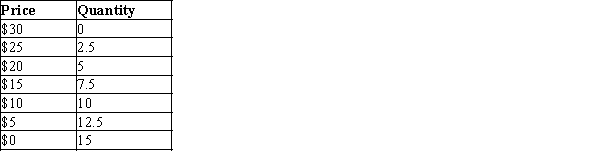 -Refer to Table 15-4. In order to maximize total revenues, the monopolist should produce
 (Multiple Choice)
4.9/5 (88)
(88) Some companies merge in order to lower costs through efficient joint production.
(True/False)
4.8/5 (73)
(73) Comparing firms in perfectly competitive markets to monopoly firms, which can earn economic profits in the long run?
(Short Answer)
4.9/5 (77)
(77) Table 15-10
The monopolist faces the following demand curve: 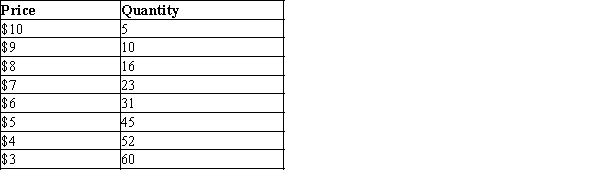 -Refer to Table 15-10. If the monopolist has total fixed costs of $40 and a constant marginal cost of $5, what is the profit-maximizing level of output?
 (Multiple Choice)
4.9/5 (76)
(76) The best solution to the problem of welfare loss from monopoly is public ownership.
(True/False)
4.7/5 (89)
(89) Scenario 15-8
Mega Media Cable TV is able to purchase an exclusive right to sell a premium sports channel in its market area. Let's assume that Mega Media pays $100,000 a year for the exclusive marketing rights to the sports channel. Since Mega Media has already installed cable to all of the homes in its market area, the marginal cost of delivering the sports channel to subscribers is zero. The manager of Mega Media needs to know what price to charge for the sports channel service to maximize her profit. Before setting price, she hires an economist to estimate demand for the sports channel. The economist discovers that there are two types of subscribers who value premium sporting channels. First are the 3,000 die-hard sports fans who will pay as much as $150 a year for the new channel. Second, the premium sports channel will appeal to 20,000 occasional sports viewers who will pay as much as $25 a year for a subscription to it.
-Refer to Scenario 15-8. If Mega Media Cable TV is unable to price discriminate, what price will it choose to maximize its profit, and what is the amount of the profit?
(Multiple Choice)
4.9/5 (70)
(70) Figure 15-6 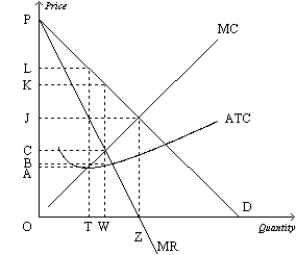 -Refer to Figure 15-6. What area measures the monopolist's profit?
 (Multiple Choice)
4.9/5 (89)
(89) Table 15-7
Sally owns the only shoe store in town. She has the following cost and revenue information. 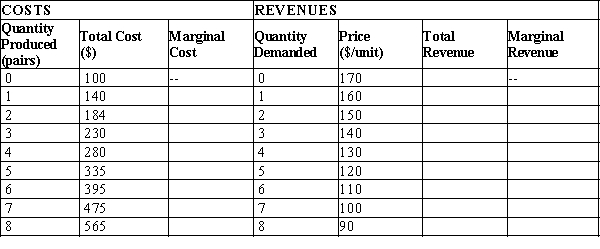 -Refer to Table 15-7. What is the marginal revenue from selling the 8th pair of shoes?
 (Multiple Choice)
4.9/5 (66)
(66) Policymakers are discussing various proposals regarding how to deal with natural monopolies. Senator Huff wants to regulate natural monopolies by equating price with average total cost. Huff contends that such a policy will ensure that monopolies make every effort to reduce costs. Senator Puff wants the government to own natural monopolies. Puff argues that government-owned monopolies usually do a better job of holding down costs than privately owned monopolies. Which senator's argument is correct?
(Multiple Choice)
4.8/5 (84)
(84) When a firm's average total cost curve continually declines, the firm is a
(Multiple Choice)
4.8/5 (79)
(79) The legislation passed by Congress in 1890 to reduce the market power of large and powerful "trusts" was the
(Multiple Choice)
4.8/5 (91)
(91) Table 15-20
A monopolist faces the following demand curve: 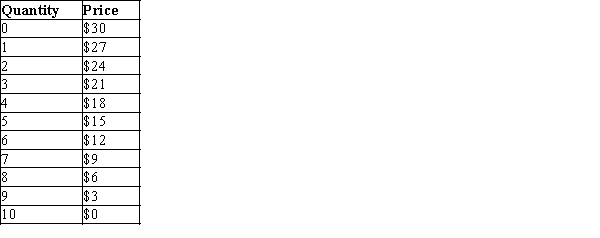 -Refer to Table 15-20. If a monopolist faces a constant marginal cost of $5, how much output should the firm produce in order to maximize profit?
 (Multiple Choice)
4.8/5 (80)
(80) Scenario 15-10
Vincent operates a scenic tour business in Boston. He has one bus which can fit 50 people per tour and each tour lasts 2 hours. His total cost of operating one tour is fixed at $450. Vincent's cost is not reduced if he runs a tour with a partially full bus. While his cost is the same for all tours, Vincent charges each passenger his/her willingness to pay: adults $18 per trip, children $10 per trip, and senior citizens $12 per trip. At those rates, on a typical day Vincent's demand is:  Assume that Vincent's customers are always available for the tour; therefore, he can fill his bus for each tour as long as there is sufficient total demand for the day.
-Refer to Scenario 15-10. Vincent is considering changing his pricing strategy. Which of the following options results in the highest profit per day?
Assume that Vincent's customers are always available for the tour; therefore, he can fill his bus for each tour as long as there is sufficient total demand for the day.
-Refer to Scenario 15-10. Vincent is considering changing his pricing strategy. Which of the following options results in the highest profit per day? (Multiple Choice)
4.8/5 (69)
(69) 
Filters
- Essay(0)
- Multiple Choice(0)
- Short Answer(0)
- True False(0)
- Matching(0)