



 Chat with AI
Exam 15: Monopoly

Exam 1: Ten Principles of Economics455 Questions
Exam 2: Thinking Like an Economist645 Questions
Exam 3: Interdependence and the Gains From Trade550 Questions
Exam 4: The Market Forces of Supply and Demand693 Questions
Exam 5: Elasticity and Its Application625 Questions
Exam 6: Supply, Demand, and Government Policies671 Questions
Exam 7: Consumers, Producers, and the Efficiency of Markets547 Questions
Exam 8: Application: The Costs of Taxation507 Questions
Exam 9: Application: International Trade521 Questions
Exam 10: Externalities543 Questions
Exam 11: Public Goods and Common Resources453 Questions
Exam 12: The Design of the Tax System563 Questions
Exam 13: The Costs of Production649 Questions
Exam 14: Firms in Competitive Markets608 Questions
Exam 15: Monopoly662 Questions
Exam 16: Monopolistic Competition649 Questions
Exam 17: Oligopoly522 Questions
Exam 18: The Markets for the Factors of Production592 Questions
Exam 19: Earnings and Discrimination511 Questions
Exam 20: Income Inequality and Poverty478 Questions
Exam 21: The Theory of Consumer Choice568 Questions
Exam 22: Frontiers in Microeconomics461 Questions
Select questions type


Suppose a profit-maximizing monopolist faces a constant marginal cost of $10, produces an output level of 100 units, and charges a price of $50. The socially efficient level of output is 200 units. Assume that the demand curve and marginal revenue curve are the typical downward-sloping straight lines. The monopoly deadweight loss equals $4,000.
(True/False)
4.9/5  (91)
(91) A monopoly is an inefficient way to produce a product because
(Multiple Choice)
4.7/5 (85)
(85) Scenario 15-6
The concert promoters of a heavy-metal band, WeR2Loud, know that there are two types of concert-goers: die-hard fans and casual fans. For a particular WeR2Loud concert, there are 1,000 die-hard fans who will pay $150 for a ticket and 500 casual fans who will pay $50 for a ticket. There are 1,500 seats available at the concert venue. Suppose the cost of putting on the concert is $50,000, which includes the cost of the band, lighting, security, etc.
-Refer to Scenario 15-6. How much profit will the concert promoters earn if they set the price of each ticket at $150?
(Multiple Choice)
5.0/5 (73)
(73) For a monopoly market, total surplus can be defined as the value of the good to
(Multiple Choice)
4.9/5 (68)
(68) Figure 15-22
The diagram depicts the market situation for a monopoly pastry shop called Bearclaws. 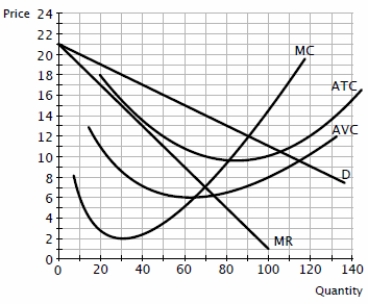 -Refer to Figure 15-22. Given that Bearclaws chooses the profit maximizing price and quantity, what profit level will it obtain?
 (Multiple Choice)
5.0/5 (76)
(76) In both perfectly competitive and monopoly markets, the price per unit of a good is equal to the
(Short Answer)
4.8/5 (74)
(74) A patent gives a single person or firm the exclusive right to sell some good or service for a specific period of time.
(True/False)
4.9/5 (73)
(73) The economic inefficiency of a monopolist can be measured by the
(Multiple Choice)
4.8/5 (84)
(84) Because monopoly firms do not have to compete with other firms, the outcome in a market with a monopoly is often
(Multiple Choice)
4.9/5 (80)
(80) Table 15-7
Sally owns the only shoe store in town. She has the following cost and revenue information. 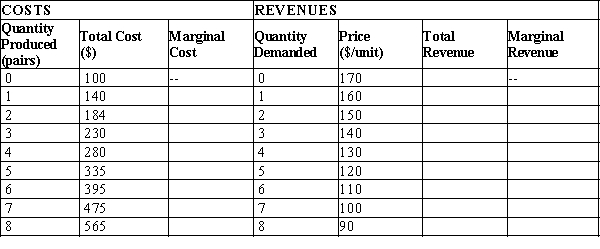 -Refer to Table 15-7. What is the total variable cost of production when Sally produces six pairs of shoes?
 (Multiple Choice)
4.7/5 (71)
(71) Which of the following statements is true about patents and copyrights? (i)
They have benefits and costs.
(ii)
They lead to higher prices.
(iii)
They enhance the ability of monopolists to earn above-average profits.
(Multiple Choice)
4.8/5 (72)
(72) Which of the following is not an example of price discrimination?
(Multiple Choice)
4.9/5 (58)
(58) Figure 15-17 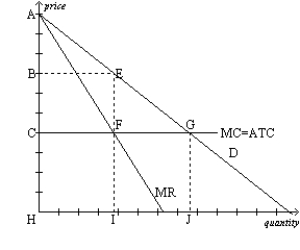 -Refer to Figure 15-17. Which of the following statements best describes the changes that would occur if this firm were to switch from operating as a single price profit-maximizing monopolist to perfect price discrimination?
 (Multiple Choice)
4.9/5 (69)
(69) Table 15-18
A monopolist faces the following demand curve: 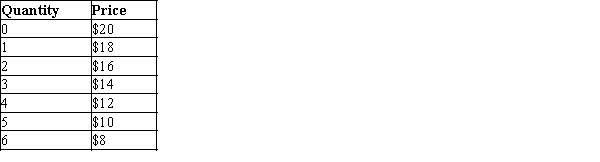 Suppose marginal cost is constant at $8 per unit.
-Refer to Table 15-18. The monopolist's total revenue from selling 4 units of output is
Suppose marginal cost is constant at $8 per unit.
-Refer to Table 15-18. The monopolist's total revenue from selling 4 units of output is (Multiple Choice)
4.9/5 (82)
(82) Figure 15-4 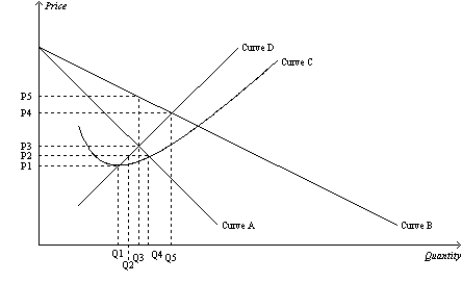 -Refer to Figure 15-4. If the monopoly firm is currently producing Q3 units of output, then a decrease in output will necessarily cause profit to
 (Multiple Choice)
4.9/5 (84)
(84) 
Filters
- Essay(0)
- Multiple Choice(0)
- Short Answer(0)
- True False(0)
- Matching(0)