



 Chat with AI
Exam 15: Monopoly

Exam 1: Ten Principles of Economics455 Questions
Exam 2: Thinking Like an Economist645 Questions
Exam 3: Interdependence and the Gains From Trade550 Questions
Exam 4: The Market Forces of Supply and Demand693 Questions
Exam 5: Elasticity and Its Application625 Questions
Exam 6: Supply, Demand, and Government Policies671 Questions
Exam 7: Consumers, Producers, and the Efficiency of Markets547 Questions
Exam 8: Application: The Costs of Taxation507 Questions
Exam 9: Application: International Trade521 Questions
Exam 10: Externalities543 Questions
Exam 11: Public Goods and Common Resources453 Questions
Exam 12: The Design of the Tax System563 Questions
Exam 13: The Costs of Production649 Questions
Exam 14: Firms in Competitive Markets608 Questions
Exam 15: Monopoly662 Questions
Exam 16: Monopolistic Competition649 Questions
Exam 17: Oligopoly522 Questions
Exam 18: The Markets for the Factors of Production592 Questions
Exam 19: Earnings and Discrimination511 Questions
Exam 20: Income Inequality and Poverty478 Questions
Exam 21: The Theory of Consumer Choice568 Questions
Exam 22: Frontiers in Microeconomics461 Questions
Select questions type


Table 15-2
Tanya has the following demand curve for selling taffy. Assume that Tanya has a marginal cost of $3 per unit. 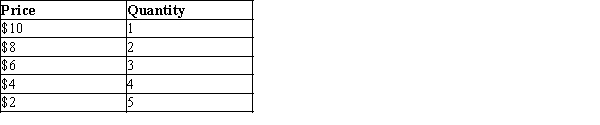 -Refer to Table 15-2. What is Tanya's profit-maximizing level of output?
 (Multiple Choice)
4.8/5  (83)
(83) What is the shape of the monopolist's marginal revenue curve?
(Multiple Choice)
4.8/5 (75)
(75) Figure 15-5 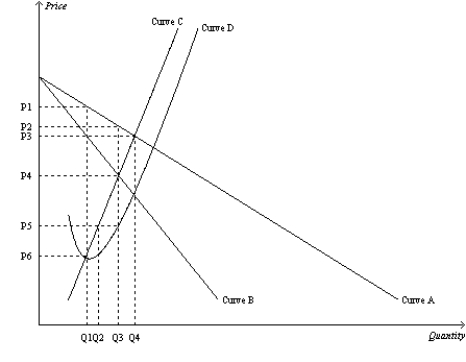 -Refer to Figure 15-5. Profit on a typical unit sold for a profit-maximizing monopoly would equal
 (Multiple Choice)
4.9/5 (85)
(85) Table 15-6
A monopolist faces the following demand curve: 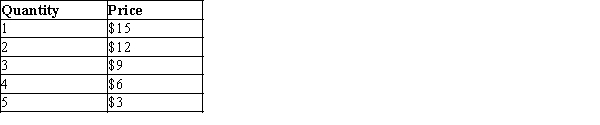 -Refer to Table 15-6. Suppose the monopolist has total fixed costs equal to $5 and a variable cost equal to $4 per unit for all units produced. What would the total profit be if she charged $6 per unit for her product?
 (Multiple Choice)
4.9/5 (76)
(76) Private ownership of a monopoly may benefit society because the monopoly will have an incentive to
(Multiple Choice)
4.9/5 (70)
(70) Table 15-18
A monopolist faces the following demand curve: 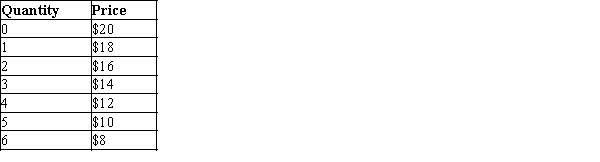 Suppose marginal cost is constant at $8 per unit.
-Refer to Table 15-18. When the price effect on revenue is greater than the output effect, marginal revenue is
Suppose marginal cost is constant at $8 per unit.
-Refer to Table 15-18. When the price effect on revenue is greater than the output effect, marginal revenue is (Multiple Choice)
4.7/5 (66)
(66) A natural monopoly has economies of scale for most if not all of its range of output.
(True/False)
4.8/5 (70)
(70) Which of the following is a characteristic of a natural monopoly?
(Multiple Choice)
4.9/5 (91)
(91) Which of the following statements is (are) true of a monopoly? (i)
A monopoly has the ability to set the price of its product at whatever level it desires.
(ii)
A monopoly's total revenue will always increase when it increases the price of its product.
(iii)
The more a monopoly increases output, the higher the profits.
(Multiple Choice)
4.8/5 (75)
(75) Suppose a profit-maximizing monopolist faces a constant marginal cost of $20, produces an output level of 100 units, and charges a price of $50. The socially efficient level of output is 200 units. Assume that the demand curve and marginal revenue curve are the typical downward-sloping straight lines. The monopoly deadweight loss equals $1,500.
(True/False)
4.8/5 (81)
(81) Which of the following is an example of price discrimination?
(Multiple Choice)
4.9/5 (75)
(75) Figure 15-18 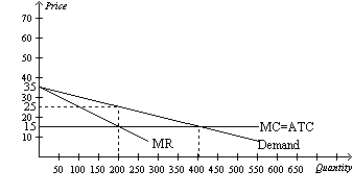 -Refer to Figure 15-18. If the monopoly firm is not allowed to price discriminate, then the deadweight loss amounts to
 (Multiple Choice)
4.8/5 (84)
(84) Goods that do not have close substitutes have downward-sloping demand curves.
(True/False)
5.0/5 (92)
(92) The legislation passed by Congress in 1914 to strengthen the government's powers and authorize private lawsuits was the
(Multiple Choice)
4.8/5 (64)
(64) Because a monopolist must lower its price in order to sell another unit of output,
(Multiple Choice)
4.8/5 (72)
(72) 
Filters
- Essay(0)
- Multiple Choice(0)
- Short Answer(0)
- True False(0)
- Matching(0)