



 Chat with AI
Exam 15: Monopoly

Exam 1: Ten Principles of Economics455 Questions
Exam 2: Thinking Like an Economist645 Questions
Exam 3: Interdependence and the Gains From Trade550 Questions
Exam 4: The Market Forces of Supply and Demand693 Questions
Exam 5: Elasticity and Its Application625 Questions
Exam 6: Supply, Demand, and Government Policies671 Questions
Exam 7: Consumers, Producers, and the Efficiency of Markets547 Questions
Exam 8: Application: The Costs of Taxation507 Questions
Exam 9: Application: International Trade521 Questions
Exam 10: Externalities543 Questions
Exam 11: Public Goods and Common Resources453 Questions
Exam 12: The Design of the Tax System563 Questions
Exam 13: The Costs of Production649 Questions
Exam 14: Firms in Competitive Markets608 Questions
Exam 15: Monopoly662 Questions
Exam 16: Monopolistic Competition649 Questions
Exam 17: Oligopoly522 Questions
Exam 18: The Markets for the Factors of Production592 Questions
Exam 19: Earnings and Discrimination511 Questions
Exam 20: Income Inequality and Poverty478 Questions
Exam 21: The Theory of Consumer Choice568 Questions
Exam 22: Frontiers in Microeconomics461 Questions
Select questions type


If a product can be produced by a natural monopoly, society will benefit in the form of lower prices if the monopolist is broken up into several smaller firms.
(True/False)
4.8/5  (96)
(96) A patent gives a single person or firm the exclusive right to sell some good or service forever.
(True/False)
4.9/5 (82)
(82) Price discrimination is a rational strategy for a profit-maximizing monopolist when
(Multiple Choice)
4.8/5 (75)
(75) Scenario 15-7
Black Box Cable TV is able to purchase an exclusive right to sell a premium movie channel (PMC) in its market area. Let's assume that Black Box Cable pays $150,000 a year for the exclusive marketing rights to PMC. Since Black Box has already installed cable to all of the homes in its market area, the marginal cost of delivering PMC to subscribers is zero. The manager of Black Box needs to know what price to charge for the PMC service to maximize her profit. Before setting price, she hires an economist to estimate demand for the PMC service. The economist discovers that there are two types of subscribers who value premium movie channels. First are the 4,000 die-hard TV viewers who will pay as much as $150 a year for the new PMC premium channel. Second, the PMC channel will appeal to 20,000 occasional TV viewers who will pay as much as $20 a year for a subscription to PMC.
-Refer to Scenario 15-7. If Black Box Cable TV is able to price discriminate, what would be the maximum amount of profit it could generate?
(Multiple Choice)
4.8/5 (80)
(80) Which of the following is not an example of price discrimination by a firm?
(Multiple Choice)
4.8/5 (76)
(76) Figure 15-22
The diagram depicts the market situation for a monopoly pastry shop called Bearclaws. 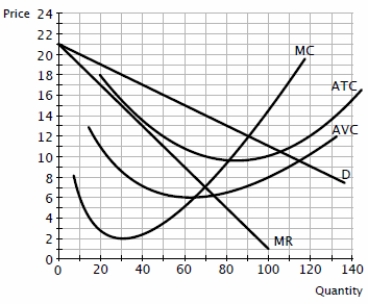 -Refer to Figure 15-22. Based upon the information shown, what is total revenue for Bearclaws, given that it maximizes profits?
 (Multiple Choice)
4.7/5 (67)
(67) A patent gives the inventor monopoly control over the patented good. Patents also
(Multiple Choice)
4.8/5 (76)
(76) The price effect describes the situation when a monopolist lowers the price of output and, all else equal, total revenue
(Multiple Choice)
5.0/5 (67)
(67) Figure 15-1 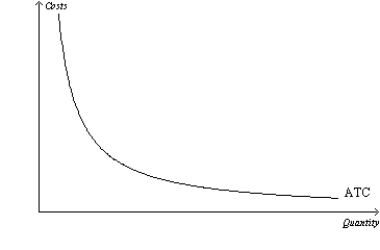 -Refer to Figure 15-1. The shape of the average total cost curve in the figure suggests an opportunity for a profit-maximizing monopolist to take advantage of
 (Multiple Choice)
4.8/5 (82)
(82) In a monopoly market, the socially efficient quantity of output is typically higher than the profit-maximizing quantity of output for the monopolist.
(True/False)
4.9/5 (74)
(74) Which of the following are necessary characteristics of a monopoly? (i)
The firm is the sole seller of its product.
(ii)
The firm's product does not have close substitutes.
(iii)
The firm generates a large economic profit.
(iv)
The firm is located in a small geographic market.
(Multiple Choice)
5.0/5 (80)
(80) Which of the following would be most likely to have monopoly power?
(Multiple Choice)
4.8/5 (70)
(70) Scenario 15-1
Vincent operates a scenic tour business in Boston. He has one bus which can fit 50 people per tour and each tour lasts 2 hours. His total cost of operating one tour is fixed at $450. Vincent's cost is not reduced if he runs a tour with a partially full bus. While his cost is the same for all tours, Vincent charges each passenger his/her willingness to pay: adults $18 per trip, children $10 per trip, and senior citizens $12 per trip. At those rates, on a typical day Vincent's demand is:  Assume that Vincent's customers are always available for the tour; therefore, he can fill his bus for each tour as long as there is sufficient total demand for the day.
-Refer to Scenario 15-1. What is Vincent's cost of serving all passengers demanding a tour on a typical day?
Assume that Vincent's customers are always available for the tour; therefore, he can fill his bus for each tour as long as there is sufficient total demand for the day.
-Refer to Scenario 15-1. What is Vincent's cost of serving all passengers demanding a tour on a typical day? (Short Answer)
4.7/5 (75)
(75) Table 15-20
A monopolist faces the following demand curve: 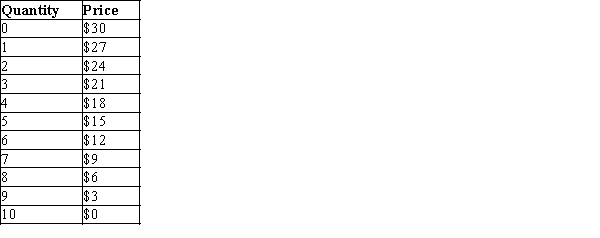 -Refer to Table 15-20. If a monopolist faces a constant marginal cost of $20, how much output should the firm produce in order to maximize profit?
 (Multiple Choice)
4.9/5 (72)
(72) 
Filters
- Essay(0)
- Multiple Choice(0)
- Short Answer(0)
- True False(0)
- Matching(0)