



 Chat with AI
Exam 15: Monopoly

Exam 1: Ten Principles of Economics455 Questions
Exam 2: Thinking Like an Economist645 Questions
Exam 3: Interdependence and the Gains From Trade550 Questions
Exam 4: The Market Forces of Supply and Demand693 Questions
Exam 5: Elasticity and Its Application625 Questions
Exam 6: Supply, Demand, and Government Policies671 Questions
Exam 7: Consumers, Producers, and the Efficiency of Markets547 Questions
Exam 8: Application: The Costs of Taxation507 Questions
Exam 9: Application: International Trade521 Questions
Exam 10: Externalities543 Questions
Exam 11: Public Goods and Common Resources453 Questions
Exam 12: The Design of the Tax System563 Questions
Exam 13: The Costs of Production649 Questions
Exam 14: Firms in Competitive Markets608 Questions
Exam 15: Monopoly662 Questions
Exam 16: Monopolistic Competition649 Questions
Exam 17: Oligopoly522 Questions
Exam 18: The Markets for the Factors of Production592 Questions
Exam 19: Earnings and Discrimination511 Questions
Exam 20: Income Inequality and Poverty478 Questions
Exam 21: The Theory of Consumer Choice568 Questions
Exam 22: Frontiers in Microeconomics461 Questions
Select questions type


Table 15-9
Consider the following demand and cost information for a monopoly. 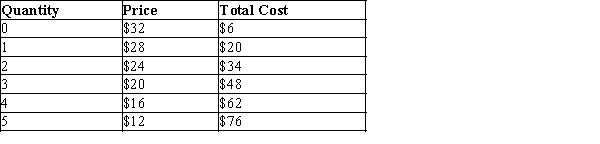 -Refer to Table 15-9. What price should the monopoly charge to maximize profit?
 (Multiple Choice)
4.8/5  (89)
(89) When a firm experiences continually declining average total costs,
(Multiple Choice)
4.9/5 (85)
(85) What is the deadweight loss due to profit-maximizing monopoly pricing under the following conditions: The price charged for goods produced is $10. The intersection of the marginal revenue and marginal cost curves occurs where output is 100 units and marginal revenue is $5. The socially efficient level of production is 110 units. The demand curve is linear and downward sloping, and the marginal cost curve is constant.
(Short Answer)
4.8/5 (82)
(82) The key issue in determining the efficiency of public versus private ownership of a monopoly is
(Multiple Choice)
4.7/5 (65)
(65) One problem with regulating a monopolist on the basis of cost is that
(Multiple Choice)
4.9/5 (85)
(85) Figure 15-1 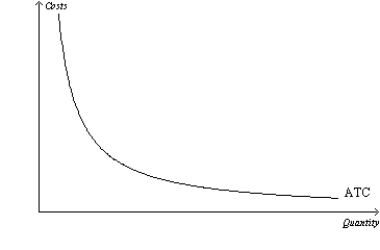 -Refer to Figure 15-1. Considering the relationship between average total cost and marginal cost, the marginal cost curve for this firm
 (Multiple Choice)
4.9/5 (79)
(79) Table 15-7
Sally owns the only shoe store in town. She has the following cost and revenue information. 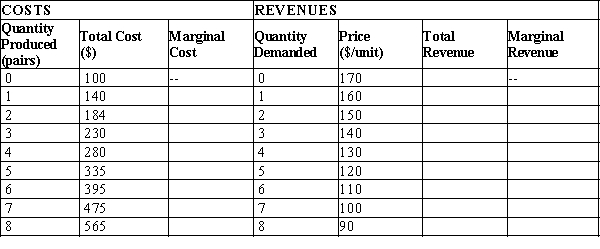 -Refer to Table 15-7. What is the total revenue from selling 8 pairs of shoes?
 (Multiple Choice)
4.9/5 (80)
(80) Figure 15-12 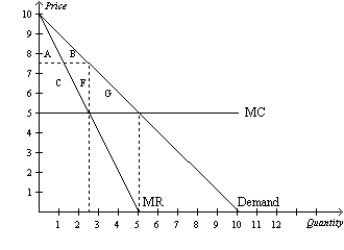 -Refer to Figure 15-12. Which area represents the deadweight loss from monopoly?
 (Multiple Choice)
4.9/5 (74)
(74) Which of the following is not a reason for the existence of a monopoly?
(Multiple Choice)
4.7/5 (98)
(98) In a market characterized by monopoly, the market demand curve is
(Multiple Choice)
4.8/5 (81)
(81) Without price discrimination, the monopolist sells every unit at the same price. As a consequence,
(Multiple Choice)
4.8/5 (74)
(74) Table 15-21
Tommy's Tie Company, a monopolist, has the following cost and revenue information. Assume that Tommy's is able to engage in perfect price discrimination. 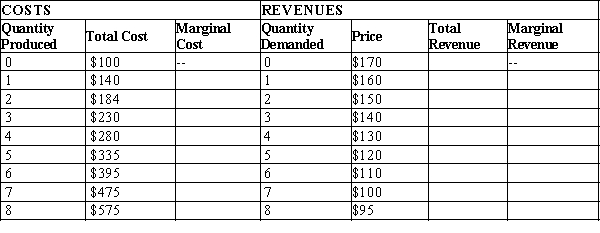 -Refer to Table 15-21. If the monopolist can engage in perfect price discrimination, what is the marginal revenue from selling the 8th tie?
 (Multiple Choice)
4.8/5 (91)
(91) A profit-maximizing monopolist charges a price of $14. The intersection of the marginal revenue curve and the marginal cost curve occurs where output is 15 units and marginal cost is $7. What is the monopolist's profit?
(Multiple Choice)
5.0/5 (85)
(85) What happens to the price and quantity sold of a drug when its patent runs out? (i)
The price will fall.
(ii)
The quantity sold will fall.
(iii)
The marginal cost of producing the drug will rise.
(Multiple Choice)
4.9/5 (66)
(66) 
Filters
- Essay(0)
- Multiple Choice(0)
- Short Answer(0)
- True False(0)
- Matching(0)