



 Chat with AI
Exam 15: Monopoly

Exam 1: Ten Principles of Economics455 Questions
Exam 2: Thinking Like an Economist645 Questions
Exam 3: Interdependence and the Gains From Trade550 Questions
Exam 4: The Market Forces of Supply and Demand693 Questions
Exam 5: Elasticity and Its Application625 Questions
Exam 6: Supply, Demand, and Government Policies671 Questions
Exam 7: Consumers, Producers, and the Efficiency of Markets547 Questions
Exam 8: Application: The Costs of Taxation507 Questions
Exam 9: Application: International Trade521 Questions
Exam 10: Externalities543 Questions
Exam 11: Public Goods and Common Resources453 Questions
Exam 12: The Design of the Tax System563 Questions
Exam 13: The Costs of Production649 Questions
Exam 14: Firms in Competitive Markets608 Questions
Exam 15: Monopoly662 Questions
Exam 16: Monopolistic Competition649 Questions
Exam 17: Oligopoly522 Questions
Exam 18: The Markets for the Factors of Production592 Questions
Exam 19: Earnings and Discrimination511 Questions
Exam 20: Income Inequality and Poverty478 Questions
Exam 21: The Theory of Consumer Choice568 Questions
Exam 22: Frontiers in Microeconomics461 Questions
Select questions type


Table 15-5
A monopolist faces the following demand curve: 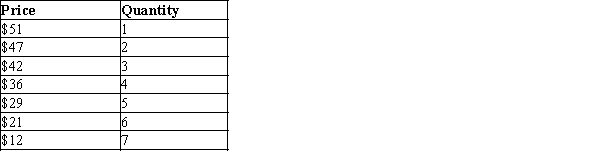 -Refer to Table 15-5. The monopolist has total fixed costs of $60 and has a constant marginal cost of $15. What is the profit-maximizing price?
 (Multiple Choice)
5.0/5  (84)
(84) Firms with substantial monopoly power are quite common because many goods are unique.
(True/False)
4.9/5 (66)
(66) Which statement best describes the effect(s) that occur when a monopoly firm reduces the price of its product?
(Multiple Choice)
4.8/5 (92)
(92) Figure 15-5 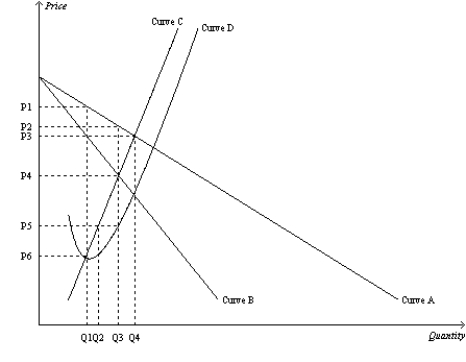 -Refer to Figure 15-5. A profit-maximizing monopoly's total cost is equal to
 (Multiple Choice)
4.9/5 (96)
(96) When a firm operates under conditions of monopoly, its price is
(Multiple Choice)
4.9/5 (80)
(80) Competitive firms differ from monopolies in which of the following ways? (i)
Competitive firms do not have to worry about the price effect lowering their total revenue.(ii)
Marginal revenue for a competitive firm equals price, while marginal revenue for a monopoly is less than the price it is able to charge.(iii)
Monopolies must lower their price in order to sell more of their product, while competitive firms do not.
(Multiple Choice)
5.0/5 (78)
(78) Which of the following governmental actions would eliminate some or all of the inefficiency that results from monopoly pricing? The government could
(Multiple Choice)
4.8/5 (89)
(89) Table 15-12
The following table provides information on the price, quantity, and average total cost for a monopoly. 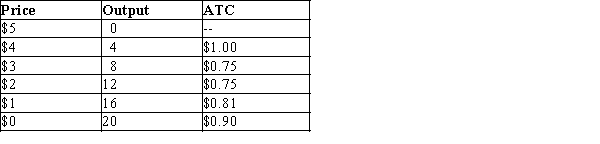 -Refer to Table 15-12. If the firm produces the profit-maximizing level of output, it will earn profits of
 (Multiple Choice)
4.9/5 (76)
(76) Which of the following is an example of a barrier to entry? (i)
A key resource is owned by a single firm.
(ii)
The costs of production make a single producer more efficient than a large number of producers.
(iii)
The government has given the existing monopolist the exclusive right to produce the good.
(Multiple Choice)
4.9/5 (81)
(81) The three main sources of barriers to entry are monopoly resources, government regulation, and the firm's production process.
(True/False)
4.8/5 (71)
(71) Like competitive firms, monopolies charge a price equal to marginal cost.
(True/False)
4.7/5 (83)
(83) Table 15-1 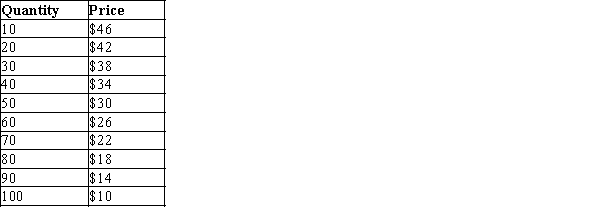 -Refer to Table 15-1. The marginal revenue, when the quantity changes from 30 to 40 units, is
 (Short Answer)
4.7/5 (68)
(68) Scenario 15-9
Suppose executives at an art museum know that 100 adults are willing to pay $12 for admission to the museum on a weekday. Suppose the executives also know that 200 students are willing to pay $8 for admission on a weekday. The cost of operating the museum on a weekday is $2,000.
-Refer to Scenario 15-9. How much profit will the museum earn if it charges all customers $8 for admission?
(Multiple Choice)
4.7/5 (74)
(74) Suppose most people regard emeralds, rubies, and sapphires as close substitutes for diamonds. Then DeBeers, a large diamond company, has
(Multiple Choice)
5.0/5 (65)
(65) Table 15-4
A monopolist faces the following demand curve: 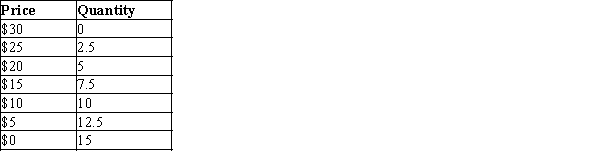 -Refer to Table 15-4. If the monopolist produces 5 units, what is its average revenue?
 (Multiple Choice)
4.9/5 (69)
(69) Figure 15-3 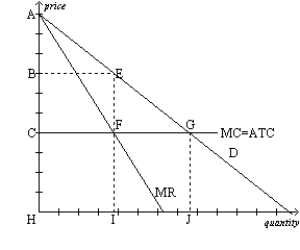 -Refer to Figure 15-3. Which letter represents the profit-maximizing quantity chosen by the single price monopolist?
 (Short Answer)
4.8/5 (76)
(76) Figure 15-21 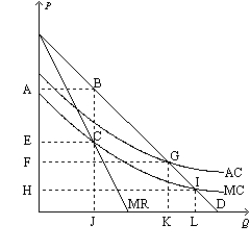 -Refer to Figure 15-21. Which of the following areas describes the profit of this natural monopolist under socially optimal pricing?
 (Multiple Choice)
5.0/5 (80)
(80) Figure 15-19 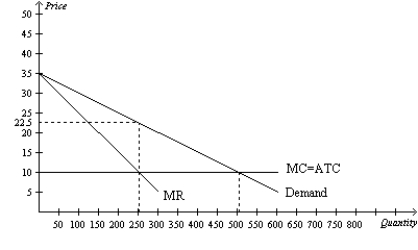 -Refer to Figure 15-19. If there are no fixed costs of production, monopoly profit without price discrimination equals
 (Multiple Choice)
4.8/5 (69)
(69) If a monopoly market were to be transformed into a competitive market, the result would be that
(Multiple Choice)
4.9/5 (83)
(83) 
Filters
- Essay(0)
- Multiple Choice(0)
- Short Answer(0)
- True False(0)
- Matching(0)