



 Chat with AI
Exam 15: Monopoly

Exam 1: Ten Principles of Economics455 Questions
Exam 2: Thinking Like an Economist645 Questions
Exam 3: Interdependence and the Gains From Trade550 Questions
Exam 4: The Market Forces of Supply and Demand693 Questions
Exam 5: Elasticity and Its Application625 Questions
Exam 6: Supply, Demand, and Government Policies671 Questions
Exam 7: Consumers, Producers, and the Efficiency of Markets547 Questions
Exam 8: Application: The Costs of Taxation507 Questions
Exam 9: Application: International Trade521 Questions
Exam 10: Externalities543 Questions
Exam 11: Public Goods and Common Resources453 Questions
Exam 12: The Design of the Tax System563 Questions
Exam 13: The Costs of Production649 Questions
Exam 14: Firms in Competitive Markets608 Questions
Exam 15: Monopoly662 Questions
Exam 16: Monopolistic Competition649 Questions
Exam 17: Oligopoly522 Questions
Exam 18: The Markets for the Factors of Production592 Questions
Exam 19: Earnings and Discrimination511 Questions
Exam 20: Income Inequality and Poverty478 Questions
Exam 21: The Theory of Consumer Choice568 Questions
Exam 22: Frontiers in Microeconomics461 Questions
Select questions type


Microsoft faces very little competition from other firms for its Windows software. Why isn't the price of the software $1,000 per copy?
(Multiple Choice)
4.9/5  (77)
(77) Antitrust laws have economic benefits that outweigh the costs if they
(Multiple Choice)
4.7/5 (73)
(73) Scenario 15-8
Mega Media Cable TV is able to purchase an exclusive right to sell a premium sports channel in its market area. Let's assume that Mega Media pays $100,000 a year for the exclusive marketing rights to the sports channel. Since Mega Media has already installed cable to all of the homes in its market area, the marginal cost of delivering the sports channel to subscribers is zero. The manager of Mega Media needs to know what price to charge for the sports channel service to maximize her profit. Before setting price, she hires an economist to estimate demand for the sports channel. The economist discovers that there are two types of subscribers who value premium sporting channels. First are the 3,000 die-hard sports fans who will pay as much as $150 a year for the new channel. Second, the premium sports channel will appeal to 20,000 occasional sports viewers who will pay as much as $25 a year for a subscription to it.
-Refer to Scenario 15-8. How much profit will Mega Media Cable TV earn if it sets the price at $150?
(Multiple Choice)
4.9/5 (77)
(77) Figure 15-4 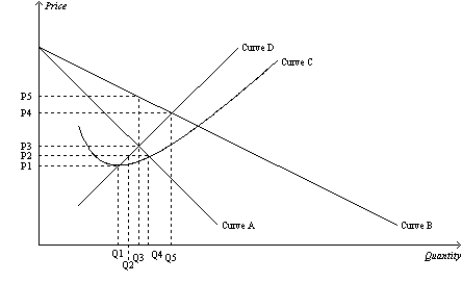 -Refer to Figure 15-4. If the monopoly firm wants to maximize its profit, it should operate at a level of output equal to
 (Multiple Choice)
4.9/5 (76)
(76) Which of the following is not a characteristic of a monopoly?
(Multiple Choice)
5.0/5 (89)
(89) Splitting up a monopoly is often justified on the grounds that
(Multiple Choice)
4.8/5 (89)
(89) Reduced competition through merging of companies will raise social welfare
(Multiple Choice)
4.9/5 (86)
(86) A market force that can prevent firms from price discriminating is
(Multiple Choice)
4.9/5 (79)
(79) Figure 15-15 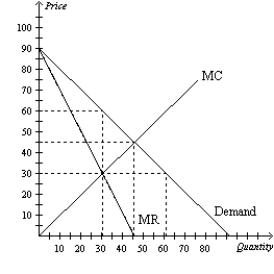 -Refer to Figure 15-15. To maximize total surplus, a benevolent social planner would choose which of the following outcomes?
 (Multiple Choice)
4.8/5 (75)
(75) Figure 15-2 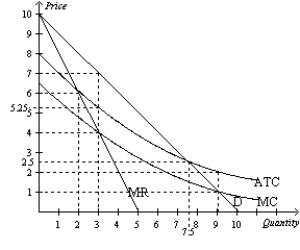 -Refer to Figure 15-2. What type of monopoly is shown in the figure?
 (Short Answer)
4.7/5 (68)
(68) Figure 15-4 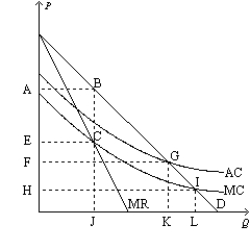 -Refer to Figure 15-4. If a regulator requires this firm to charge a fair return price, which letter represents the amount of output it will produce?
 (Short Answer)
4.8/5 (75)
(75) Table 15-21
Tommy's Tie Company, a monopolist, has the following cost and revenue information. Assume that Tommy's is able to engage in perfect price discrimination. 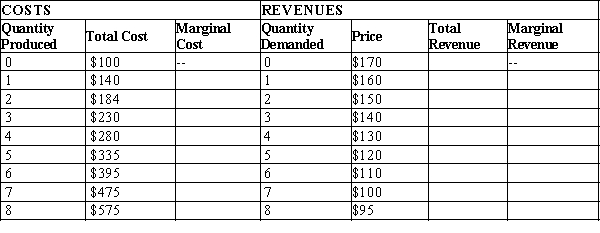 -Refer to Table 15-21. If the monopolist can engage in perfect price discrimination, what is the quantity that maximizes economic profit?
 (Multiple Choice)
5.0/5 (71)
(71) A monopolist faces the following demand curve: 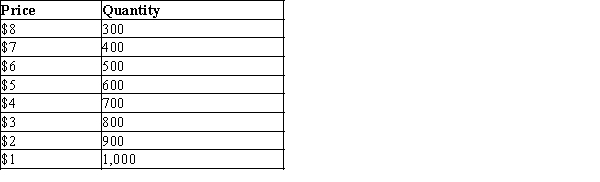 The monopolist has fixed costs of $1,000 and has a constant marginal cost of $2 per unit. If the monopolist were able to perfectly price discriminate, how many units would it sell?
 (Multiple Choice)
4.9/5 (72)
(72) The profit-maximization problem for a monopolist differs from that of a competitive firm in which of the following ways?
(Multiple Choice)
4.8/5 (99)
(99) Bob's Butcher Shop is the only place within 100 miles that sells bison burgers. Assuming that Bob is maximizing his profit, which of the following statements is true?
(Multiple Choice)
4.9/5 (74)
(74) The government may choose to do nothing to reduce monopoly inefficiency because the "fix" may be worse than the problem.
(True/False)
4.9/5 (75)
(75) Explain how a profit-maximizing monopolist chooses its level of output and the price of its goods.
(Essay)
5.0/5 (92)
(92) Because monopoly firms do not have to compete with other firms, the outcome in a market with a monopoly
(Multiple Choice)
4.8/5 (87)
(87) 
Filters
- Essay(0)
- Multiple Choice(0)
- Short Answer(0)
- True False(0)
- Matching(0)