



 Chat with AI
Exam 15: Monopoly

Exam 1: Ten Principles of Economics455 Questions
Exam 2: Thinking Like an Economist645 Questions
Exam 3: Interdependence and the Gains From Trade550 Questions
Exam 4: The Market Forces of Supply and Demand693 Questions
Exam 5: Elasticity and Its Application625 Questions
Exam 6: Supply, Demand, and Government Policies671 Questions
Exam 7: Consumers, Producers, and the Efficiency of Markets547 Questions
Exam 8: Application: The Costs of Taxation507 Questions
Exam 9: Application: International Trade521 Questions
Exam 10: Externalities543 Questions
Exam 11: Public Goods and Common Resources453 Questions
Exam 12: The Design of the Tax System563 Questions
Exam 13: The Costs of Production649 Questions
Exam 14: Firms in Competitive Markets608 Questions
Exam 15: Monopoly662 Questions
Exam 16: Monopolistic Competition649 Questions
Exam 17: Oligopoly522 Questions
Exam 18: The Markets for the Factors of Production592 Questions
Exam 19: Earnings and Discrimination511 Questions
Exam 20: Income Inequality and Poverty478 Questions
Exam 21: The Theory of Consumer Choice568 Questions
Exam 22: Frontiers in Microeconomics461 Questions
Select questions type


Suppose a monopolist chooses the price and production level that maximizes its profit. From that point, to increase society's economic welfare, output would need to be increased as long as
(Multiple Choice)
4.8/5  (87)
(87) Figure 15-1 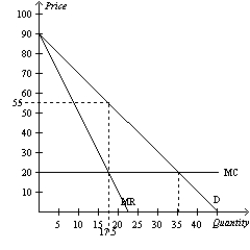 -Refer to Figure 15-1. How much deadweight loss results if this single-price monopolist profit-maximizes?
 (Short Answer)
4.7/5 (79)
(79) One method used to control the ability of firms to capture monopoly profit in the United States is through
(Multiple Choice)
4.9/5 (96)
(96) Figure 15-3 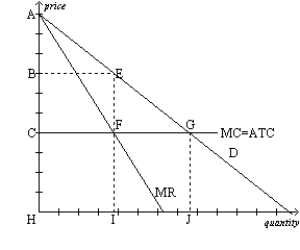 -Refer to Figure 15-3. Use the letters in the figure to identify the profit area if this firm were able to perfectly price discriminate.
 (Short Answer)
4.8/5 (77)
(77) Table 15-4
A monopolist faces the following demand curve: 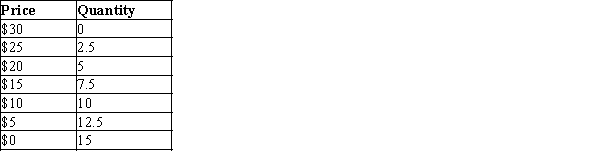 -Refer to Table 15-4. The monopolist will not produce
 (Multiple Choice)
4.7/5 (72)
(72) Table 15-8
The following table provides information on the price, quantity, and average total cost for a monopoly. 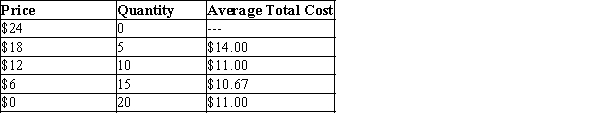 -Refer to Table 15-8. How much extra revenue does the monopolist earn when he lowers the price from $18 to $12?
 (Multiple Choice)
4.7/5 (80)
(80) Which of the following is not an example of a barrier to entry?
(Multiple Choice)
4.8/5 (69)
(69) A firm that is the sole seller of a product without close substitutes is
(Multiple Choice)
4.8/5 (80)
(80) Figure 15-1
-Refer to Figure 15-1. Which is more efficient, single price profit maximization or perfect price discrimination?
-Refer to Figure 15-1. Which is more efficient, single price profit maximization or perfect price discrimination? (Essay)
4.8/5 (73)
(73) Declining average total cost with increased production is one of the defining characteristics of a natural monopoly.
(True/False)
4.8/5 (75)
(75) Figure 15-1
-Refer to Figure 15-1. If the monopolist uses perfect price discrimination, what price will it charge?
-Refer to Figure 15-1. If the monopolist uses perfect price discrimination, what price will it charge? (Essay)
4.8/5 (79)
(79) Allowing an inventor to have the exclusive rights to market her new invention will lead to (i)
A product that is priced higher than it would be without the exclusive rights.
(ii)
Desirable behavior in the sense that inventors are encouraged to invent.
(iii)
Higher profits for the inventor.
(Multiple Choice)
4.8/5 (75)
(75) For a monopoly, the level of output at which marginal revenue equals zero is also the level of output at which
(Multiple Choice)
4.8/5 (79)
(79) Which of the following is an example of a barrier to entry?
(Multiple Choice)
4.7/5 (70)
(70) Scenario 15-8
Mega Media Cable TV is able to purchase an exclusive right to sell a premium sports channel in its market area. Let's assume that Mega Media pays $100,000 a year for the exclusive marketing rights to the sports channel. Since Mega Media has already installed cable to all of the homes in its market area, the marginal cost of delivering the sports channel to subscribers is zero. The manager of Mega Media needs to know what price to charge for the sports channel service to maximize her profit. Before setting price, she hires an economist to estimate demand for the sports channel. The economist discovers that there are two types of subscribers who value premium sporting channels. First are the 3,000 die-hard sports fans who will pay as much as $150 a year for the new channel. Second, the premium sports channel will appeal to 20,000 occasional sports viewers who will pay as much as $25 a year for a subscription to it.
-Refer to Scenario 15-8. If Mega Media Cable TV is able to price discriminate, what would be the maximum amount of profit it could generate?
(Multiple Choice)
4.8/5 (66)
(66) Scenario 15-3
A monopoly firm maximizes its profit by producing Q = 500 units of output. At that level of output, its marginal revenue is $30, its average revenue is $60, and its average total cost is $34.
-Refer to Scenario 15-3. At Q = 500, the firm's profit is
(Multiple Choice)
4.7/5 (76)
(76) A profit-maximizing monopolist will produce the level of output at which
(Multiple Choice)
4.8/5 (82)
(82) 
Filters
- Essay(0)
- Multiple Choice(0)
- Short Answer(0)
- True False(0)
- Matching(0)