



 Chat with AI
Exam 15: Monopoly

Exam 1: Ten Principles of Economics455 Questions
Exam 2: Thinking Like an Economist645 Questions
Exam 3: Interdependence and the Gains From Trade550 Questions
Exam 4: The Market Forces of Supply and Demand693 Questions
Exam 5: Elasticity and Its Application625 Questions
Exam 6: Supply, Demand, and Government Policies671 Questions
Exam 7: Consumers, Producers, and the Efficiency of Markets547 Questions
Exam 8: Application: The Costs of Taxation507 Questions
Exam 9: Application: International Trade521 Questions
Exam 10: Externalities543 Questions
Exam 11: Public Goods and Common Resources453 Questions
Exam 12: The Design of the Tax System563 Questions
Exam 13: The Costs of Production649 Questions
Exam 14: Firms in Competitive Markets608 Questions
Exam 15: Monopoly662 Questions
Exam 16: Monopolistic Competition649 Questions
Exam 17: Oligopoly522 Questions
Exam 18: The Markets for the Factors of Production592 Questions
Exam 19: Earnings and Discrimination511 Questions
Exam 20: Income Inequality and Poverty478 Questions
Exam 21: The Theory of Consumer Choice568 Questions
Exam 22: Frontiers in Microeconomics461 Questions
Select questions type


One characteristic of a monopoly market is that the product is virtually identical to products produced by competing firms.
(True/False)
5.0/5  (89)
(89) Scenario 15-8
Mega Media Cable TV is able to purchase an exclusive right to sell a premium sports channel in its market area. Let's assume that Mega Media pays $100,000 a year for the exclusive marketing rights to the sports channel. Since Mega Media has already installed cable to all of the homes in its market area, the marginal cost of delivering the sports channel to subscribers is zero. The manager of Mega Media needs to know what price to charge for the sports channel service to maximize her profit. Before setting price, she hires an economist to estimate demand for the sports channel. The economist discovers that there are two types of subscribers who value premium sporting channels. First are the 3,000 die-hard sports fans who will pay as much as $150 a year for the new channel. Second, the premium sports channel will appeal to 20,000 occasional sports viewers who will pay as much as $25 a year for a subscription to it.
-Refer to Scenario 15-8. How much profit will Mega Media Cable TV earn if it sets the price at $25?
(Multiple Choice)
4.9/5 (85)
(85) Figure 15-18 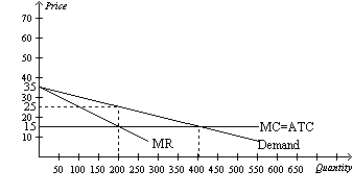 -Refer to Figure 15-18. If the monopoly firm is not allowed to price discriminate, then consumer surplus amounts to
 (Multiple Choice)
4.8/5 (68)
(68) Figure 15-10 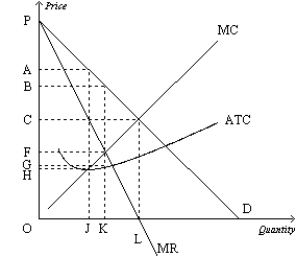 -Refer to Figure 15-10. What area measures the deadweight loss?
 (Multiple Choice)
4.9/5 (93)
(93) Figure 15-3 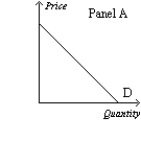
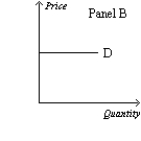
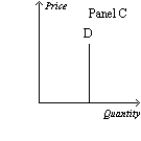
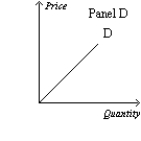 -Refer to Figure 15-3. Which panel could represent the demand curve facing a soybean farmer?
 (Multiple Choice)
4.8/5 (64)
(64) Scenario 15-1
Vincent operates a scenic tour business in Boston. He has one bus which can fit 50 people per tour and each tour lasts 2 hours. His total cost of operating one tour is fixed at $450. Vincent's cost is not reduced if he runs a tour with a partially full bus. While his cost is the same for all tours, Vincent charges each passenger his/her willingness to pay: adults $18 per trip, children $10 per trip, and senior citizens $12 per trip. At those rates, on a typical day Vincent's demand is:  Assume that Vincent's customers are always available for the tour; therefore, he can fill his bus for each tour as long as there is sufficient total demand for the day.
-Refer to Scenario 15-1. One of Vincent's friends tells him he would be more profitable if he charged a single price of $12. Assuming no changes in consumer demand, what would Vincent's profit be if he charged every customer $12?
Assume that Vincent's customers are always available for the tour; therefore, he can fill his bus for each tour as long as there is sufficient total demand for the day.
-Refer to Scenario 15-1. One of Vincent's friends tells him he would be more profitable if he charged a single price of $12. Assuming no changes in consumer demand, what would Vincent's profit be if he charged every customer $12? (Short Answer)
5.0/5 (85)
(85) Figure 15-22
The diagram depicts the market situation for a monopoly pastry shop called Bearclaws. 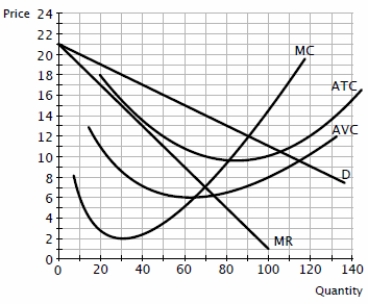 -Refer to Figure 15-22. Based upon the information shown, what are total costs for Bearclaws, given that it maximizes profits?
 (Multiple Choice)
4.9/5 (72)
(72) The process of buying a good in one market at a low price and selling the good in another market for a higher price in order to profit from the price difference is known as
(Multiple Choice)
4.8/5 (89)
(89) Figure 15-4 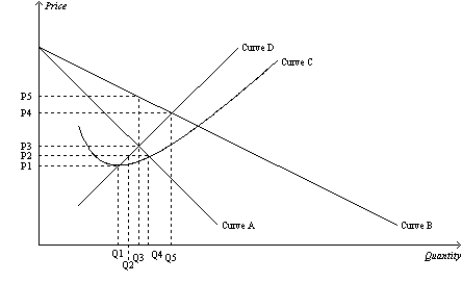 -Refer to Figure 15-4. The demand curve for a monopoly firm is depicted by curve
 (Multiple Choice)
4.8/5 (77)
(77) Figure 15-17 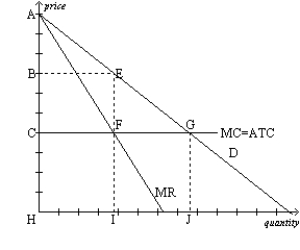 -Refer to Figure 15-17. If this firm were able to perfectly price discriminate, which of the following areas would represent the profit to this perfectly discriminating monopolist?
 (Multiple Choice)
4.9/5 (73)
(73) Economic welfare is generally measured by (i)
Profit.
(ii)
Total surplus.
(iii)
The price consumers pay for the product.
(Multiple Choice)
4.8/5 (78)
(78) A rational pricing strategy for a profit-maximizing monopolist is
(Multiple Choice)
4.9/5 (75)
(75) Figure 15-8 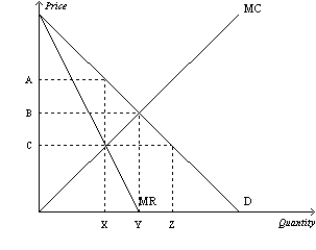 -Refer to Figure 15-8. What is the area of deadweight loss?
 (Multiple Choice)
4.9/5 (86)
(86) The assessment by George Stigler concerning the tradeoffs between "market failure" and "political failure" in the American economy provides support for which of the following solutions to the problems of monopolies?
(Multiple Choice)
4.8/5 (78)
(78) Table 15-1 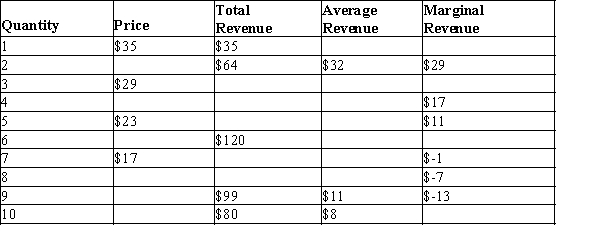 -Refer to Table 15-1. If the monopolist wants to maximize its revenue, how many units of its product should it sell?
 (Multiple Choice)
4.9/5 (67)
(67) Assume that a monopolist decides to maximize revenue rather than profit. How does this operating objective change the size of the deadweight loss? If you are a "benevolent" manager of a monopoly firm and are interested in reducing the deadweight loss of monopoly, should you maximize profits or maximize revenue? Explain your answer.
(Essay)
4.9/5 (74)
(74) Table 15-21
Tommy's Tie Company, a monopolist, has the following cost and revenue information. Assume that Tommy's is able to engage in perfect price discrimination. 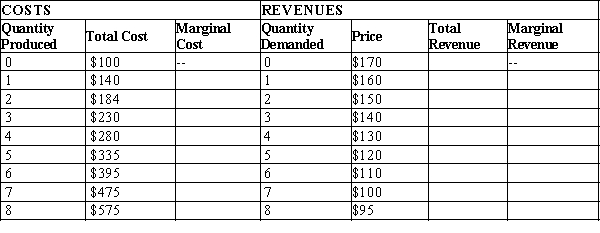 -Refer to Table 15-21. If the monopolist can engage in perfect price discrimination, what is the total revenue when 3 ties are sold?
 (Multiple Choice)
4.8/5 (82)
(82) 
Filters
- Essay(0)
- Multiple Choice(0)
- Short Answer(0)
- True False(0)
- Matching(0)