



 Chat with AI
Exam 15: Monopoly

Exam 1: Ten Principles of Economics455 Questions
Exam 2: Thinking Like an Economist645 Questions
Exam 3: Interdependence and the Gains From Trade550 Questions
Exam 4: The Market Forces of Supply and Demand693 Questions
Exam 5: Elasticity and Its Application625 Questions
Exam 6: Supply, Demand, and Government Policies671 Questions
Exam 7: Consumers, Producers, and the Efficiency of Markets547 Questions
Exam 8: Application: The Costs of Taxation507 Questions
Exam 9: Application: International Trade521 Questions
Exam 10: Externalities543 Questions
Exam 11: Public Goods and Common Resources453 Questions
Exam 12: The Design of the Tax System563 Questions
Exam 13: The Costs of Production649 Questions
Exam 14: Firms in Competitive Markets608 Questions
Exam 15: Monopoly662 Questions
Exam 16: Monopolistic Competition649 Questions
Exam 17: Oligopoly522 Questions
Exam 18: The Markets for the Factors of Production592 Questions
Exam 19: Earnings and Discrimination511 Questions
Exam 20: Income Inequality and Poverty478 Questions
Exam 21: The Theory of Consumer Choice568 Questions
Exam 22: Frontiers in Microeconomics461 Questions
Select questions type


Additional firms often do not try to compete with a natural monopoly because
(Multiple Choice)
4.9/5  (76)
(76) Microsoft's government-granted exclusive right to make and sell the Windows operating system is called a
(Short Answer)
4.9/5 (80)
(80) Figure 15-19 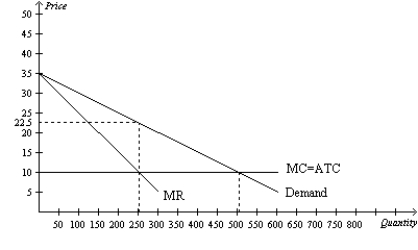 -Refer to Figure 15-19. If there are no fixed costs of production, monopoly profit with perfect price discrimination equals
 (Multiple Choice)
4.9/5 (79)
(79) Table 15-21
Tommy's Tie Company, a monopolist, has the following cost and revenue information. Assume that Tommy's is able to engage in perfect price discrimination. 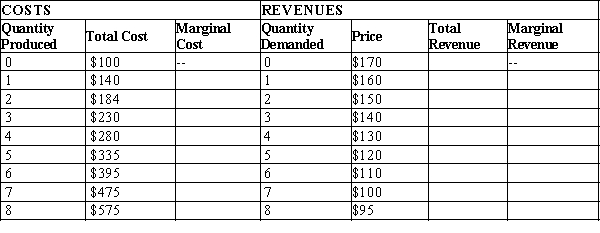 -Refer to Table 15-21. If the monopolist can engage in perfect price discrimination, what is total profit at the profit-maximizing quantity?
 (Multiple Choice)
4.9/5 (71)
(71) Figure 15-3 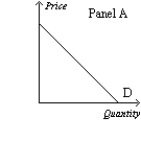
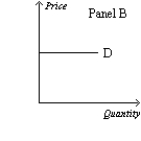
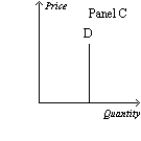
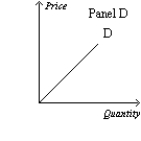 -Refer to Figure 15-3. Which panel could represent the demand curve facing the soybean industry?
 (Multiple Choice)
4.9/5 (85)
(85) Which of the following is not a characteristic of a monopoly?
(Multiple Choice)
4.8/5 (75)
(75) A monopoly creates a deadweight loss to society because it earns both short-run and long-run positive economic profits.
(True/False)
4.9/5 (84)
(84) If government officials break up a natural monopoly into four smaller firms, then
(Multiple Choice)
4.8/5 (70)
(70) Granting a pharmaceutical company a patent for a new medicine will lead to (i)
A product that is priced higher than it would be without the exclusive rights.
(ii)
Incentives for pharmaceutical companies to invest in research and development.
(iii)
Higher quantities of output than without the patent.
(Multiple Choice)
4.9/5 (65)
(65) In order for a firm to maximize profits through price discrimination, the firm must have some market power and be able to prevent arbitrage.
(True/False)
4.9/5 (70)
(70) Figure 15-2 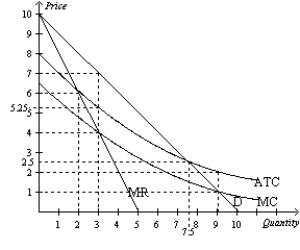 -Refer to Figure 15-2. If a regulator requires the firm to charge an average cost price, what is the amount of profit or loss earned by the firm?
 (Short Answer)
4.7/5 (86)
(86) Figure 15-19
-Refer to Figure 15-19. If the monopoly firm is not allowed to price discriminate, then consumer surplus amounts to
-Refer to Figure 15-19. If the monopoly firm is not allowed to price discriminate, then consumer surplus amounts to (Multiple Choice)
4.8/5 (80)
(80) Price discrimination explains why Ivy League universities often base tuition costs on students'
(Multiple Choice)
4.8/5 (78)
(78) If the ABC company owns the exclusive rights to mine land in Afghanistan for Lapis Lazuli, a rare stone used in jewelry which is found only in Afghanistan, the company benefits from a barrier to entry.
(True/False)
4.8/5 (81)
(81) Monopoly pricing prevents some mutually beneficial trades from taking place. These unrealized, mutually beneficial trades are
(Multiple Choice)
4.8/5 (76)
(76) If the government regulates the price that a natural monopolist can charge to be equal to the firm's average total cost, the firm will
(Multiple Choice)
5.0/5 (75)
(75) A natural monopoly will always operate in the region of the long run average total cost curve where the cost per unit is constant.
(True/False)
4.9/5 (87)
(87) A movie theater can increase its profits through price discrimination by charging a higher price to adults and a lower price to children if
(Multiple Choice)
4.7/5 (79)
(79) 
Filters
- Essay(0)
- Multiple Choice(0)
- Short Answer(0)
- True False(0)
- Matching(0)