



 Chat with AI
Exam 16: Monopolistic Competition

Exam 1: Ten Principles of Economics455 Questions
Exam 2: Thinking Like an Economist645 Questions
Exam 3: Interdependence and the Gains From Trade550 Questions
Exam 4: The Market Forces of Supply and Demand693 Questions
Exam 5: Elasticity and Its Application625 Questions
Exam 6: Supply, Demand, and Government Policies671 Questions
Exam 7: Consumers, Producers, and the Efficiency of Markets547 Questions
Exam 8: Application: The Costs of Taxation507 Questions
Exam 9: Application: International Trade521 Questions
Exam 10: Externalities543 Questions
Exam 11: Public Goods and Common Resources453 Questions
Exam 12: The Design of the Tax System563 Questions
Exam 13: The Costs of Production649 Questions
Exam 14: Firms in Competitive Markets608 Questions
Exam 15: Monopoly662 Questions
Exam 16: Monopolistic Competition649 Questions
Exam 17: Oligopoly522 Questions
Exam 18: The Markets for the Factors of Production592 Questions
Exam 19: Earnings and Discrimination511 Questions
Exam 20: Income Inequality and Poverty478 Questions
Exam 21: The Theory of Consumer Choice568 Questions
Exam 22: Frontiers in Microeconomics461 Questions
Select questions type


Figure 16-10
The figure is drawn for a monopolistically-competitive firm. 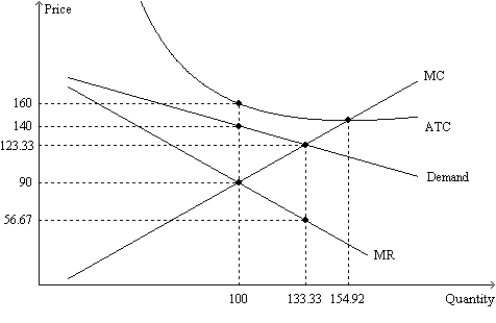 -Refer to Figure 16-10. When the firm is maximizing its profit,
 (Multiple Choice)
5.0/5  (93)
(93) Figure 16-3
This figure depicts a situation in a monopolistically competitive market. 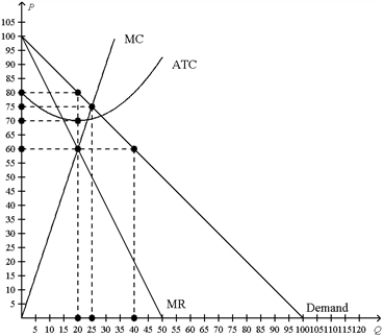 -Refer to Figure 16-3. What price will the monopolistically competitive firm charge in this market?
 (Multiple Choice)
4.8/5 (67)
(67) Figure 16-14 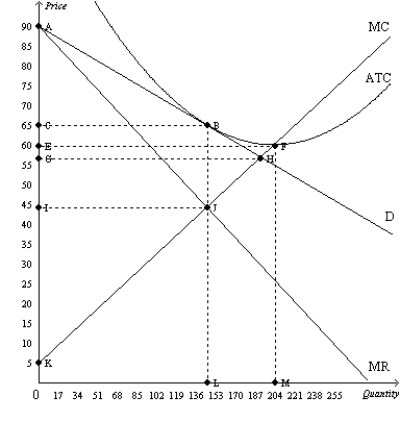 -Refer to Figure 16-14. Use the letters to identify the deadweight loss from this firm producing at its profit-maximizing level of output.
 (Short Answer)
4.9/5 (73)
(73) The product-variety externality arises in monopolistically competitive markets because
(Multiple Choice)
4.8/5 (84)
(84) Figure 16-4 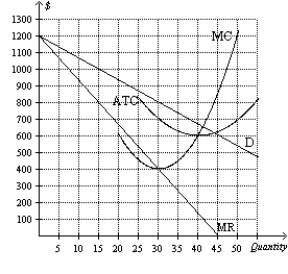 -Refer to Figure 16-4. What price will the monopolistically competitive firm charge in this market?
 (Multiple Choice)
4.8/5 (76)
(76) Why does a typical monopolistically competitive firm face a downward-sloping demand curve?
(Essay)
4.9/5 (72)
(72) Figure 16-13 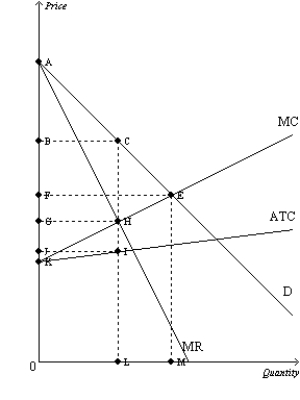 -Refer to Figure 16-13. Which letter represents the profit-maximizing price?
 (Short Answer)
4.8/5 (81)
(81) Table 16-1
The following table shows the percentage of output supplied by the top eight firms in four different industries. 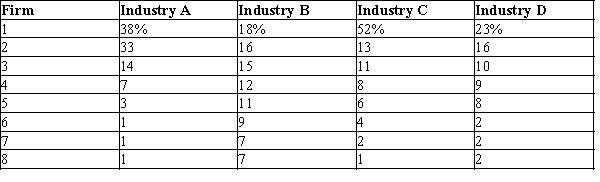 -Refer to Table 16-1. Which industry has the highest concentration ratio?
 (Multiple Choice)
4.8/5 (83)
(83) If regulators required firms in monopolistically competitive markets to set price equal to marginal cost,
(Multiple Choice)
5.0/5 (79)
(79) Figure 16-6 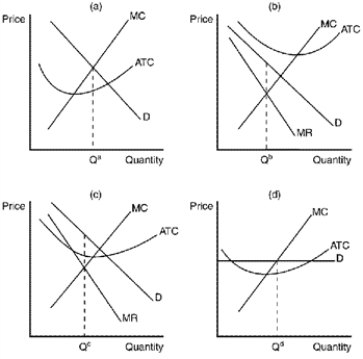 -Refer to Figure 16-6. Which of the graphs depicts a monopolistically competitive firm in long-run equilibrium?
 (Multiple Choice)
4.8/5 (89)
(89) Figure 16-5 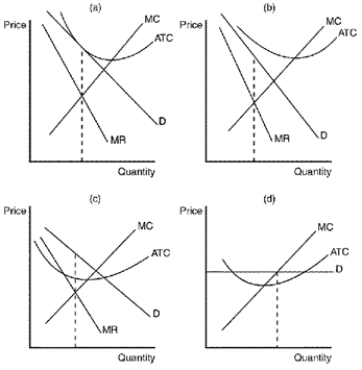 -Refer to Figure 16-5. Which of the graphs depicts a short-run equilibrium that will encourage the exit of some firms from a monopolistically competitive industry?
 (Multiple Choice)
4.8/5 (77)
(77) Figure 16-14 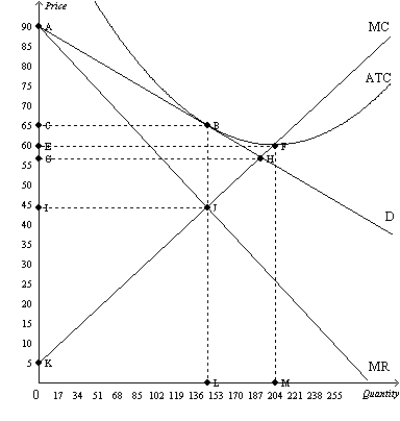 -Refer to Figure 16-14. The deadweight loss from production for this firm is represented by which of the following areas?
 (Multiple Choice)
4.8/5 (80)
(80) Professional organizations (for example, the American Medical Association and the American Bar Association) have been active advocates for regulation to restrict the right of professionals to advertise. Describe what economic incentives might exist for existing professionals to restrict advertising.
(Essay)
4.7/5 (69)
(69) A monopolistically competitive firm has the following cost structure:  The firm faces the following demand curve:
 If the government forces this firm to produce at its efficient scale, it will
The firm faces the following demand curve: If the government forces this firm to produce at its efficient scale, it will (Multiple Choice)
4.8/5 (93)
(93) Assume a monopolistically competitive firm encounters a decrease in average variable cost at all output levels.We would expect:
(Multiple Choice)
4.8/5 (69)
(69) Figure 16-14
-Refer to Figure 16-14. The deadweight loss from production for this firm is represented by which of the following areas?
-Refer to Figure 16-14. The deadweight loss from production for this firm is represented by which of the following areas? (Multiple Choice)
4.9/5 (86)
(86) Which of the following is a characteristic of monopolistic competition?
(Multiple Choice)
4.8/5 (81)
(81) As firms exit a monopolistically competitive market, profits of remaining firms
(Multiple Choice)
4.9/5 (80)
(80) 
Filters
- Essay(0)
- Multiple Choice(0)
- Short Answer(0)
- True False(0)
- Matching(0)