



 Chat with AI
Exam 16: Monopolistic Competition

Exam 1: Ten Principles of Economics455 Questions
Exam 2: Thinking Like an Economist645 Questions
Exam 3: Interdependence and the Gains From Trade550 Questions
Exam 4: The Market Forces of Supply and Demand693 Questions
Exam 5: Elasticity and Its Application625 Questions
Exam 6: Supply, Demand, and Government Policies671 Questions
Exam 7: Consumers, Producers, and the Efficiency of Markets547 Questions
Exam 8: Application: The Costs of Taxation507 Questions
Exam 9: Application: International Trade521 Questions
Exam 10: Externalities543 Questions
Exam 11: Public Goods and Common Resources453 Questions
Exam 12: The Design of the Tax System563 Questions
Exam 13: The Costs of Production649 Questions
Exam 14: Firms in Competitive Markets608 Questions
Exam 15: Monopoly662 Questions
Exam 16: Monopolistic Competition649 Questions
Exam 17: Oligopoly522 Questions
Exam 18: The Markets for the Factors of Production592 Questions
Exam 19: Earnings and Discrimination511 Questions
Exam 20: Income Inequality and Poverty478 Questions
Exam 21: The Theory of Consumer Choice568 Questions
Exam 22: Frontiers in Microeconomics461 Questions
Select questions type


Table 16-2
The following table shows the total output produced by the top six firms as well as the total industry output for each industry. 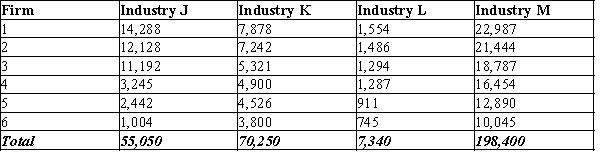 -Refer to Table 16-2. What is the concentration ratio for Industry J?
 (Multiple Choice)
4.9/5  (69)
(69) The breakfast cereal industry, with its concentration ratio of 80%, would best be described as a(n)
(Multiple Choice)
4.8/5 (91)
(91) Table 16-1
The following table shows the percentage of output supplied by the top eight firms in four different industries. 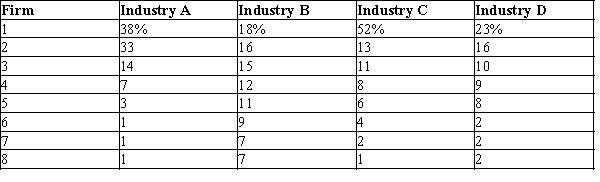 -Refer to Table 16-1. What is the concentration ratio in Industry D?
 (Multiple Choice)
4.8/5 (81)
(81) Scenario 16-3
Peter operates an ice cream shop in the center of Fairfield. He sells several unusual flavors of organic, homemade ice cream so he has a monopoly over his own ice cream, though he competes with many other firms selling ice cream in Fairfield for the same customers. Peter's demand and cost values for sales per day are given in the table below. (Everyone who purchases Peter's ice cream buys a double scoop cone because it's so delicious.) 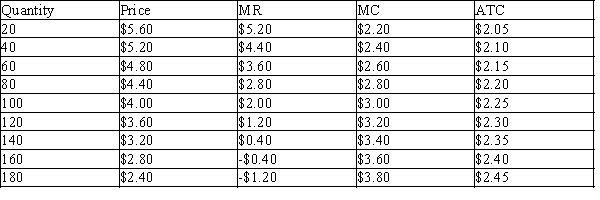 -Refer to Scenario 16-3. How many double scoop ice cream cones should Peter sell per day to maximize his profit?
 (Multiple Choice)
4.8/5 (84)
(84) If advertising decreases the elasticity of demand for specific brand names of hard liquor, we would expect firms to be able to charge a larger markup over marginal cost.
(True/False)
4.8/5 (78)
(78) Monopolistic competition differs from perfect competition because in monopolistically competitive markets
(Multiple Choice)
4.8/5 (73)
(73) Figure 16-12 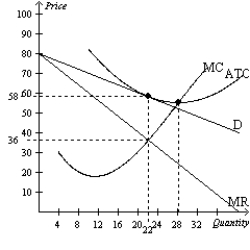 -Refer to Figure 16-12. If this firm profit-maximizes, what price will it charge?
 (Short Answer)
4.8/5 (85)
(85) Table 16-7
A monopolistically competitive firm faces the following demand schedule for its product. In addition, the firm has total fixed costs equal to 20.  -Refer to Table 16-7. If this firm has a constant marginal cost of $7, what is the profit-maximizing level of output?
 (Short Answer)
4.8/5 (69)
(69) Considering perfect competition, monopolistic competition, and monopoly, which of the market structures can have positive profits in the short run?
(Essay)
4.7/5 (82)
(82) The market structure in which each firm has a monopoly over the product it makes, but many other firms make similar products that compete for the same customers is called
(Short Answer)
4.9/5 (81)
(81) In monopolistically competitive markets, positive economic profits
(Multiple Choice)
4.8/5 (97)
(97) In which of the following market structures can a firm earn an economic profit in the short run?
(Multiple Choice)
4.9/5 (62)
(62) Figure 16-13 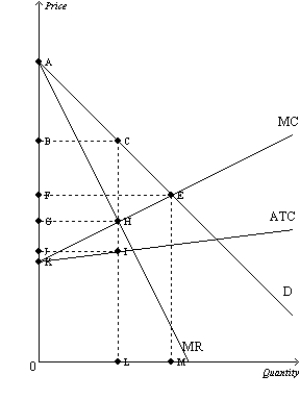 -Refer to Figure 16-13. Which letter represents the profit-maximizing quantity?
 (Short Answer)
4.9/5 (83)
(83) Which of the following statements regarding monopolistic competition is not correct?
(Multiple Choice)
4.8/5 (77)
(77) Figure 16-6 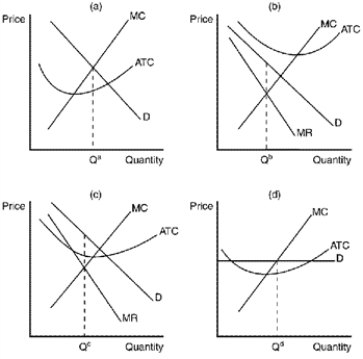 -Refer to Figure 16-6. Which of the graphs shown would be consistent with a firm in a monopolistically competitive market that is doing its best but still losing money?
 (Multiple Choice)
4.8/5 (81)
(81) Both monopolistic competition and oligopoly are market structures
(Multiple Choice)
5.0/5 (76)
(76) Which of the following markets is not likely characterized by a monopolistically competitive market?
(Multiple Choice)
4.8/5 (73)
(73) A firm has the following cost structure:  If this firm is in a typical monopolistically competitive market, in the long run it will likely produce
 (Multiple Choice)
4.9/5 (91)
(91) Scenario 16-5
McDonald's restaurants has recently announced intentions to open a new restaurant in Smalltown, Indiana. Assume that the fast-food restaurant market in Smalltown is characterized by monopolistic competition.
-Refer to Scenario 16-5. As a result of the new McDonald's, existing fast food restaurants in Smalltown are likely to
(Multiple Choice)
4.8/5 (73)
(73) 
Filters
- Essay(0)
- Multiple Choice(0)
- Short Answer(0)
- True False(0)
- Matching(0)